Thank you for visiting SNEWPapers!
Sign up free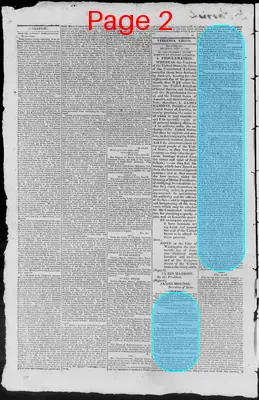
Virginia Argus
Richmond, Virginia
What is this article about?
On May 11, 1812, John Bellingham assassinated British Chancellor of the Exchequer Mr. Percival in the House of Commons lobby. A coroner's jury returned a verdict of wilful murder. Bellingham claimed grievances against the government. Public mobs showed support for the assassin, indicating widespread discontent. The event is seen as potentially disruptive to British policy toward America.
Clipping
OCR Quality
Full Text
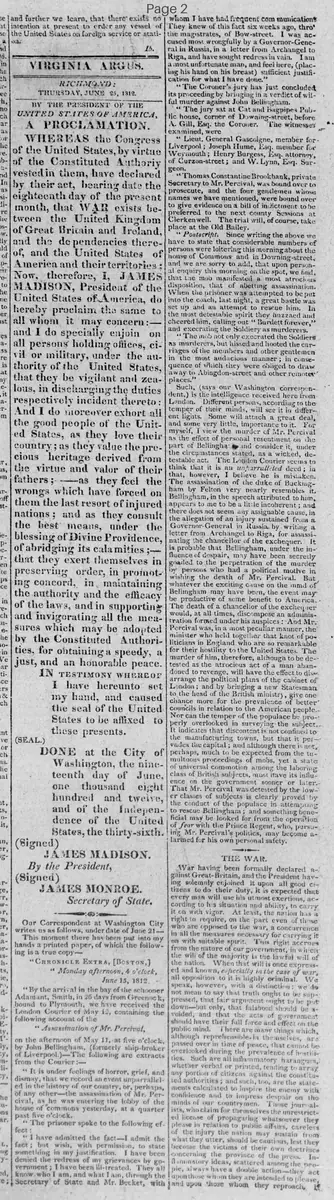
This moment there has been put into my hands a printed paper, of which the following is a true Copy~
"Chronicle Extra, [Boston,]
Monday afternoon, 4 o'clock, June 15, 1812.
By the arrival in the bay of the schooner Adamant, Smith, in 26 days from Greenock, bound to Plymouth, we have received the London Courier of May 2, containing the following account of the
Assassination of Mr. Percival, on the afternoon of May 11, at five o'clock, by John Bellingham, (formerly ship-broker of Liverpool.)—The following are extracts from the Courier:-
It is under feelings of horror, grief, and dismay, that we record an event unparalleled in the history of our country, or, perhaps, of any other—the assassination of Mr. Percival, as he was entering the lobby of the house of commons yesterday, at a quarter past five o'clock.
The prisoner spoke to the following effect :
I have admitted the fact—I admit the fact; but wish, with permission, to state something in my justification. I have been denied the redress of my grievances by government; I have been ill-treated. They all know who I am, and what I am, through the Secretary of State and Mr. Becket, with whom I have had frequent communications They knew of this fact six weeks ago, thro' the magistrates, of Bow-street. I was accused most wrongfully by a Governor-General in Russia, in a letter from Archangel to Riga, and have sought redress in vain. I am a most unfortunate man, and feel here, (placing his hand on his breast) sufficient justification for what I have done."
The Coroner's jury has just concluded its proceeding by bringing in a verdict of wilful murder against John Bellingham.
The jury sat at Cat and Bagpipes Public house, corner of Downing-street, before A. Gill, Esq. the Coroner. The witnesses examined, were
Lieut. General Gascoigne, member for Liverpool; Joseph Hume, Esq. member for Weymouth; Henry Burgess, Esq. attorney, of Curzon-street; and W. Lynn, Esq. Surgeon.
Thomas Constantine Brookbank, private Secretary to Mr. Percival, was bound over to prosecute, and the four gentlemen whose names we have mentioned, were bound over to give evidence on a bill of indictment to be preferred to the next county Sessions at Clerkenwell. The trial will, of course, take place at the Old Bailey.
Postscript. Since writing the above we have to state that considerable numbers of persons were loitering this morning about the house of Commons and in Downing-street, and we are sorry to add, that upon personal enquiry this morning on the spot, we find, that the mob manifested a most atrocious disposition, that of abetting assassination. When the prisoner was attempted to be put into the coach, last night, a great bustle was set up and an attempt to rescue him. In the most detestable spirit they huzzaed and cheered him, calling out "Burdett forever," and execrating the Soldiery as murderers.
The mob not only execrated the Soldiers as murderers, but hissed and hooted the carriages of the members and other gentlemen in the most audacious manner; in consequence of which they were obliged to draw away to Abingdon-street and other remoter places."
Such, (says our Washington correspondent,) is the intelligence received here from London. Different persons, according to the temper of their minds, will see it in different lights. Some will attach a great deal, and some very little, importance to it. For myself, I view the murder of Mr. Percival as the effect of personal resentment on the part of Bellingham and consider it, under the circumstances stated, as a wicked, detestable act. The London Courier seems to think that it is an unparalleled deed; in that, however, I believe he is mistaken. The assassination of the duke of Buckingham by Felton very nearly resembles it. Bellingham, in the speech attributed to him, appears to me to be a little incoherent; and there does not seem any assignable cause, in the allegation of an injury sustained from a Governor-General in Russia by writing a letter from Archangel to Riga, for assassinating the chancellor of the exchequer. It is probable that Bellingham, under the influence of despair, may have been secretly goaded to the perpetration of the murder by persons who had a political motive in wishing the death of Mr. Percival. But whatever the exciting cause on the mind of Bellingham may have been, the event may be productive of some benefit to America. The death of a chancellor of the exchequer would, at all times, discompose an administration formed under his auspices : And Mr. Percival was, in a most peculiar manner, the minister who held together that knot of politicians in England who are so remarkable for their hostility to the United States. The murder of him, therefore, although to be detested as the atrocious act of a man abandoned to revenge, will have the effect to disarrange the political plans of the cabinet of London; and by bringing a new Statesman to the head of the British ministry, give one chance more for the prevalence of better councils in relation to the American people.— Nor can the temper of the populace be properly overlooked in surveying the subject. It indicates that discontent is not confined to the manufacturing towns, but that it pervades the capital; and although there is not, perhaps, much to be expected from the tumultuous proceedings of mobs, yet a state of universal commotion among the laboring class of British subjects, must have its influence on the government sooner or later. That Mr. Percival was detested by the lower classes of subjects is clearly proved by the conduct of the populace in attempting to rescue Bellingham; and something beneficial may be looked for from the operation of fear with the Prince Regent, who, pursuing Mr. Percival's politics, may become alarmed for his own personal safety.
What sub-type of article is it?
What keywords are associated?
What entities or persons were involved?
Where did it happen?
Foreign News Details
Primary Location
London
Event Date
May 11, 1812
Key Persons
Outcome
mr. percival assassinated; coroner's jury verdict of wilful murder against john bellingham; bellingham bound for trial at old bailey; mob attempted to rescue bellingham and showed support for him while execrating soldiers and members of parliament.
Event Details
John Bellingham assassinated Mr. Percival as he entered the lobby of the House of Commons at a quarter past five o'clock on May 11, 1812. Bellingham admitted the act but justified it by claiming denied redress for grievances involving the government, Secretary of State, Mr. Becket, and a wrongful accusation by a Governor-General in Russia via a letter from Archangel to Riga. The coroner's jury at the Cat and Bagpipes Public house, corner of Downing-street, before A. Gill, Esq., examined witnesses including Lieut. General Gascoigne, Joseph Hume, Henry Burgess, and W. Lynn, and returned a verdict of wilful murder. Thomas Constantine Brookbank was bound to prosecute, and witnesses to give evidence at the next county sessions at Clerkenwell, with trial at the Old Bailey. Mobs loitered around the House of Commons and Downing-street, abetted the assassination, attempted to rescue Bellingham, cheered him with cries of 'Burdett forever,' and execrated soldiers as murderers while hissing carriages of members.