Thank you for visiting SNEWPapers!
Sign up free
The Midland Journal
Rising Sun, Cecil County, Maryland
What is this article about?
The Silver Canning Co. in Colora, Md., held its annual grower meeting and banquet on Feb. 19, 1943, at West Nottingham Academy, attended by 95 from nearby counties. Speakers discussed 1942's record 61,000-case corn pack (35% for armed forces), 1943 goals of 70,000 cases (42% for government), increased acreage, 3-ton corn clubs with prizes in war bonds, production tips, and cooperation for the war effort.
Clipping
OCR Quality
Full Text
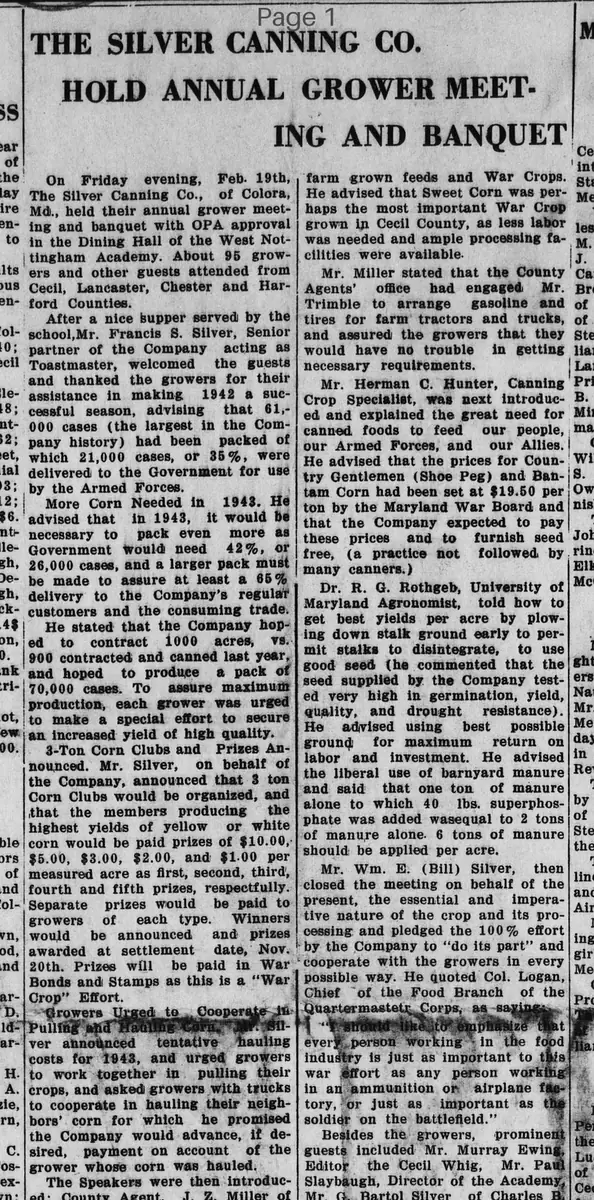
HOLD ANNUAL GROWER MEET
On Friday evening, Feb. 19th, The Silver Canning Co., of Colora, Md., held their annual grower meeting and banquet with OPA approval in the Dining Hall of the West Nottingham Academy. About 95 growers and other guests attended from Cecil, Lancaster, Chester and Harford Counties.
After a nice supper served by the school, Mr. Francis S. Silver, Senior partner of the Company acting as Toastmaster, welcomed the guests and thanked the growers for their assistance in making 1942 a successful season, advising that 61,000 cases (the largest in the Company history) had been packed of which 21,000 cases, or 35%, were delivered to the Government for use by the Armed Forces.
More Corn Needed in 1943. He advised that in 1943, it would be necessary to pack even more as Government would need 42%, or 26,000 cases, and a larger pack must be made to assure at least a 65% delivery to the Company's regular customers and the consuming trade.
He stated that the Company hoped to contract 1000 acres, vs. 900 contracted and canned last year and hoped to produce a pack of 70,000 cases. To assure maximum production, each grower was urged to make a special effort to secure an increased yield of high quality.
3-Ton Corn Clubs and Prizes Announced. Mr. Silver, on behalf of the Company, announced that 3 ton Corn Clubs would be organized and that the members producing the highest yields of yellow or white corn would be paid prizes of $10.00, $5.00, $3.00, $2.00, and $1.00 per measured acre as first, second, third, fourth and fifth prizes, respectively.
Separate prizes would be paid to growers of each type. Winners would be announced and prizes awarded at settlement date, Nov. 20th. Prizes will be paid in War Bonds and Stamps as this is a "War Crop" Effort.
County Agent, J. Z. Miller of Elkton, told those present that they should produce all the food they could in the form of milk, meat, farm grown feeds and War Crops.
He advised that Sweet Corn was perhaps the most important War Crop grown in Cecil County, as less labor was needed and ample processing facilities were available.
Mr. Miller stated that the County Agents' office had engaged Mr. Trimble to arrange gasoline and tires for farm tractors and trucks, and assured the growers that they would have no trouble in getting necessary requirements.
Mr. Herman C. Hunter, Canning Crop Specialist, was next introduced and explained the great need for canned foods to feed our people, our Armed Forces, and our Allies.
He advised that the prices for Country Gentlemen (Shoe Peg) and Bantam Corn had been set at $19.50 per ton by the Maryland War Board and that the Company expected to pay these prices and to furnish seed free, (a practice not followed by many canners.)
Dr. R. G. Rothgeb, University of Maryland Agronomist, told how to get best yields per acre by plowing down stalk ground early to permit stalks to disintegrate, to use good seed (he commented that the seed supplied by the Company tested very high in germination, yield, quality, and drought resistance).
He advised using best possible ground for maximum return on labor and investment. He advised the liberal use of barnyard manure and said that one ton of manure alone to which 40 lbs. superphosphate was added was equal to 2 tons of manure alone. 6 tons of manure should be applied per acre.
Growers Urged to Cooperate in Pulling and Hauling corn. Mr. Wm. E. (Bill) Silver then closed the meeting on behalf of the present, the essential and imperative nature of the crop and its processing and pledged the 100% effort by the Company to "do its part" and cooperate with the growers in every possible way. He quoted Col. Logan, Chief of the Food Branch of the Quartermaster Corps, as saying "I should like to emphasize that every person working in the food industry is just as important to this war effort as any person working in an ammunition or airplane factory, or just as important as the soldier on the battlefield."
Mr. Silver announced tentative hauling costs for 1943 and urged growers to work together in pulling their crops, and asked growers with trucks to cooperate in hauling their neighbors' corn for which he promised the Company would advance, if desired, payment on account of the grower whose corn was hauled.
Besides the growers, prominent guests included Mr. Murray Ewing, Editor the Cecil Whig; Mr. Paul Slaybaugh, Director of the Academy; Mr. G. Bartol Silver of Charles B. Silver & Son of Havre de Grace, and Messrs. Walter, Robert and George Cameron of Rising Sun.
The Speakers were then introduced.
What sub-type of article is it?
What themes does it cover?
What keywords are associated?
What entities or persons were involved?
Where did it happen?
Story Details
Key Persons
Location
West Nottingham Academy, Colora, Md.
Event Date
1943 02 19
Story Details
The Silver Canning Co. hosted its annual grower meeting, reviewing 1942's record corn pack for the war effort and outlining 1943 plans for increased production, acreage, and quality. Speakers emphasized cooperation, provided agricultural advice, announced prizes for high yields in war bonds, and highlighted the importance of canned foods to the war.