Thank you for visiting SNEWPapers!
Sign up free
Story
December 9, 1897
Connecticut Western News
North Canaan, Salisbury, Canaan, Litchfield County, Connecticut
What is this article about?
Rev. Dr. Talmage's 1897 sermon in Washington urges applying worldly practicality to religion, critiquing church design and spiritual inertia, with anecdotes promoting bold faith and immediate salvation through Christ.
Clipping
OCR Quality
95%
Excellent
Full Text
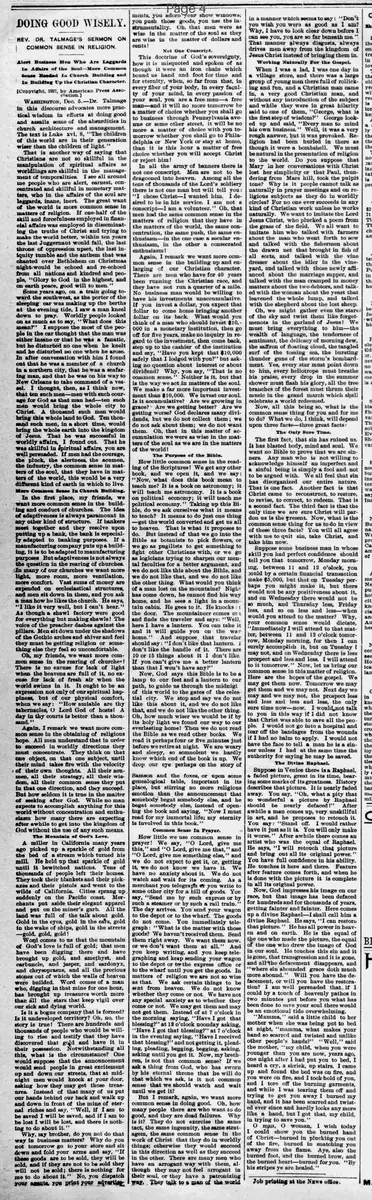
DOING GOOD WISELY.
REV. DR. TALMAGE'S SERMON ON
COMMON SENSE IN RELIGION.
Alert Business Men Who Are Laggards
In Affairs of the Soul—More Common
Sense Needed In Church Building and
In Building Up the Christian Character.
[Copyright, 1897, by American Press Association.]
WASHINGTON, Dec. 5.—Dr. Talmage
in this discourse advocates more prac-
tical wisdom in efforts at doing good
and assails some of the absurdities in
church architecture and management.
The text is Luke xvi, 8, "The children
of this world are in their generation
wiser than the children of light."
That is another way of saying that
Christians are not so skillful in the
manipulation of spiritual affairs as
worldlings are skillful in the manage-
ment of temporalities. I see all around
me people who are alert, earnest, con-
centrated and skillful in monetary mat-
ters, who in the affairs of the soul are
laggards, inane, inert. The great want
of the world is more common sense in
matters of religion. If one-half of the
skill and forcefulness employed in finan-
cial affairs was employed in disseminat-
ing the truths of Christ and trying to
make the world better, within ten years
the last Juggernaut would fall, the last
throne of oppression upset, the last in-
iquity tumble and the anthem that was
chanted over Bethlehem on Christmas
night would be echoed and re-echoed
from all nations and kindred and peo-
ple, "Glory to God in the highest, and
on earth peace, good will to men."
Some years ago, on a train going to-
ward the southwest, as the porter of the
sleeping car was making up the berths
the evening tide, I saw a man kneel
down to pray. Worldly people looked
on as much as to say,"What does this
mean?" I suppose the most of the peo-
ple in the car thought that the man was
either insane or that he was a fanatic,
but he disturbed no one when he knelt
and he disturbed no one when he arose.
In after conversation with him I found
out that he was a member of a church
in a northern city. that he was a seafar-
ing man, and that he was on his way to
New Orleans to take command of a ves-
sel. I thought, then, as I think now,
had ten such men-men with such cour-
age for God as that man had-ten such
men would bring the whole city to
Christ. A thousand such men would
bring this whole land to God. Ten thon-
sand such men, in a short time, would
bring the whole earth into the kingdom
of Jesus. That he was successful in
worldly affairs, I found out. That he
was skillful in spiritual affairs, you are
well persuaded. If men had the courage,
the pluck. the alertness, the acumen,
the industry, the common sense in mat-
ters of the soul. that they have in mat-
ters of the world, this would be a very
different kind of earth in which to live.
More Common Sense In Church Building.
In the first place, my friends, we
want more common sense in the build-
ing and conduct of churches. The idea
of adaptiveness is always paramount in
any other kind of structure. If bankers
meet together and they resolve upon
putting up a bank, the bank is especial-
ly adapted to banking purposes. If a
manufacturing company puts up a build-
ing, it is to be adapted to manufacturing
purposes. But adaptiveness is not always
the question in the rearing of churches.
In many of our churches we want more
light, more room, more ventilation,
more comfort. Vast sums of money are
expended on ecclesiastical structures,
and men sit down in them. and you ask
man how he likes the church. He says,
"I like it very well, but I can't hear."
As though a shawl factory were good
for everything but making shawls! The
voice of the preacher dashes against the
pillars. Men sit down under the shadows
of the Gothic arches and shiver and feel
they must be getting religion or some-
thing else they feel so uncomfortable.
Oh, my friends, we want more com-
mon sense in the rearing of churches
There is no excuse for lack of light
when the heavens are full of it, no ex-
cuse for lack of fresh air when the
world swims in it. It ought to be an
expression not only of our spiritual hap-
piness, but of our physical comfort.
when we say: "How amiable are thy
tabernacles, O Lord God of hosts! A
day in thy courts is better than a thou-
sand."
Again, I remark we want more com-
mon sense in the obtaining of religious
hope. All men understand that in order
to succeed in worldly directions they
must concentrate. They think on that
one object, on that one subject, until
their mind takes fire with the velocity
of their own thoughts. All their acumen, all their strategy, all their wis-
dom. all their common sense they put
in that one direction, and they succeed.
But how seldom it is true in the matter
of seeking after God. While no man
expects to accomplish anything for this
world without concentration and enthu-
siasm how many there are expecting
after awhile to get into the kingdom of
God without the use of any such means.
The Mountain of God's Love.
A miller in California many years
ago picked up a sparkle of gold from
the bed of a stream which turned his
mill. He held up that sparkle of gold
until it bewitched nations. Tens of
thousands of people left their homes.
They took their blankets and their pick-
axes and their pistols and went to the
wilds of California. Cities sprang up
suddenly on the Pacific coast. Mer-
chants put aside their elegant apparel
and put on the miner's garb. All the
land was full of the talk about gold.
Gold in the eyes, gold in the ears, gold
in the wake of ships, gold in the streets
—gold. gold, gold!
Word comes to us that the mountain
of God's love is full of gold; that men
have been digging there and have
brought up gold, and amethyst, and
carbuncle, and jasper, and sardonyx,
and chrysoprasus, and all the precious
stones out of which the walls of heaven
were builded. Word comes of a man
who, digging in that mine for one hour,
has brought up treasures worth more
than all the stars that keep vigil over
our sick and dying world.
Is it a bogus company that is formed?
Is it undeveloped territory? Oh, no, the
story is true! There are hundreds and
thousands of people who would be will-
ing to rise and testify that they have
discovered that gold and have it in
their possession. Notwithstanding all
this, what is the circumstance? One
would suppose that the announcement
would send people in great excitement
up and down our streets, that at mid-
night men would knock at your door,
asking how they may get those treas-
ures. Instead of that many of us put
our hands behind our back and walk up
and down in front of the mine of eter-
pai riches and say, "Well, if I am to
be saved I will be saved, and if I am to
be lost I will be lost, and there is noth-
ing to do about it."
Why, my brother, do you not do that
way in business matters? Why do you
not tomorrow go to your store and sit
dewn and fold your arms and say, 'If
these goods are to be sold, they will be
sold, and if they are not to be sold they
will not be sold; there is nothing for
me to do about it." No, you dispatch
your agents, you print your advertise-
ments. you adorn your show windows
you push those goods, you use the in-
strumentality. Oh, that men were as
wise in the matter of the soul as they
are wise in the matter of dollars and
cents!
Not One Conscript.
This doctrine of God's sovereignty,
how it is misquoted and spoken of as
though it were an iron chain which
bound us hand and foot for time and
for eternity, when, so far from that, in
every fiber of your body, in every facul-
ty of your mind, in every passion of
your soul, you are a free man—a free
man—and it will no more tomorrow be
a matter of choice whether you shall go
to business through Pennsylvania ave-
nue or some other street, it will be no
more a matter of choice with you to-
morrow whether you shall go to Phila-
delphia or New York or stay at home,
than it is this hour a matter of free
choice whether you will accept Christ
or reject him!
In all the army of banners there is
not one conscript. Men are not to be
dragooned into heaven. Among all the
tens of thousands of the Lord's soldiery
there is not one man but will tell you
"I chose Christ—I wanted him. I de-
sired to be in his service. I am not a
conscript I am a volunteer." Oh, that
men had the same common sense in the
matters of religion that they have in
the matters of the world. the same con-
centration. the same push, the same en-
thusaism—in the one case a secular en-
thusaism, in the other a consecrated
enthusiasm!
Again, I remark we want more com-
mon sense in the building up and en-
larging of our Christian character.
There are men who have for 40 years
been running the Christian race, and
they have not run a quarter of a mile.
No business man would be willing to
have his investments unaccumulative.
If you invest a dollar, you expect that
dollar to come home bringing another
dollar on its back. What would you
think of a man who should invest $10,
000 in a monetary institution, then go
off for five years, make no inquiry in re-
gard to the investment, then come back,
step up to the cashier of the institution
and say. "Have you kept that 10,000
safely that I lodged with you?" but ask-
ing no question about interest or about
dividend? Why, you say, "That is no
common sense." Neither is it, but that
is the way we act in matters of the soul
We make a far more important invest-
ment than $10,000. We invest our soul.
Is it accumulative? Are we growing in
grace? Are we getting better? Are we
getting worse? God declares many divi-
dends, but we do not collect them; we
do not ask about them: we do not want
them. Oh. that in this matter of ac-
cumulation we were as wise in the mat-
ters of the soul as we are in the matters
of the world!
The Purpose of the Bible.
How little common sense in the read-
ing of the Scriptures! We get any other
book, and we open it, and we say:
"Now, what does this book mean to
teach me? It is a book on astronomy: it
will teach me astronomy. It is a book
on political economy; it wil teach me
political economy." Taking up this Bi-
ble, do we ask ourselves what it means
to teach? It means to do just one thing
—get the world converted and get us all
to heaven. That is what it proposes to
do. But instead of that we go into the
Bible as botanists to pick flowers, or
we go as pugilists to get something to
fight other Christians with, or we go
as logicians trying to sharpen our men-
tal faculties for a better argument, and
we do not like this about the Bible, and
we do not like that. and we do not like
the other thing. What would you think
of a man lost on the mountains? Night
has come down, he cannot find his way
home, and he sees a light in a moun-
tain cabin. He goes to it. He knocks at
the door. The mountaineer comes out
and finds the traveler and says: "Well,
here I have a lantern. You can take it
and it will guide you on the way
home." And suppose that traveler
should say:"I don't like that lantern.
I don't like the handle of it. There are
10 or 15 things about it I don't like
If you can't give me a better lantern
than that I won't have any?"
Now. God says this Bible is to be a
lamp to our feet and a lantern to our
path, to guide us through the midnight
of this world to the gates of the celes-
tial city. We stop and say we do not
like this about it, and we do not like
that, and we do not like the other thing.
Oh, how much wiser we would be if by
its holy light we found our way to our
everlasting home! Then we do not read
the Bible as we read other books. We
read it perhaps four or five minutes just
before we retire at night. We are weary
and sleepy, so somnolent we hardly
know which end of the book is up. We
drop our eye perhaps on the story of
Samson and the foxes, or upon some
genealogical table, important in its
place, but stirring no more religious
emotion than the announcement that
somebody begat somebody else. and he
begat somebody else, instead of open-
ing the book and saying, "Now I must
read for my immortal life; my eternity
is involved in this book."
Common Sense In Prayer.
How little we use common sense in
prayer! We say, "O Lord, give me
this,"and "O Lord, give me that."and
"O Lord, give me something else,"and
we do not expect to get it, or, getting
it, we do not know we have it. We
have no anxiety about it. We do not
watch and wait for its coming. As a
merchant you telegraph or you write to
some other city for a bill of goods. You
say, 'Send me by such express or by
such a steamer or by such a rail train."
The day arrives. You send your wagon
to the depot or to the wharf. The goods
do not come. You immediately tele-
graph: "What is the matter with those
goods? We haven't received them. Send
them right away. We want them now.
or we don't want them at all." And
you keep writing, and you keep tele-
graphing and keep sending your wagon
to the depot or to the express office or
to the wharf until you get the goods. In
matters of religion we are not so wise
as that. We ask certain things to be
sent from heaven. We do not know
whether they come or not. We have not
any special anxiety as to whether they
come or not. We may get them and may
not get them. Instead of at 7 o'clock in
the morning saying, "Have I got that
blessing?"at 12 o'clock noonday asking,
"Have I got that blessing?"at 7 o'clock
in the evening saying, "Have I received
that blessing?" and not getting it, plead-
ing, pleading, begging, begging, asking,
asking until you get it. Now, my breth-
ren, is not that common sense? If we
ask a thing from God, who has sworn
by his eternal throne that he will do
that which we ask, is it not common
sense that we should watch and wait
until we get it?
But I remark, again, we want more
common sense in doing good. Oh, how
many people there are who want to do
good, and they are dead failures. Why
is it? They do not exercise the same
tact, the same ingenuity, the same strat-
agem, the same common sense in the
work of Christ that they do in worldly
things; otherwise they would succeed
in this direction as well as they succeed
in the other. There are many men who
have an arrogant way with them, al-
though they may not feel arrogant in
their soul, or they have a patronizing
way. They talk to a man of the world
in a manner which seems to say: "Don't
you wish you were as good as I am?
Why. I have to look clear down before I
can see you, you are so far beneath me."
That manner always disgusts, always
drives men away from the kingdom of
Jesus Christ instead of bringing them in.
Working Naturally For the Gospel,
When I was a lad, I was one day in
a village store, and there was a large
group of young men there full of rollick-
ing and fun. and a Christian man came
in. a very good Christian man. and
without any introduction of the subject
and while they were in great hilarity
said to one of them. "George. what is
the first step of wisdom?" George look-
ed up and said, "Every man to mind
his own business." Well, it was a very
rough answer, but it was provoked. Re-
ligion had been hurled in there as
though it were a bombshell. We must
be natural in the presentation of religion
to the world. Do you suppose that
Martha, in her conversations with Christ
lost her simplicity or that Paul, thun-
dering from Mars hill, took the pulpit
tone? Why is it people cannot talk as
naturally in prayer meetings and on re-
ligious subjects as they do in worldly
circles? For no one ever succeeds in any
kind of Christian work unless he works
naturally. We want to imitate the Lord
Jesus Christ. who plucked a poem from
the grass of the field. We all want to
imitate him who talked with farmers
about the man who went forth to sow
and talked with the fishermen about
the drawn net that brought in fish of
all sorts, and talked with the vine
dresser about the idler in the vine-
yard, and talked with those newly aff-
anced about the marriage supper, and
talked with the man cramped in money
matters about the two debtors, and talk-
ed with the woman about the yeast that
leavened the whole lump. and talked
with the shepherd about the lost sheep.
Oh. we might gather even the stars
of the sky and twist them like forget-
menots in the garland of Jesus! We
must bring everything to him—the
wealth of language, the tenderness of
sentiment, the delicacy of morning dew,
the saffron of floating cloud, the tangled
surf of the tossing sea, the bursting
thunder guns of the storm's bombard-
ment. Yes, every star must point down
to him. every heliotrope must breathe
his praise. every drop in the summer
shower must flash his glory, all the tree
branches of the forest must thrum their
music in the grand march which shall
celebrate a world redeemed.
Now. all this being so. what is the
common sense thing for you and for me
to do? What we do, I think, will depend
upon three facts—three great facts:
The Only Sure Time.
The first fact, that sin has ruined us.
It has blasted body, mind and soul. We
want no Bible to prove that we are sin-
ners. Any man who is not willing to
acknowledge himself an imperfect and
a sinful being is simply a fool and not
to be argued with. We all feel that sin
has disorganized our entire nature.
That is one fact. Another fact is that
Christ came to reconstruct, to restore,
to revise. to correct. to redeem. That is
a second fact. The third fact is that the
only time we are sure Christ will par-
don us is the present. Now, what is the
common sense thing for us to do in view
of these three facts? You will all agree
with me to quit sin. take Christ. and
take him now.
Suppose some business man in whose
skill you had perfect confidence should
tell you that tomorrow, Monday morn-
ing, between 11 and 12 o'clock, you
should by a certain financial transaction
make $5,000, but that on Tuesday per-
haps you might make it, but there
would not be any positiveness about it,
and on Wednesday there would not be
so much, and Thursday less, Friday
less, and so on less and less—when
would you attend to the matter? Why,
your common sense would dictate,
"Immediately I will attend to that mat-
ter, between 11 and 12 o'clock tomor-
row, Monday morning, for then I can
surely accomplish it, but on Tuesday I
may not, and on Wednesday there is less
prospect and less and less. I will attend
to it tomorrow." Now, let us bring our
common sense in this matter of religion.
Here are the hopes of the gospel. We
may get them now. Tomorrow we may
get them and we may not. Next day we
may and we may not, the prospect less
and less and less and less, the only
sure time now—now. I would not talk
to you in this way if I did not know
that Christ was able to save all the peo-
ple. I would not go into a hospital and
tear off the bandages from the wounds
if I had no balm to apply. I would not
have the face to tell a man he is a sin-
ner unless I had at the same time the
authority for saying he may be saved.
The Divine Raphael.
Suppose in Venice there is a Raphael.
a faded picture, great in its time, bear-
ing some marks of its greatness. History
describes that picture. It is nearly faded
away. You say, "Oh, what a pity that
so wonderful a picture by Raphael
should be nearly defaced!" After
awhile a man comes up, very unskillful
in art, and he proposes to retouch it.
You say: "Stand off. I would rather
have it just as it is. You will only make
it worse."After awhile there comes an
artist who was the equal of Raphael.
He says, "I will retouch that picture
and bring out all its original power."
You have full confidence in his ability.
He touches it here and there. Feature
after feature comes forth, and when he
is done with the picture it is complete
in all its original power.
Now, God impresses his image on our
race, but that image has been defaced
for hundreds and for thousands of years,
getting fainter and fainter. Here comes
up a divine Raphael—I shall call him a
divine Raphael. He says, "I can restore
that picture."He has all power in heav-
en and on earth. He is the equal of
the one who made the picture, the equal
of the one who drew the image of God
in our soul. He touches this sin and it
is gone, that transgression and it is gone,
and all the defacement disappears, and
"where sin abounded grace doth much
more abound." Will you have the de-
facment, or will you have the restora-
tion? I am well persuaded that if I
could by a touch of heavenly pathos in
two minutes put before you what has
been done to save your soul there would
be an emotional tide overwhelming.
"Mamma," said a little child to her
mother when she was being put to bed
at night, "mamma, what makes your
hand so scarred and twisted and unlike
other people's hands?" "Well," said
the mother, "my child, when you were
younger than you are now, years ago,
one night after I had put you to bed, I
heard a cry, a shriek, up stairs. I came
up and found the bed was on fire, and
you were on fire, and I took hold of you,
and I tore off the burning garments,
and while I was tearing them off and
trying to get you away I burned my
hand, and it has been scarred and twist-
ed ever since and hardly looks any more
like a hand, but I got that, my child,
in trying to save you."
O man, O woman, I wish today
I could show you the burned hand
of Christ—burned in plucking you out
of the fire, burned in snatching you
away from the flame. Aye, also the
burned foot, and the burned brow, and
the burned heart—burned for you. "By
his stripes ye are healed."
Job printing at the News office.
REV. DR. TALMAGE'S SERMON ON
COMMON SENSE IN RELIGION.
Alert Business Men Who Are Laggards
In Affairs of the Soul—More Common
Sense Needed In Church Building and
In Building Up the Christian Character.
[Copyright, 1897, by American Press Association.]
WASHINGTON, Dec. 5.—Dr. Talmage
in this discourse advocates more prac-
tical wisdom in efforts at doing good
and assails some of the absurdities in
church architecture and management.
The text is Luke xvi, 8, "The children
of this world are in their generation
wiser than the children of light."
That is another way of saying that
Christians are not so skillful in the
manipulation of spiritual affairs as
worldlings are skillful in the manage-
ment of temporalities. I see all around
me people who are alert, earnest, con-
centrated and skillful in monetary mat-
ters, who in the affairs of the soul are
laggards, inane, inert. The great want
of the world is more common sense in
matters of religion. If one-half of the
skill and forcefulness employed in finan-
cial affairs was employed in disseminat-
ing the truths of Christ and trying to
make the world better, within ten years
the last Juggernaut would fall, the last
throne of oppression upset, the last in-
iquity tumble and the anthem that was
chanted over Bethlehem on Christmas
night would be echoed and re-echoed
from all nations and kindred and peo-
ple, "Glory to God in the highest, and
on earth peace, good will to men."
Some years ago, on a train going to-
ward the southwest, as the porter of the
sleeping car was making up the berths
the evening tide, I saw a man kneel
down to pray. Worldly people looked
on as much as to say,"What does this
mean?" I suppose the most of the peo-
ple in the car thought that the man was
either insane or that he was a fanatic,
but he disturbed no one when he knelt
and he disturbed no one when he arose.
In after conversation with him I found
out that he was a member of a church
in a northern city. that he was a seafar-
ing man, and that he was on his way to
New Orleans to take command of a ves-
sel. I thought, then, as I think now,
had ten such men-men with such cour-
age for God as that man had-ten such
men would bring the whole city to
Christ. A thousand such men would
bring this whole land to God. Ten thon-
sand such men, in a short time, would
bring the whole earth into the kingdom
of Jesus. That he was successful in
worldly affairs, I found out. That he
was skillful in spiritual affairs, you are
well persuaded. If men had the courage,
the pluck. the alertness, the acumen,
the industry, the common sense in mat-
ters of the soul. that they have in mat-
ters of the world, this would be a very
different kind of earth in which to live.
More Common Sense In Church Building.
In the first place, my friends, we
want more common sense in the build-
ing and conduct of churches. The idea
of adaptiveness is always paramount in
any other kind of structure. If bankers
meet together and they resolve upon
putting up a bank, the bank is especial-
ly adapted to banking purposes. If a
manufacturing company puts up a build-
ing, it is to be adapted to manufacturing
purposes. But adaptiveness is not always
the question in the rearing of churches.
In many of our churches we want more
light, more room, more ventilation,
more comfort. Vast sums of money are
expended on ecclesiastical structures,
and men sit down in them. and you ask
man how he likes the church. He says,
"I like it very well, but I can't hear."
As though a shawl factory were good
for everything but making shawls! The
voice of the preacher dashes against the
pillars. Men sit down under the shadows
of the Gothic arches and shiver and feel
they must be getting religion or some-
thing else they feel so uncomfortable.
Oh, my friends, we want more com-
mon sense in the rearing of churches
There is no excuse for lack of light
when the heavens are full of it, no ex-
cuse for lack of fresh air when the
world swims in it. It ought to be an
expression not only of our spiritual hap-
piness, but of our physical comfort.
when we say: "How amiable are thy
tabernacles, O Lord God of hosts! A
day in thy courts is better than a thou-
sand."
Again, I remark we want more com-
mon sense in the obtaining of religious
hope. All men understand that in order
to succeed in worldly directions they
must concentrate. They think on that
one object, on that one subject, until
their mind takes fire with the velocity
of their own thoughts. All their acumen, all their strategy, all their wis-
dom. all their common sense they put
in that one direction, and they succeed.
But how seldom it is true in the matter
of seeking after God. While no man
expects to accomplish anything for this
world without concentration and enthu-
siasm how many there are expecting
after awhile to get into the kingdom of
God without the use of any such means.
The Mountain of God's Love.
A miller in California many years
ago picked up a sparkle of gold from
the bed of a stream which turned his
mill. He held up that sparkle of gold
until it bewitched nations. Tens of
thousands of people left their homes.
They took their blankets and their pick-
axes and their pistols and went to the
wilds of California. Cities sprang up
suddenly on the Pacific coast. Mer-
chants put aside their elegant apparel
and put on the miner's garb. All the
land was full of the talk about gold.
Gold in the eyes, gold in the ears, gold
in the wake of ships, gold in the streets
—gold. gold, gold!
Word comes to us that the mountain
of God's love is full of gold; that men
have been digging there and have
brought up gold, and amethyst, and
carbuncle, and jasper, and sardonyx,
and chrysoprasus, and all the precious
stones out of which the walls of heaven
were builded. Word comes of a man
who, digging in that mine for one hour,
has brought up treasures worth more
than all the stars that keep vigil over
our sick and dying world.
Is it a bogus company that is formed?
Is it undeveloped territory? Oh, no, the
story is true! There are hundreds and
thousands of people who would be will-
ing to rise and testify that they have
discovered that gold and have it in
their possession. Notwithstanding all
this, what is the circumstance? One
would suppose that the announcement
would send people in great excitement
up and down our streets, that at mid-
night men would knock at your door,
asking how they may get those treas-
ures. Instead of that many of us put
our hands behind our back and walk up
and down in front of the mine of eter-
pai riches and say, "Well, if I am to
be saved I will be saved, and if I am to
be lost I will be lost, and there is noth-
ing to do about it."
Why, my brother, do you not do that
way in business matters? Why do you
not tomorrow go to your store and sit
dewn and fold your arms and say, 'If
these goods are to be sold, they will be
sold, and if they are not to be sold they
will not be sold; there is nothing for
me to do about it." No, you dispatch
your agents, you print your advertise-
ments. you adorn your show windows
you push those goods, you use the in-
strumentality. Oh, that men were as
wise in the matter of the soul as they
are wise in the matter of dollars and
cents!
Not One Conscript.
This doctrine of God's sovereignty,
how it is misquoted and spoken of as
though it were an iron chain which
bound us hand and foot for time and
for eternity, when, so far from that, in
every fiber of your body, in every facul-
ty of your mind, in every passion of
your soul, you are a free man—a free
man—and it will no more tomorrow be
a matter of choice whether you shall go
to business through Pennsylvania ave-
nue or some other street, it will be no
more a matter of choice with you to-
morrow whether you shall go to Phila-
delphia or New York or stay at home,
than it is this hour a matter of free
choice whether you will accept Christ
or reject him!
In all the army of banners there is
not one conscript. Men are not to be
dragooned into heaven. Among all the
tens of thousands of the Lord's soldiery
there is not one man but will tell you
"I chose Christ—I wanted him. I de-
sired to be in his service. I am not a
conscript I am a volunteer." Oh, that
men had the same common sense in the
matters of religion that they have in
the matters of the world. the same con-
centration. the same push, the same en-
thusaism—in the one case a secular en-
thusaism, in the other a consecrated
enthusiasm!
Again, I remark we want more com-
mon sense in the building up and en-
larging of our Christian character.
There are men who have for 40 years
been running the Christian race, and
they have not run a quarter of a mile.
No business man would be willing to
have his investments unaccumulative.
If you invest a dollar, you expect that
dollar to come home bringing another
dollar on its back. What would you
think of a man who should invest $10,
000 in a monetary institution, then go
off for five years, make no inquiry in re-
gard to the investment, then come back,
step up to the cashier of the institution
and say. "Have you kept that 10,000
safely that I lodged with you?" but ask-
ing no question about interest or about
dividend? Why, you say, "That is no
common sense." Neither is it, but that
is the way we act in matters of the soul
We make a far more important invest-
ment than $10,000. We invest our soul.
Is it accumulative? Are we growing in
grace? Are we getting better? Are we
getting worse? God declares many divi-
dends, but we do not collect them; we
do not ask about them: we do not want
them. Oh. that in this matter of ac-
cumulation we were as wise in the mat-
ters of the soul as we are in the matters
of the world!
The Purpose of the Bible.
How little common sense in the read-
ing of the Scriptures! We get any other
book, and we open it, and we say:
"Now, what does this book mean to
teach me? It is a book on astronomy: it
will teach me astronomy. It is a book
on political economy; it wil teach me
political economy." Taking up this Bi-
ble, do we ask ourselves what it means
to teach? It means to do just one thing
—get the world converted and get us all
to heaven. That is what it proposes to
do. But instead of that we go into the
Bible as botanists to pick flowers, or
we go as pugilists to get something to
fight other Christians with, or we go
as logicians trying to sharpen our men-
tal faculties for a better argument, and
we do not like this about the Bible, and
we do not like that. and we do not like
the other thing. What would you think
of a man lost on the mountains? Night
has come down, he cannot find his way
home, and he sees a light in a moun-
tain cabin. He goes to it. He knocks at
the door. The mountaineer comes out
and finds the traveler and says: "Well,
here I have a lantern. You can take it
and it will guide you on the way
home." And suppose that traveler
should say:"I don't like that lantern.
I don't like the handle of it. There are
10 or 15 things about it I don't like
If you can't give me a better lantern
than that I won't have any?"
Now. God says this Bible is to be a
lamp to our feet and a lantern to our
path, to guide us through the midnight
of this world to the gates of the celes-
tial city. We stop and say we do not
like this about it, and we do not like
that, and we do not like the other thing.
Oh, how much wiser we would be if by
its holy light we found our way to our
everlasting home! Then we do not read
the Bible as we read other books. We
read it perhaps four or five minutes just
before we retire at night. We are weary
and sleepy, so somnolent we hardly
know which end of the book is up. We
drop our eye perhaps on the story of
Samson and the foxes, or upon some
genealogical table, important in its
place, but stirring no more religious
emotion than the announcement that
somebody begat somebody else. and he
begat somebody else, instead of open-
ing the book and saying, "Now I must
read for my immortal life; my eternity
is involved in this book."
Common Sense In Prayer.
How little we use common sense in
prayer! We say, "O Lord, give me
this,"and "O Lord, give me that."and
"O Lord, give me something else,"and
we do not expect to get it, or, getting
it, we do not know we have it. We
have no anxiety about it. We do not
watch and wait for its coming. As a
merchant you telegraph or you write to
some other city for a bill of goods. You
say, 'Send me by such express or by
such a steamer or by such a rail train."
The day arrives. You send your wagon
to the depot or to the wharf. The goods
do not come. You immediately tele-
graph: "What is the matter with those
goods? We haven't received them. Send
them right away. We want them now.
or we don't want them at all." And
you keep writing, and you keep tele-
graphing and keep sending your wagon
to the depot or to the express office or
to the wharf until you get the goods. In
matters of religion we are not so wise
as that. We ask certain things to be
sent from heaven. We do not know
whether they come or not. We have not
any special anxiety as to whether they
come or not. We may get them and may
not get them. Instead of at 7 o'clock in
the morning saying, "Have I got that
blessing?"at 12 o'clock noonday asking,
"Have I got that blessing?"at 7 o'clock
in the evening saying, "Have I received
that blessing?" and not getting it, plead-
ing, pleading, begging, begging, asking,
asking until you get it. Now, my breth-
ren, is not that common sense? If we
ask a thing from God, who has sworn
by his eternal throne that he will do
that which we ask, is it not common
sense that we should watch and wait
until we get it?
But I remark, again, we want more
common sense in doing good. Oh, how
many people there are who want to do
good, and they are dead failures. Why
is it? They do not exercise the same
tact, the same ingenuity, the same strat-
agem, the same common sense in the
work of Christ that they do in worldly
things; otherwise they would succeed
in this direction as well as they succeed
in the other. There are many men who
have an arrogant way with them, al-
though they may not feel arrogant in
their soul, or they have a patronizing
way. They talk to a man of the world
in a manner which seems to say: "Don't
you wish you were as good as I am?
Why. I have to look clear down before I
can see you, you are so far beneath me."
That manner always disgusts, always
drives men away from the kingdom of
Jesus Christ instead of bringing them in.
Working Naturally For the Gospel,
When I was a lad, I was one day in
a village store, and there was a large
group of young men there full of rollick-
ing and fun. and a Christian man came
in. a very good Christian man. and
without any introduction of the subject
and while they were in great hilarity
said to one of them. "George. what is
the first step of wisdom?" George look-
ed up and said, "Every man to mind
his own business." Well, it was a very
rough answer, but it was provoked. Re-
ligion had been hurled in there as
though it were a bombshell. We must
be natural in the presentation of religion
to the world. Do you suppose that
Martha, in her conversations with Christ
lost her simplicity or that Paul, thun-
dering from Mars hill, took the pulpit
tone? Why is it people cannot talk as
naturally in prayer meetings and on re-
ligious subjects as they do in worldly
circles? For no one ever succeeds in any
kind of Christian work unless he works
naturally. We want to imitate the Lord
Jesus Christ. who plucked a poem from
the grass of the field. We all want to
imitate him who talked with farmers
about the man who went forth to sow
and talked with the fishermen about
the drawn net that brought in fish of
all sorts, and talked with the vine
dresser about the idler in the vine-
yard, and talked with those newly aff-
anced about the marriage supper, and
talked with the man cramped in money
matters about the two debtors, and talk-
ed with the woman about the yeast that
leavened the whole lump. and talked
with the shepherd about the lost sheep.
Oh. we might gather even the stars
of the sky and twist them like forget-
menots in the garland of Jesus! We
must bring everything to him—the
wealth of language, the tenderness of
sentiment, the delicacy of morning dew,
the saffron of floating cloud, the tangled
surf of the tossing sea, the bursting
thunder guns of the storm's bombard-
ment. Yes, every star must point down
to him. every heliotrope must breathe
his praise. every drop in the summer
shower must flash his glory, all the tree
branches of the forest must thrum their
music in the grand march which shall
celebrate a world redeemed.
Now. all this being so. what is the
common sense thing for you and for me
to do? What we do, I think, will depend
upon three facts—three great facts:
The Only Sure Time.
The first fact, that sin has ruined us.
It has blasted body, mind and soul. We
want no Bible to prove that we are sin-
ners. Any man who is not willing to
acknowledge himself an imperfect and
a sinful being is simply a fool and not
to be argued with. We all feel that sin
has disorganized our entire nature.
That is one fact. Another fact is that
Christ came to reconstruct, to restore,
to revise. to correct. to redeem. That is
a second fact. The third fact is that the
only time we are sure Christ will par-
don us is the present. Now, what is the
common sense thing for us to do in view
of these three facts? You will all agree
with me to quit sin. take Christ. and
take him now.
Suppose some business man in whose
skill you had perfect confidence should
tell you that tomorrow, Monday morn-
ing, between 11 and 12 o'clock, you
should by a certain financial transaction
make $5,000, but that on Tuesday per-
haps you might make it, but there
would not be any positiveness about it,
and on Wednesday there would not be
so much, and Thursday less, Friday
less, and so on less and less—when
would you attend to the matter? Why,
your common sense would dictate,
"Immediately I will attend to that mat-
ter, between 11 and 12 o'clock tomor-
row, Monday morning, for then I can
surely accomplish it, but on Tuesday I
may not, and on Wednesday there is less
prospect and less and less. I will attend
to it tomorrow." Now, let us bring our
common sense in this matter of religion.
Here are the hopes of the gospel. We
may get them now. Tomorrow we may
get them and we may not. Next day we
may and we may not, the prospect less
and less and less and less, the only
sure time now—now. I would not talk
to you in this way if I did not know
that Christ was able to save all the peo-
ple. I would not go into a hospital and
tear off the bandages from the wounds
if I had no balm to apply. I would not
have the face to tell a man he is a sin-
ner unless I had at the same time the
authority for saying he may be saved.
The Divine Raphael.
Suppose in Venice there is a Raphael.
a faded picture, great in its time, bear-
ing some marks of its greatness. History
describes that picture. It is nearly faded
away. You say, "Oh, what a pity that
so wonderful a picture by Raphael
should be nearly defaced!" After
awhile a man comes up, very unskillful
in art, and he proposes to retouch it.
You say: "Stand off. I would rather
have it just as it is. You will only make
it worse."After awhile there comes an
artist who was the equal of Raphael.
He says, "I will retouch that picture
and bring out all its original power."
You have full confidence in his ability.
He touches it here and there. Feature
after feature comes forth, and when he
is done with the picture it is complete
in all its original power.
Now, God impresses his image on our
race, but that image has been defaced
for hundreds and for thousands of years,
getting fainter and fainter. Here comes
up a divine Raphael—I shall call him a
divine Raphael. He says, "I can restore
that picture."He has all power in heav-
en and on earth. He is the equal of
the one who made the picture, the equal
of the one who drew the image of God
in our soul. He touches this sin and it
is gone, that transgression and it is gone,
and all the defacement disappears, and
"where sin abounded grace doth much
more abound." Will you have the de-
facment, or will you have the restora-
tion? I am well persuaded that if I
could by a touch of heavenly pathos in
two minutes put before you what has
been done to save your soul there would
be an emotional tide overwhelming.
"Mamma," said a little child to her
mother when she was being put to bed
at night, "mamma, what makes your
hand so scarred and twisted and unlike
other people's hands?" "Well," said
the mother, "my child, when you were
younger than you are now, years ago,
one night after I had put you to bed, I
heard a cry, a shriek, up stairs. I came
up and found the bed was on fire, and
you were on fire, and I took hold of you,
and I tore off the burning garments,
and while I was tearing them off and
trying to get you away I burned my
hand, and it has been scarred and twist-
ed ever since and hardly looks any more
like a hand, but I got that, my child,
in trying to save you."
O man, O woman, I wish today
I could show you the burned hand
of Christ—burned in plucking you out
of the fire, burned in snatching you
away from the flame. Aye, also the
burned foot, and the burned brow, and
the burned heart—burned for you. "By
his stripes ye are healed."
Job printing at the News office.
What sub-type of article is it?
Biography
What themes does it cover?
Moral Virtue
Providence Divine
Triumph
What keywords are associated?
Common Sense Religion
Church Building
Christian Character
Spiritual Wisdom
Salvation Urgency
What entities or persons were involved?
Rev. Dr. Talmage
Where did it happen?
Washington
Story Details
Key Persons
Rev. Dr. Talmage
Location
Washington
Event Date
Dec. 5, 1897
Story Details
Rev. Dr. Talmage delivers a sermon advocating common sense in religion, criticizing lack of practicality in spiritual affairs compared to worldly matters, using anecdotes like a praying seafarer and California gold rush to illustrate concentration needed for salvation, and urging immediate acceptance of Christ.