Thank you for visiting SNEWPapers!
Sign up free
Jenks's Portland Gazette
Portland, Cumberland County, Maine
What is this article about?
Letters detail the unjust dismissal of Captain John Michael from the U.S. Army in 1802 due to political partisanship, despite assurances from officials like George Logan, Robert Smith, and Henry Dearborn that he would be retained after 10 years of service. His brother William protests the broken promises and impact on Michael's family at Niagara.
Clipping
OCR Quality
Full Text
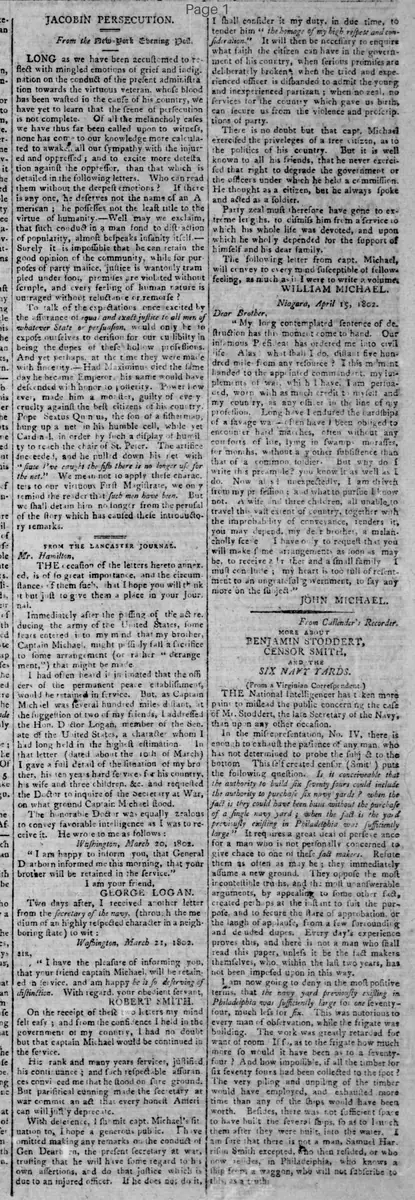
From the New-York Evening Post.
LONG as we have been accustomed to reflect with mingled emotions of grief and indignation on the conduct of the present administration towards the virtuous veteran, whose blood has been wasted in the cause of his country, we have yet to learn that the scene of persecution is not complete. Of all the melancholy cases we have thus far been called upon to witness, none has come to our knowledge more calculated to awaken all our sympathy with the injured and oppressed: and to excite more detestation against the oppressor, than that which is detailed in the following letters. Who can read them without the deepest emotions? If there is any one, he deserves not the name of an American; he possesses not the least title to the virtue of humanity.—Well may we exclaim, that such conduct in a man fond of distinction of popularity, almost bespeaks insanity itself.—
Surely it is impossible that he can retain the good opinion of the community, while for purposes of party malice, justice is wantonly trampled under foot, promises are violated without scruple, and every feeling of human nature is outraged without reluctance or remorse?
To talk of the expectations once excited by the assurance of equal and exact justice to all men of whatever State or persuasion, would only be to expose ourselves to derision for our past credulity. And yet perhaps, at the time they were made with sincerity.—Had Maximinus died the same day he became Emperor, his name would have descended with honor to posterity. Power however, made him a monster, guilty of every cruelty against the best citizens of his country.
Pope Sextus Quintus, the son of a fisherman hung up a net in his humble cell, while yet Cardinal, in order by such a display of humility to reach the chair of St. Peter. The artifice succeeded, and he pulled down his net with "since I've caught the fish there is no longer use for the net." We mean not to apply these characters to our virtuous First Magistrate, we only remind the reader that such men have been. But we shall detain him no longer from the perusal of the story which has caused these introductory remarks.
FROM THE LANCASTER JOURNAL.
Mr. Hamilton,
THE occasion of the letters hereto annexed, is of so great importance, and the circumstances of them such, that I hope you will think it but just to give them a place in your Journal.
I immediately after the passing of the act reducing the army of the United States, some fears entered into my mind that my brother, Captain Michael, might possibly fall a sacrifice to some arrangement or rather "derangement,"
that might be made I had often heard it insinuated that the officers of the permanent peace establishment, would be retained in service. But, as Captain Michael was several hundred miles distant, at the suggestion of two of my friends, I addressed the Hon. Doctor Logan, member of the Senate of the United States, a character whom I had long held in the highest estimation. In that letter (dated about the 10th of March) I gave a full detail of the situation of my brother, his ten years hard service for his country, his wife and three children, &c. and requested the Doctor to inquire of the secretary at War, on what ground Captain Michael stood.
The honorable Doctor was equally zealous to convey favorable intelligence as I was to receive it. He wrote to me as follows:
Washington, March 20, 1802.
"I am happy to inform you, that General Dearborn informed me this morning, that your brother will be retained in the service."
I am your friend,
GEORGE LOGAN.
Two days after, I received another letter from the secretary of the navy, (through the medium of an highly respected character in a neighboring state) to wit:
Washington, March 21, 1802.
SIR,
"I have the pleasure of informing you, that your friend captain Michael, will be retained in service, and am happy he is so deserving of distinction. With regard, your obedient servant,
ROBERT SMITH."
On the receipt of these two letters my mind felt easy; and from the confidence I held in the government of my country, I had no doubt but that captain Michael would be continued in the service.
His rank and many years services, justified his continuance and such respectable assurances convinced me that he stood on sure ground.
But political cunning made the secretary at war commit an act that every honest American will justly deprecate.
With deference, I submit capt. Michael's situation to, I hope a generous public. I have omitted making any remarks on the conduct of Gen. Dearborn, the present secretary at war, trusting that he will have some regard to his own assertions, and do that justice which is due to an injured officer. If he does not do it, I shall consider it my duty, in due time, to tender him "the homage of my high respect and consideration." It will then be necessary to enquire what faith the citizen can have in the government of his country, when serious promises are deliberately broken; when the tried and experienced officer is disbanded to admit the young and inexperienced partizan; when no zeal, no services for the country which gave us birth, can secure us from the violence and proscriptions of party.
There is no doubt but that capt. Michael exercised the privileges of a free citizen, as to the politics of his country. But it is well known to all his friends, that he never exercised that right to degrade the government or the officers under which he held a commission. He thought as a citizen, but he always spoke and acted as a soldier.
Party zeal must therefore have gone to extreme lengths, to dismiss him from a service to which his whole life was devoted, and upon which he wholly depended for the support of himself and his dear family.
The following letter from capt. Michael, will convey to every mind susceptible of feeling, as much as if I were to write a volume
WILLIAM MICHAEL.
Niagara, April 15, 1802.
Dear Brother,
"My long contemplated sentence of destruction has this moment come to hand. Our infamous President has ordered me into civil life Alas! what shall I do, distant five hundred miles from any resource? I this moment handed to the appointed commandant, my implements of war, which I have, I am persuaded, worn with as much credit to myself and my country, as any other in the line of my profession. Long have I endured the hardships of a savage war—(French have I been obliged to encounter hard marches, often without any comforts of life, lying in swamps morasses, for months, without any other subsistence than that of a common soldier. But why do I write this preamble? you know it as well as I do. Now alas! unexpectedly, I am driven from my profession; and what to pursue I know not. A wife and three children, all unable to travel this vast extent of country, together with the improbability of conveyance, renders it, you may depend, my dear brother, a melancholy case I have only to request that you will make me arrangements as soon as may be, to receive a brother and a small family I must conclude; my heart is too full of resentment to an ungrateful government, to say any more on the subject."
JOHN MICHAEL.
What sub-type of article is it?
What themes does it cover?
What keywords are associated?
What entities or persons were involved?
Where did it happen?
Story Details
Key Persons
Location
Niagara, Washington
Event Date
March April 1802
Story Details
After assurances from George Logan and Robert Smith that Captain John Michael would be retained in the U.S. Army following the reduction act, he is dismissed due to political partisanship by the administration, leaving him and his family destitute at Niagara.