Thank you for visiting SNEWPapers!
Sign up free
The Freeman's Journal, Or, New Hampshire Gazette
Portsmouth, Rockingham County, New Hampshire
What is this article about?
In this letter, 'Orthodoxus' clarifies the term 'requisition' as a voluntary legislative request, argues against supreme authority over American colonies to preserve liberty, critiques British ministerial policies leading to independence, and prays for the King's rescue from evil counselors and Anglo-American reconciliation.
Clipping
OCR Quality
Full Text
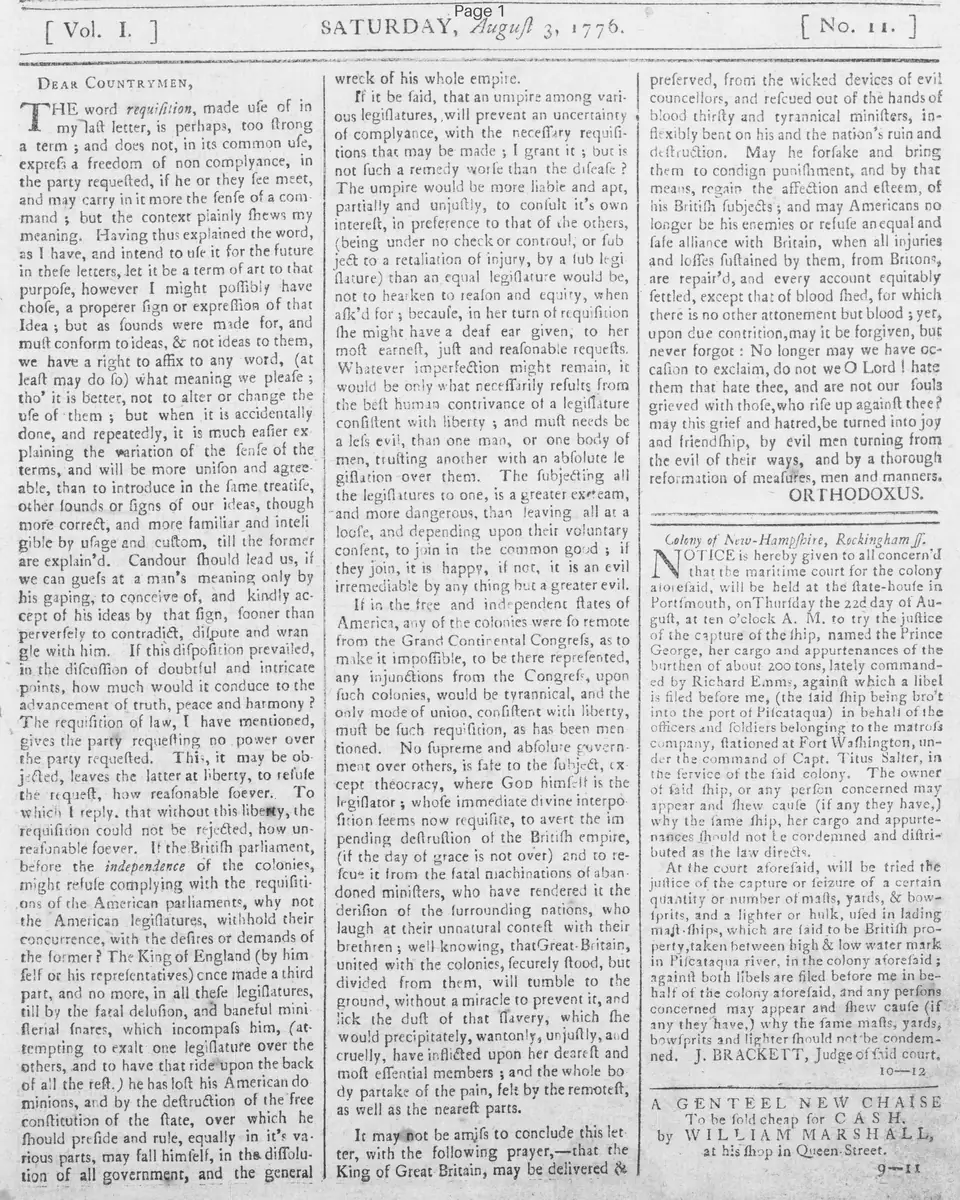
DEAR COUNTRYMEN,
The word requisition, made use of in my last letter, is perhaps, too strong a term ; and does not, in its common use, express a freedom of non compliance, in the party requested, if he or they see meet, and may carry in it more the sense of a command : but the context plainly shows my meaning. Having thus explained the word, as I have, and intend to use it for the future in these letters, let it be a term of art to that purpose, however I might possibly have chose, a properer sign or expression of that Idea ; but as sounds were made for, and must conform to ideas, & not ideas to them, we have a right to affix to any word, (at least may do so) what meaning we please ; tho' it is better, not to alter or change the use of them ; but when it is accidentally done, and repeatedly, it is much easier explaining the variation of the sense of the terms, and will be more uniform and agreeable, than to introduce in the same treatise, other sounds or signs of our ideas, though more correct, and more familiar and intelligible by usage and custom, till the former are explain'd. Candour should lead us, if we can guess at a man's meaning only by his gaping, to conceive of, and kindly accept of his ideas by that sign, sooner than perversely to contradict, dispute and wrangle with him. If this disposition prevailed, in the discussion of doubtful and intricate points, how much would it conduce to the advancement of truth, peace and harmony ?
The requisition of law, I have mentioned, gives the party requesting no power over the party requested. This, it may be objected, leaves the latter at liberty, to refuse the request, how reasonable soever. To which I reply, that without this liberty, the requisition could not be rejected, how unreasonable soever. If the British parliament, before the independence of the colonies, might refuse complying with the requisitions of the American parliaments, why not the American legislatures, withhold their concurrence, with the desires or demands of the former? The King of England (by himself or his representatives) once made a third part, and no more, in all these legislatures, till by the fatal delusion, and baneful ministerial snares, which encompass him, (attempting to exalt one legislature over the others, and to have that ride upon the back of all the rest,) he has lost his American dominions, and by the destruction of the free constitution of the state, over which he should preside and rule, equally in it's various parts, may fall himself, in that dissolution of all government, and the general wreck of his whole empire.
If it be said, that an umpire among various legislatures, will prevent an uncertainty of compliance, with the necessary requisitions that may be made ; I grant it ; but is not such a remedy worse than the disease ? The umpire would be more liable and apt, partially and unjustly, to consult it's own interest, in preference to that of the others, (being under no check or controul; or subject to a retaliation of injury, by a sub legislature) than an equal legislature would be, not to hearken to reason and equity, when asked for ; because, in her turn of requisition she might have a deaf ear given, to her most earnest, just and reasonable requests. Whatever imperfection might remain, it would be only what necessarily results from the best human contrivance of a legislature consistent with liberty ; and must needs be a less evil, than one man, or one body of men, trusting another with an absolute legislation over them. The subjecting all the legislatures to one, is a greater extreme, and more dangerous, than leaving all at a loose, and depending upon their voluntary consent, to join in the common good ; if they join, it is happy, if not, it is an evil irremediable by any thing but a greater evil.
If in the free and independent states of America, any of the colonies were so remote from the Grand Continental Congress, as to make it impossible, to be there represented, any injunctions from the Congress, upon such colonies, would be tyrannical, and the only mode of union, consistent with liberty, must be such requisition, as has been mentioned. No supreme and absolute government over others, is safe to the subject, (except theocracy, where God himself is the legislator ; whose immediate divine interposition seems now requisite, to avert the impending destruction of the British empire, (if the day of grace is not over) and to rescue it from the fatal machinations of abandoned ministers, who have rendered it the derision of the surrounding nations, who laugh at their unnatural contest with their brethren ; well knowing, that Great-Britain, united with the colonies, securely stood, but divided from them, will tumble to the ground, without a miracle to prevent it, and lick the dust of that slavery, which they would precipitately, wantonly, unjustly, and cruelly, have inflicted upon her dearest and most essential members ; and the whole body partake of the pain, felt by the remotest, as well as the nearest parts.
It may not be amiss to conclude this letter, with the following prayer,--that the King of Great Britain, may be delivered & preserved, from the wicked devices of evil counsellors, and rescued out of the hands of blood thirsty and tyrannical ministers, inflexibly bent on his and the nation's ruin and destruction. May he forsake and bring them to condign punishment, and by that means, regain the affection and esteem, of his British subjects ; and may Americans no longer be his enemies or refuse an equal and safe alliance with Britain, when all injuries and losses sustained by them, from Britons, are repair'd, and every account equitably settled, except that of blood shed, for which there is no other atonement but blood ; yet upon due contrition, may it be forgiven, but never forgot : No longer may we have occasion to exclaim, do not we O Lord ! hate them that hate thee. and are not our souls grieved with those, who rise up against thee? may this grief and hatred, be turned into joy and friendship, by evil men turning from the evil of their ways, and by a thorough reformation of measures, men and manners.
ORTHODOXUS.
What sub-type of article is it?
What themes does it cover?
What keywords are associated?
What entities or persons were involved?
Letter to Editor Details
Author
Orthodoxus
Recipient
Countrymen
Main Argument
the author defends 'requisition' as a voluntary, non-binding request among equal legislatures to preserve liberty, opposes supreme authority or an umpire that could enable tyranny, critiques british policies leading to loss of american dominions, and prays for the king's deliverance from evil ministers and reconciliation with america upon reparations.
Notable Details