Thank you for visiting SNEWPapers!
Sign up free
Editorial
January 23, 1945
Imperial Valley Press
El Centro, Imperial County, California
What is this article about?
The editorial strongly criticizes President Roosevelt's nomination of Henry A. Wallace to replace Jesse Jones as Secretary of Commerce, calling it a politically motivated decision that ignores Wallace's qualifications and anti-business stance, predicting it will undermine postwar economic recovery and business confidence.
Clipping
OCR Quality
98%
Excellent
Full Text
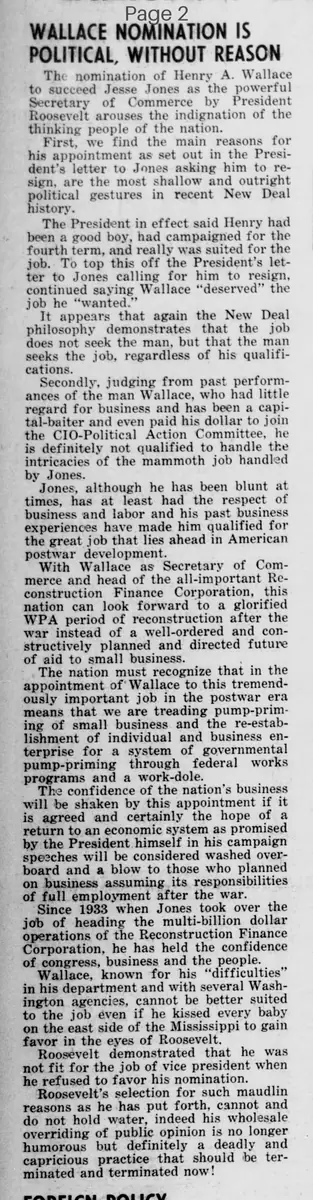
WALLACE NOMINATION IS POLITICAL. WITHOUT REASON
The nomination of Henry A. Wallace to succeed Jesse Jones as the powerful Secretary of Commerce by President Roosevelt arouses the indignation of the thinking people of the nation.
First, we find the main reasons for his appointment as set out in the President's letter to Jones asking him to resign, are the most shallow and outright political gestures in recent New Deal history.
The President in effect said Henry had been a good boy, had campaigned for the fourth term, and really was suited for the job. To top this off the President's letter to Jones calling for him to resign, continued saving Wallace "deserved" the job he wanted.
It appears that again the New Deal philosophy demonstrates that the job does not seek the man, but that the man seeks the job, regardless of his qualifications.
Secondly, judging from past performances of the man Wallace, who had little regard for business and has been a capital-baiter and even paid his dollar to join the CIO-Political Action Committee, he is definitely not qualified to handle the intricacies of the mammoth job handled by Jones.
Jones, although he has been blunt at times, has at least had the respect of business and labor and his past business experiences have made him qualified for the great job that lies ahead in American postwar development.
With Wallace as Secretary of Commerce and head of the all-important Reconstruction Finance Corporation, this nation can look forward to a glorified WPA period of reconstruction after the war instead of a well-ordered and constructively planned and directed future of aid to small business.
The nation must recognize that in the appointment of Wallace to this tremendously important job in the postwar era means that we are treading pump-priming of small business and the re-establishment of individual and business enterprise for a system of governmental pump-priming through federal works programs and a work-dole.
The confidence of the nation's business will be shaken by this appointment if it is agreed and certainly the hope of a return to an economic system as promised by the President himself in his campaign speeches will be considered washed overboard and a blow to those who planned on business assuming its responsibilities of full employment after the war.
Since 1933 when Jones took over the job of heading the multi-billion dollar operations of the Reconstruction Finance Corporation, he has held the confidence of congress, business and the people.
Wallace, known for his "difficulties" in his department and with several Washington agencies, cannot be better suited to the job even if he kissed every baby on the east side of the Mississippi to gain favor in the eyes of Roosevelt.
Roosevelt demonstrated that he was not fit for the job of vice president when he refused to favor his nomination.
Roosevelt's selection for such maudlin reasons as he has put forth, cannot and do not hold water. Indeed his wholesale overriding of public opinion is no longer humorous but definitely a deadly and capricious practice that should be terminated and terminated now!
The nomination of Henry A. Wallace to succeed Jesse Jones as the powerful Secretary of Commerce by President Roosevelt arouses the indignation of the thinking people of the nation.
First, we find the main reasons for his appointment as set out in the President's letter to Jones asking him to resign, are the most shallow and outright political gestures in recent New Deal history.
The President in effect said Henry had been a good boy, had campaigned for the fourth term, and really was suited for the job. To top this off the President's letter to Jones calling for him to resign, continued saving Wallace "deserved" the job he wanted.
It appears that again the New Deal philosophy demonstrates that the job does not seek the man, but that the man seeks the job, regardless of his qualifications.
Secondly, judging from past performances of the man Wallace, who had little regard for business and has been a capital-baiter and even paid his dollar to join the CIO-Political Action Committee, he is definitely not qualified to handle the intricacies of the mammoth job handled by Jones.
Jones, although he has been blunt at times, has at least had the respect of business and labor and his past business experiences have made him qualified for the great job that lies ahead in American postwar development.
With Wallace as Secretary of Commerce and head of the all-important Reconstruction Finance Corporation, this nation can look forward to a glorified WPA period of reconstruction after the war instead of a well-ordered and constructively planned and directed future of aid to small business.
The nation must recognize that in the appointment of Wallace to this tremendously important job in the postwar era means that we are treading pump-priming of small business and the re-establishment of individual and business enterprise for a system of governmental pump-priming through federal works programs and a work-dole.
The confidence of the nation's business will be shaken by this appointment if it is agreed and certainly the hope of a return to an economic system as promised by the President himself in his campaign speeches will be considered washed overboard and a blow to those who planned on business assuming its responsibilities of full employment after the war.
Since 1933 when Jones took over the job of heading the multi-billion dollar operations of the Reconstruction Finance Corporation, he has held the confidence of congress, business and the people.
Wallace, known for his "difficulties" in his department and with several Washington agencies, cannot be better suited to the job even if he kissed every baby on the east side of the Mississippi to gain favor in the eyes of Roosevelt.
Roosevelt demonstrated that he was not fit for the job of vice president when he refused to favor his nomination.
Roosevelt's selection for such maudlin reasons as he has put forth, cannot and do not hold water. Indeed his wholesale overriding of public opinion is no longer humorous but definitely a deadly and capricious practice that should be terminated and terminated now!
What sub-type of article is it?
Partisan Politics
Economic Policy
What keywords are associated?
Wallace Nomination
Roosevelt
Secretary Of Commerce
New Deal Politics
Postwar Economy
Business Confidence
Reconstruction Finance Corporation
What entities or persons were involved?
Henry A. Wallace
President Roosevelt
Jesse Jones
New Deal
Reconstruction Finance Corporation
Cio Political Action Committee
Editorial Details
Primary Topic
Criticism Of Henry A. Wallace's Nomination As Secretary Of Commerce
Stance / Tone
Indignant Opposition To The Nomination
Key Figures
Henry A. Wallace
President Roosevelt
Jesse Jones
New Deal
Reconstruction Finance Corporation
Cio Political Action Committee
Key Arguments
Nomination Is Based On Shallow Political Gestures For Campaigning Loyalty
Wallace Lacks Qualifications Due To Anti Business Views And Cio Involvement
Jones Is Respected And Experienced In Business And Postwar Development
Appointment Will Lead To Excessive Government Intervention Like Wpa Instead Of Business Led Recovery
Shakes Business Confidence And Undermines Promises Of Private Sector Full Employment
Wallace's Past Difficulties Make Him Unsuitable
Roosevelt's Decision Overrides Public Opinion Capriciously