Thank you for visiting SNEWPapers!
Sign up free
National Gazette
Philadelphia, Philadelphia County, Pennsylvania
What is this article about?
A letter defending President Washington's neutrality proclamation during the Franco-British war, arguing it upholds the U.S. Constitution and treaties by maintaining peace, which only Congress can declare war to end. The author criticizes 'VERITAS' for urging war involvement with France and outlines reasons for strict neutrality to protect the young republic.
Clipping
OCR Quality
Full Text
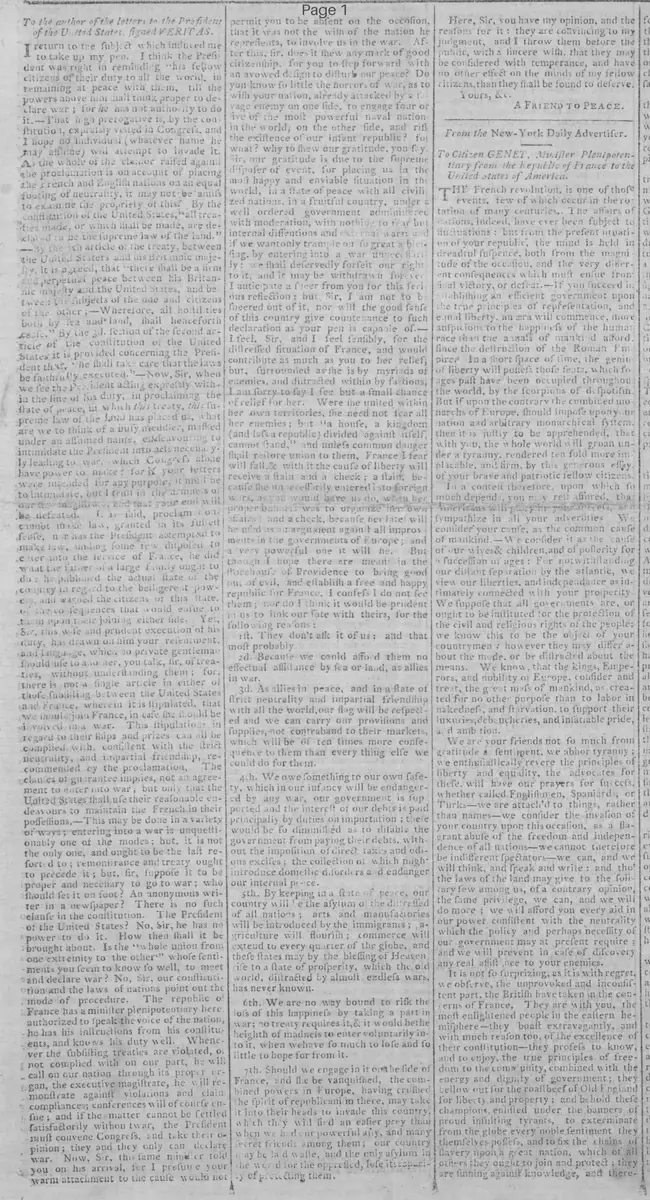
I return to the subject which induced me to take up my pen. I think the President was right in reminding his fellow citizens of their duty to all the world in remaining at peace with them, till the powers above shall think proper to declare war; for he has not authority to do it. That high prerogative is, by the constitution, expressly vested in Congress, and I hope no individual (whatever name he may assume) will attempt to invade it.
On the whole, the clamor raised against the proclamation is on account of placing the French and English nations on an equal footing of neutrality, it may not be amiss to examine the propriety of this. By the constitution of the United States, "all treaties made, or which shall be made, are declared to be the supreme law of the land."
By the 1st article of the treaty, between the United States and his Britannic majesty, it is agreed, that "there shall be a firm and perpetual peace between his Britannic majesty and the United States, and between the subjects of the one and citizens of the other. Wherefore, all hostilities both by sea and land, shall henceforth cease."
By the 2d section of the second article of the constitution of the United States it is provided concerning the President that, he shall take care that the laws be faithfully executed."—Now, Sir, when we see the President acting expressly within the line of his duty, in proclaiming the state of peace, in which this treaty, this supreme law of the land has placed us, what are we to think of a busy meddler, masked under an assumed name, endeavouring to intimidate the President into acts necessarily leading to war, which Congress alone have power to make? For if your letters were intended for any purpose, it must be to intimidate, but I trust in the firmness of our magistrate and the good sense of our citizens it will be defeated.
I am afraid, proclamation cannot make law, granted in its full extent, nor has the President attempted to make law, being some few disposed to enter into the service of France, he did what the father of a large family ought to do: he published the actual state of the country in regard to the belligerent powers, and warned the citizens of this state of the consequences that would ensue to them upon their joining either side. Yet, Sir, this wise and prudent execution of his duty, has drawn on him your resentment, and language, which no private gentleman should use to a brother, you talk, Sir, of treaties, without understanding them; for there is not a single article in either of those subsisting between the United States and France, wherein it is stipulated, that we should join France, in case she should be involved in a war. This stipulation in regard to their ships and prizes can all be complied with, consistent with the strict neutrality, and impartial friendship, recommended by the proclamation. The clauses of guarantee imply, not an agreement to enter into war; but only that the United States shall use their reasonable endeavours to maintain the French in their possessions. This may be done in a variety of ways; entering into a war is unquestionably one of the modes; but it is not the only one, and ought to be the last resorted to; remonstrance and treaty ought to precede it; but, sir, suppose it to be proper and necessary to go to war; who should set it on foot? An anonymous writer in a newspaper? There is no such clause in the constitution. The President of the United States? No, Sir, he has no power to do it. How then shall it be brought about? Is the whole union from one extremity to the other, whose sentiments you seem to know so well, to meet and declare war? No, Sir, our constitution and the laws of nations point out the mode of procedure. The republic of France has a minister plenipotentiary here authorized to speak the voice of the nation, he has his instructions from his constituents, and knows his duty well. Whenever the subsisting treaties are violated, or not complied with on our part, he will call on our nation through its proper organ, the executive magistrate, he will remonstrate against violations and claim compliances; conferences will of course ensue; and if the matter cannot be settled satisfactorily without war, the President must convene Congress, and take their opinion; they and they only can declare war. Now, Sir, this same minister took you on his arrival, for I presume your warm attachment to the cause would not permit you to be absent on the occasion, that it was not the wish of the nation he represents, to involve us in the war. After this, sir, does it show any mark of good citizenship, for you to step forward with an avowed design to disturb our peace? Do you know so little the horrors of war, as to wish your nation, already attacked by a savage enemy on one side, to engage four or five of the most powerful naval nations in the world, on the other side, and risk the existence of our infant republic? For what? why to show our gratitude, you say Sir, our gratitude is due to the supreme disposer of events, for placing us in the most happy and enviable situation in the world, in a state of peace with all civilized nations, in a fruitful country, under a well ordered government administered with moderation, with nothing to fear but internal dissentions and external wars; and if we wantonly trample on so great a blessing, by entering into a war unnecessarily; we shall deservedly forfeit our right to it, and it may be withdrawn from us.
I anticipate a sneer from you for this serious reflection; but Sir, I am not to be sneered out of it, nor will the good sense of this country give countenance to such declarations as your pen is capable of. I feel, Sir, and I feel sensibly, for the distressed situation of France, and would contribute as much as you to her relief; but, surrounded as she is by myriads of enemies, and distracted within by factions, I am sorry to say I see but a small chance of relief for her. Were they united within her own territories, she need not fear all her enemies; but "a house, a kingdom (and more a republic) divided against itself, cannot stand," and unless common danger shall restore union to them, France I fear will fall, & with it the cause of liberty will receive a stain and a check; a stain, because she unnecessarily entered into foreign wars, as you would have us do, when her proper business was to organize her own affairs; and a check, because her fate will be an argument against all improvement in the governments of Europe; and a very powerful one it will be. But though I hope there are means in the dispensations of Providence to bring good out of evil, and establish a free and happy republic for France, I confess I do not see them; nor do I think it would be prudent in us to link our fate with theirs, for the following reasons:
1st. They don't ask it of us: and that most probably
2d. Because we could afford them no effectual assistance by sea or land, as allies in war.
3d. As allies in peace, and in a state of strict neutrality and impartial friendship with all the world, our flag will be respected and we can carry our provisions and supplies, not contraband to their markets, which will be of ten times more consequence to them than every thing else we could do for them.
4th. We owe something to our own safety, which in our infancy will be endangered by any war, our government is supported and the interest of our debts is paid principally by duties on importation; these would be so diminished as to disable the government from paying their debts, without the imposition of direct taxes and odious excises; the collection of which might introduce domestic disorders and endanger our internal peace.
5th. By keeping in a state of peace, our country will be the asylum of the distressed of all nations; arts and manufactures will be introduced by the immigrants; agriculture will flourish; commerce will extend to every quarter of the globe, and these states may by the blessing of Heaven rise to a state of prosperity, which the old world, distracted by almost endless wars, has never known.
6th. We are no way bound to risk the loss of this happiness by taking a part in war; no treaty requires it, & it would be the height of madness to enter voluntarily into it, when we have so much to lose and so little to hope for from it.
7th. Should we engage in it on the side of France, and she be vanquished, the combined powers in Europe, having crushed the spirit of republicanism there, may take it into their heads to invade this country, which they will find an easier prey than when we had our powerful ally, and many secret friends among them; our country may be laid waste, and the only asylum in the world for the oppressed, lose its capacity of protecting them.
Here, Sir, you have my opinion, and the reasons for it: they are convincing to my judgment, and I throw them before the public, with a sincere wish, that they may be considered with temperance, and have no other effect on the minds of my fellow citizens, than they shall be found to deserve.
Yours, &c.
A FRIEND TO PEACE.
What sub-type of article is it?
What themes does it cover?
What keywords are associated?
What entities or persons were involved?
Letter to Editor Details
Author
A Friend To Peace
Recipient
To The Author Of The Letters To The President Of The United States, Signed Veritas
Main Argument
the president's neutrality proclamation is constitutional and prudent, as only congress can declare war; u.s. treaties do not require joining france in war, and involvement would endanger the young republic's peace and prosperity.
Notable Details