Thank you for visiting SNEWPapers!
Sign up free
Editorial
March 5, 1954
Arkansas State Press
Little Rock, Pulaski County, Arkansas
What is this article about?
S. S. Taylor argues that financial pressures will lead Arkansas to integrate public schools for races, as equalization of separate facilities is costlier. Highlights inequalities in Negro school plants, higher pupil-teacher ratios, greater retardation, and lower high school enrollment. Suggests integration enables consolidation, better equipment, and reforms in boys' schools near Wrightsville and Pine Bluff.
Clipping
OCR Quality
98%
Excellent
Full Text
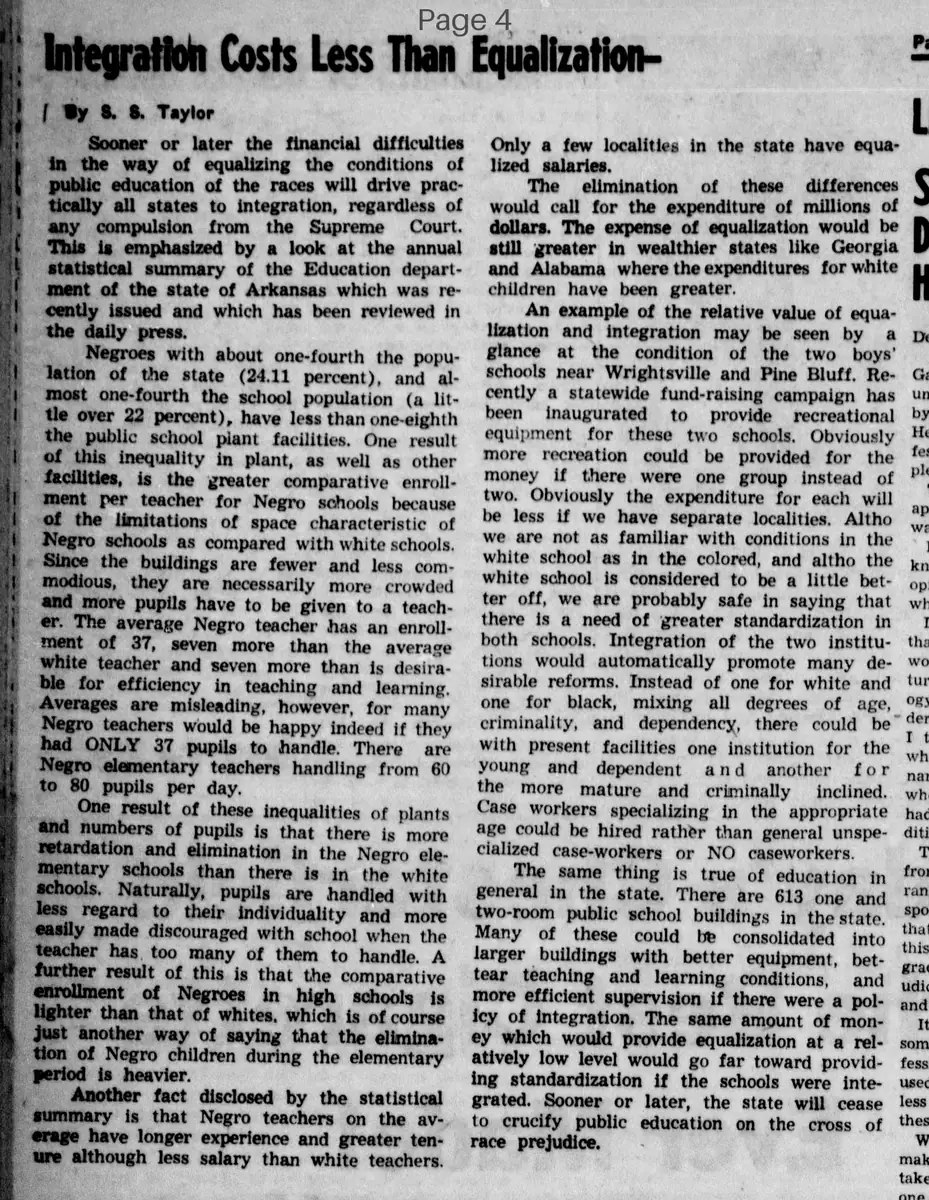
Integration Costs Less Than Equalization
S. S. Taylor
Sooner or later the financial difficulties in the way of equalizing the conditions of public education of the races will drive practically all states to integration, regardless of any compulsion from the Supreme Court.
This is emphasized by a look at the annual statistical summary of the Education department of the state of Arkansas which was recently issued and which has been reviewed in the daily press.
Negroes with about one-fourth the population of the state (24.11 percent), and almost one-fourth the school population (a little over 22 percent), have less than one-eighth the public school plant facilities. One result of this inequality in plant, as well as other facilities, is the greater comparative enrollment per teacher for Negro schools because of the limitations of space characteristic of Negro schools as compared with white schools.
Since the buildings are fewer and less commodious, they are necessarily more crowded and more pupils have to be given to a teacher. The average Negro teacher has an enrollment of 37, seven more than the average white teacher and seven more than is desirable for efficiency in teaching and learning.
Averages are misleading, however, for many Negro teachers would be happy indeed if they had ONLY 37 pupils to handle. There are Negro elementary teachers handling from 60 to 80 pupils per day.
One result of these inequalities of plants and numbers of pupils is that there is more retardation and elimination in the Negro elementary schools than there is in the white schools. Naturally, pupils are handled with less regard to their individuality and more easily made discouraged with school when the teacher has too many of them to handle. A further result of this is that the comparative enrollment of Negroes in high schools is lighter than that of whites, which is of course just another way of saying that the elimination of Negro children during the elementary period is heavier.
Another fact disclosed by the statistical summary is that Negro teachers on the average have longer experience and greater tenure although less salary than white teachers.
Only a few localities in the state have equalized salaries.
The elimination of these differences would call for the expenditure of millions of dollars. The expense of equalization would be still greater in wealthier states like Georgia and Alabama where the expenditures for white children have been greater.
An example of the relative value of equalization and integration may be seen by a glance at the condition of the two boys' schools near Wrightsville and Pine Bluff. Recently a statewide fund-raising campaign has been inaugurated to provide recreational equipment for these two schools. Obviously more recreation could be provided for the money if there were one group instead of two. Obviously the expenditure for each will be less if we have separate localities. Although we are not as familiar with conditions in the white school as in the colored, and although the white school is considered to be a little better off, we are probably safe in saying that there is a need of greater standardization in both schools. Integration of the two institutions would automatically promote many desirable reforms. Instead of one for white and one for black, mixing all degrees of age, criminality, and dependency, there could be with present facilities one institution for the young and dependent and another for the more mature and criminally inclined.
Case workers specializing in the appropriate age could be hired rather than general unspecialized case-workers or NO caseworkers.
The same thing is true of education in general in the state. There are 613 one and two-room public school buildings in the state. Many of these could be consolidated into larger buildings with better equipment, better teaching and learning conditions, and more efficient supervision if there were a policy of integration. The same amount of money which would provide equalization at a relatively low level would go far toward providing standardization if the schools were integrated. Sooner or later, the state will cease to crucify public education on the cross of race prejudice.
S. S. Taylor
Sooner or later the financial difficulties in the way of equalizing the conditions of public education of the races will drive practically all states to integration, regardless of any compulsion from the Supreme Court.
This is emphasized by a look at the annual statistical summary of the Education department of the state of Arkansas which was recently issued and which has been reviewed in the daily press.
Negroes with about one-fourth the population of the state (24.11 percent), and almost one-fourth the school population (a little over 22 percent), have less than one-eighth the public school plant facilities. One result of this inequality in plant, as well as other facilities, is the greater comparative enrollment per teacher for Negro schools because of the limitations of space characteristic of Negro schools as compared with white schools.
Since the buildings are fewer and less commodious, they are necessarily more crowded and more pupils have to be given to a teacher. The average Negro teacher has an enrollment of 37, seven more than the average white teacher and seven more than is desirable for efficiency in teaching and learning.
Averages are misleading, however, for many Negro teachers would be happy indeed if they had ONLY 37 pupils to handle. There are Negro elementary teachers handling from 60 to 80 pupils per day.
One result of these inequalities of plants and numbers of pupils is that there is more retardation and elimination in the Negro elementary schools than there is in the white schools. Naturally, pupils are handled with less regard to their individuality and more easily made discouraged with school when the teacher has too many of them to handle. A further result of this is that the comparative enrollment of Negroes in high schools is lighter than that of whites, which is of course just another way of saying that the elimination of Negro children during the elementary period is heavier.
Another fact disclosed by the statistical summary is that Negro teachers on the average have longer experience and greater tenure although less salary than white teachers.
Only a few localities in the state have equalized salaries.
The elimination of these differences would call for the expenditure of millions of dollars. The expense of equalization would be still greater in wealthier states like Georgia and Alabama where the expenditures for white children have been greater.
An example of the relative value of equalization and integration may be seen by a glance at the condition of the two boys' schools near Wrightsville and Pine Bluff. Recently a statewide fund-raising campaign has been inaugurated to provide recreational equipment for these two schools. Obviously more recreation could be provided for the money if there were one group instead of two. Obviously the expenditure for each will be less if we have separate localities. Although we are not as familiar with conditions in the white school as in the colored, and although the white school is considered to be a little better off, we are probably safe in saying that there is a need of greater standardization in both schools. Integration of the two institutions would automatically promote many desirable reforms. Instead of one for white and one for black, mixing all degrees of age, criminality, and dependency, there could be with present facilities one institution for the young and dependent and another for the more mature and criminally inclined.
Case workers specializing in the appropriate age could be hired rather than general unspecialized case-workers or NO caseworkers.
The same thing is true of education in general in the state. There are 613 one and two-room public school buildings in the state. Many of these could be consolidated into larger buildings with better equipment, better teaching and learning conditions, and more efficient supervision if there were a policy of integration. The same amount of money which would provide equalization at a relatively low level would go far toward providing standardization if the schools were integrated. Sooner or later, the state will cease to crucify public education on the cross of race prejudice.
What sub-type of article is it?
Education
Social Reform
What keywords are associated?
School Integration
Racial Equalization
Public Education
Arkansas Schools
Negro Facilities
Pupil Teacher Ratio
School Consolidation
What entities or persons were involved?
S. S. Taylor
Arkansas Education Department
Negro Schools
White Schools
Boys' Schools Near Wrightsville And Pine Bluff
Editorial Details
Primary Topic
Financial Advantages Of School Integration Over Racial Equalization In Arkansas
Stance / Tone
Pro Integration, Critical Of Racial Segregation In Education
Key Figures
S. S. Taylor
Arkansas Education Department
Negro Schools
White Schools
Boys' Schools Near Wrightsville And Pine Bluff
Key Arguments
Equalizing Separate School Facilities For Races Requires Millions In Expenditure
Negroes Have Fewer School Facilities Despite Similar Population Proportion
Higher Pupil Teacher Ratios In Negro Schools Lead To Overcrowding And Inefficiency
Greater Retardation And Elimination In Negro Elementary Schools
Negro Teachers Have More Experience But Lower Salaries
Integration Allows Consolidation Of Small Schools For Better Equipment And Supervision
Integration Of Boys' Schools Would Enable Specialized Institutions And Reforms