Thank you for visiting SNEWPapers!
Sign up free
The National Intelligencer And Washington Advertiser
Washington, District Of Columbia
What is this article about?
Publication of explanatory letter from US Minister Gen. Armstrong in Paris dated Nov 26, 1805, addressing controversy over insurance claim for captured ship New-Jersey under US-France treaties, clarifying no rejection based on insurers' rights and detailing admission of partial claim.
Clipping
OCR Quality
Full Text
MONDAY, MARCH 3.
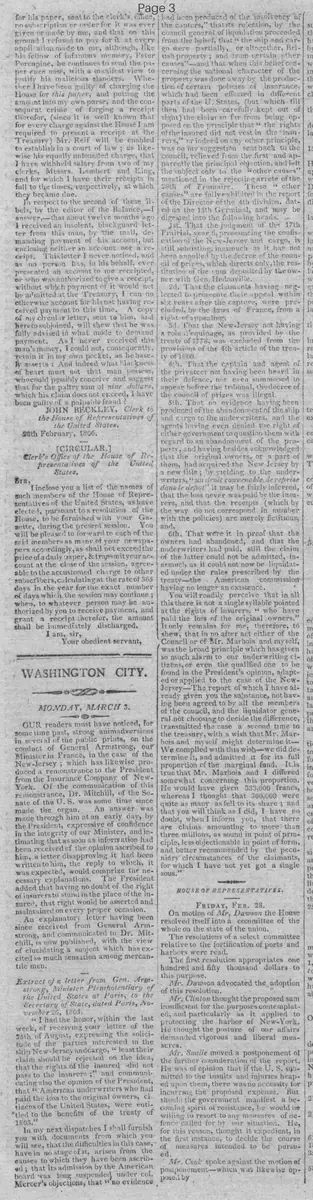
OUR readers must have noticed, for some time past, strong animadversions in several of the public prints, on the conduct of General Armstrong, our Minister in France, in the case of the New-Jersey ; which has likewise produced a remonstrance to the President from the Insurance Company of New-York. Of the communication of this remonstrance, Dr. Mitchill, of the Senate of the U.S. was some time since made the organ. An answer was made through him at an early day, by the President, expressive of confidence in the integrity of our Minister, and intimating that as soon as information had been received of the opinion ascribed to him, a letter disapproving it had been written to him, the reply to which, it was expected, would comprize the necessary explanations. The President added that having no doubt of the rights of insurers to stand in the place of the insured, that right would be asserted and maintained on every proper occasion.
An explanatory letter having been since received from General Armstrong, and communicated to Dr. Mitchill, is now published, with the view of elucidating a subject which has excited so much sensation among mercantile men.
Extract of a letter from Gen. Armstrong, Minister Plenipotentiary of the United States at Paris, to the Secretary of State, dated Paris, November 26, 1805.
" I had the honor, within the last week, of receiving your letter of the 25th of August, expressing the solicitude of the parties interested in the ship New-Jersey and cargo, " least their claim should be rejected on the idea, that the rights of the insured did not pass to the insurers ;" and communicating also the opinion of the President, that " American underwriters who had paid the loss to the original owners, citizens of the United States, were entitled to the benefits of the treaty of 1803."
In my next dispatches I shall furnish you with documents from which you will see, that the difficulties in this case, have in no stage of it, arisen from the causes to which they have been ascribed; that its admission by the American board was long suspended under col. Mercer's objections, that " no evidence had been produced of the insolvency of the captors," that its rejection, by the council general of liquidation proceeded from the belief, that " the ship and cargo were partially, or altogether, British property; and from certain other causes" and that when this belief concerning the national character of the property was done away by the production of certain policies of insurance, which had been effected in different parts of the U. States. (but which till then had been carefully kept out of sight) the claim so far from being opposed on the principle that " the rights of the insured did not vest in the insurers," or indeed on any other principle, was on my suggestion sent back to the council, relieved from the first and apparently the principal objection, and left the subject only to the "other causes" mentioned in the rejecting arrete of the 28th of Frimaire. These " other causes" are fully exhibited in the report of the Director of the 4th division, dated on the 15th Germinal, and may be digested into the following heads. —
1st. That the judgment of the 17th Prairial, year 6, pronouncing the confiscation of the New-Jersey and cargo, is still subsisting, inasmuch as it has not been annulled by the decree of the council of prizes, which directs only, the restitution of the sum deposited by the owner with Gen. Hedouville.
2d. That the claimants having neglected to prosecute their appeal within six years after the capture, were precluded, by the laws of France, from a right of appealing.
3d. That the New Jersey not having a role d'equipage, as provided by the treaty of 1778, was excluded from the provisions of the 4th article of the treaty of 1800
4th. That the captain and agent of the privateer not having been heard in their defence. nor even summoned to appear before the tribunal, the decree of the council of prizes was illegal
5th. That no evidence having been produced of the abandonment of the ship and cargo to the underwriters, and the agents having even denied the right of either government to question them with regard to an abandonment of the property, and having besides acknowledged that the original owners. or a part of them, had acquired the New Jersey by a new title; by yielding to the underwriters, " un droit convenable de rachat dans le debit" it may be fairly inferred, that the loss never was paid by the insurers, and that the receipts (which by the way do not correspond in number with the policies) are merely fictitious, and,
6th. That were it in proof that the owners had abandoned. and that the underwriters had paid, still the claim of the latter could not be admitted, inasmuch as it could not now be liquidated under the rules prescribed by the treaty--the , American commission having no longer an existence.
You will readily perceive that in all this there is not a single syllable pointed at the rights of insurers, " who have paid the loss of the original owners." It only remains for me, therefore, to shew, that in no after act either of the Council or of Mr. Marbois and myself, was the broad principle which has given so much alarm to our underwriting citizens, or even the qualified one to be found in the President's opinion, adapted or applied to the case of the New-Jersey-The report of which I have already given you the substance, not having been agreed to by all the members of the council, and the liquidator general not choosing to decide the difference. transmitted the case a second time to the treasury, with a wish that Mr. Marbois and myself might determine it We complied with thus wish we did determine it, and admitted it for its full proportion of the marginal fund. It is true that Mr. Marbois and I differed somewhat concerning this proportion. He would have given 33,000 francs, whereas I thought that 300,000 were quite as many as fell to its share : and that you will think as I did, I have no doubt, when I inform you, that there are claims amounting to more than three millions, as sound in point of principle, less objectionable in point of form, and better recommended by the pecuniary circumstances of the claimants, for which I have not yet got a single sous."
What sub-type of article is it?
What keywords are associated?
What entities or persons were involved?
Where did it happen?
Foreign News Details
Primary Location
Paris
Event Date
November 26, 1805
Key Persons
Outcome
claim admitted for 300,000 francs from marginal fund despite objections; other claims totaling over three million francs remain unpaid.
Event Details
Explanatory letter from Gen. Armstrong details history of New-Jersey ship claim rejection and readmission, refuting concerns over insurers' rights under US-France treaties of 1800 and 1803; objections included prior confiscation judgment, missed appeal deadline, lack of crew list, illegal prize council decree, questionable abandonment evidence, and expired American commission.