Thank you for visiting SNEWPapers!
Sign up free
Editorial
October 16, 1793
National Gazette
Philadelphia, Philadelphia County, Pennsylvania
What is this article about?
This 1793 editorial from the Alexandria Advertiser urges American support for France against despotism, defends the U.S.-France alliance despite Louis XVI's execution, criticizes neutrality advocates, and praises France's recent commercial decree. It warns of global consequences if France falls.
Clipping
OCR Quality
98%
Excellent
Full Text
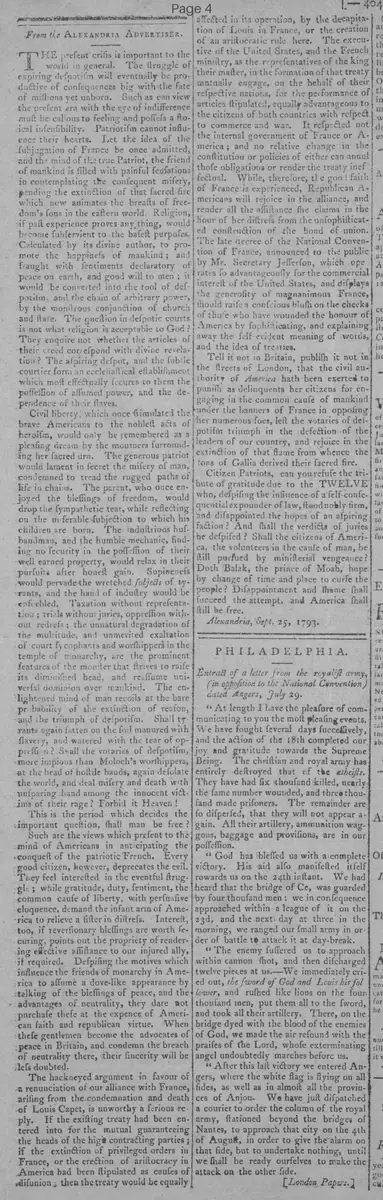
From the ALEXANDRIA ADVERTISER.
The present crisis is important to the world in general. The struggle of expiring despotism will eventually be productive of consequences big with the fate of millions yet unborn. Such as can view the present era with the eye of indifference must be callous to feeling and possess a stoical insensibility. Patriotism cannot influence their hearts. Let the idea of the subjugation of France be once admitted, and the mind of the true Patriot, the friend of mankind is filled with painful sensations in contemplating the consequent misery, pending the extinction of that sacred fire which now animates the breasts of freedom's sons in the eastern world. Religion, if past experience proves any thing, would become subservient to the basest purposes. Calculated by its divine author, to promote the happiness of mankind; and fraught with sentiments declaratory of peace on earth, and good will to men: it would be converted into the tool of despotism, and the chain of arbitrary power, by the monstrous conjunction of church and state. The question in despotic courts is not what religion is acceptable to God? They enquire not whether the articles of their creed correspond with divine revelation? The aspiring despot, and the subtle courtier form an ecclesiastical establishment which most effectually secures to them the possession of assumed power, and the dependence of their slaves.
Civil liberty, which once stimulated the brave Americans to the noblest acts of heroism, would only be remembered as a pleasing dream by the mourners surrounding her sacred urn. The generous patriot would lament in secret the misery of man, condemned to tread the rugged paths of life in chains. The parent, who once enjoyed the blessings of freedom, would drop the sympathetic tear, while reflecting on the miserable subjection to which his children are born. The industrious husbandman, and the humble mechanic, finding no security in the possession of their well earned property, would relax in their pursuits after honest gain. Supineness would pervade the wretched subjects of tyrants, and the hand of industry would be enfeebled. Taxation without representation; trials without juries, oppression without redress; the unnatural degradation of the multitude, and unmerited exaltation of court sycophants and worshippers in the temple of monarchy, are the prominent features of the monster that strives to raise its diminished head, and resume universal dominion over mankind. The enlightened mind of man recoils at the bare probability of the extinction of reason, and the triumph of despotism. Shall tyrants again fatten on the soil manured with slavery, and watered with the tear of oppression? Shall all the votaries of despotism, more impious than Moloch's worshippers, at the head of hostile bands, again desolate the world, and deal misery and death with unsparing hand among the innocent victims of their rage? Forbid it Heaven!
This is the period which decides the important question, shall man be free?
Such are the views which present to the mind of Americans in anticipating the conquest of the patriotic French. Every good citizen, however, deprecates the evil. They feel interested in the eventful struggle; while gratitude, duty, sentiment, the common cause of liberty, with persuasive eloquence, demand the instant arm of America to relieve a sister in distress. Interest, too, if reversionary blessings are worth securing, points out the propriety of rendering effective assistance to our injured ally, if required. Despite the motives which influence the friends of monarchy in America to assume a dove-like appearance by talking of the blessings of peace, and the advantages of neutrality, they dare not purchase these at the expense of American faith and republican virtue. When these gentlemen become the advocates of peace in Britain, and condemn the breach of neutrality there, their sincerity will be less doubted.
The hackneyed argument in favour of a renunciation of our alliance with France, arising from the condemnation and death of Louis Capet, is unworthy a serious reply. If the existing treaty had been entered into for the mutual guaranteeing the heads of the high contracting parties; if the extinction of privileged orders in France, or the erection of aristocracy in America had been stipulated as causes of disunion; then the treaty would be equally affected in its operation, by the decapitation of Louis in France, or the creation of an aristocratic rule here. The executive of the United States, and the French ministry, as the representatives of the king their master, in the formation of that treaty mutually engage, on the behalf of their respective nations, for the performance of articles stipulated, equally advantageous to the citizens of both countries with respect to commerce and war. It respected not the internal government of France or America; and no relative change in the constitution or policies of either can annul those obligations or render the treaty ineffectual. While, therefore, the good faith of France is experienced, Republican Americans will rejoice in the alliance, and render all the assistance the claims in the hour of her distress from the unsophisticated construction of the bond of union.
The late decree of the National Convention of France, announced to the public by Mr. Secretary Jefferson, which operates so advantageously for the commercial interest of the United States, and displays the generosity of magnanimous France, should raise a conscious blush on the cheeks of those who have wounded the honour of America by sophisticating, and explaining away the self evident meaning of words, and the idea of treaties.
Tell it not in Britain, publish it not in the streets of London, that the civil authority of America hath been exerted to punish as delinquents her citizens for engaging in the common cause of mankind under the banners of France in opposing her numerous foes, lest the votaries of despotism triumph in the defection of the leaders of our country, and rejoice in the extinction of that flame from whence the sons of Gallia derived their sacred fire.
Citizen Patriots, can you refuse the tribute of gratitude due to the TWELVE who, despising the influence of a self-consequential expounder of law, stood nobly firm, and disappointed the hopes of an aspiring faction? And shall the verdicts of juries be despised? Shall the citizens of America, the volunteers in the cause of man, be still pursued by ministerial vengeance? Doth Balak, the prince of Moab, hope by change of time and place to curse the people? Disappointment and shame shall succeed the attempt, and America shall still be free.
Alexandria, Sept. 25, 1793.
The present crisis is important to the world in general. The struggle of expiring despotism will eventually be productive of consequences big with the fate of millions yet unborn. Such as can view the present era with the eye of indifference must be callous to feeling and possess a stoical insensibility. Patriotism cannot influence their hearts. Let the idea of the subjugation of France be once admitted, and the mind of the true Patriot, the friend of mankind is filled with painful sensations in contemplating the consequent misery, pending the extinction of that sacred fire which now animates the breasts of freedom's sons in the eastern world. Religion, if past experience proves any thing, would become subservient to the basest purposes. Calculated by its divine author, to promote the happiness of mankind; and fraught with sentiments declaratory of peace on earth, and good will to men: it would be converted into the tool of despotism, and the chain of arbitrary power, by the monstrous conjunction of church and state. The question in despotic courts is not what religion is acceptable to God? They enquire not whether the articles of their creed correspond with divine revelation? The aspiring despot, and the subtle courtier form an ecclesiastical establishment which most effectually secures to them the possession of assumed power, and the dependence of their slaves.
Civil liberty, which once stimulated the brave Americans to the noblest acts of heroism, would only be remembered as a pleasing dream by the mourners surrounding her sacred urn. The generous patriot would lament in secret the misery of man, condemned to tread the rugged paths of life in chains. The parent, who once enjoyed the blessings of freedom, would drop the sympathetic tear, while reflecting on the miserable subjection to which his children are born. The industrious husbandman, and the humble mechanic, finding no security in the possession of their well earned property, would relax in their pursuits after honest gain. Supineness would pervade the wretched subjects of tyrants, and the hand of industry would be enfeebled. Taxation without representation; trials without juries, oppression without redress; the unnatural degradation of the multitude, and unmerited exaltation of court sycophants and worshippers in the temple of monarchy, are the prominent features of the monster that strives to raise its diminished head, and resume universal dominion over mankind. The enlightened mind of man recoils at the bare probability of the extinction of reason, and the triumph of despotism. Shall tyrants again fatten on the soil manured with slavery, and watered with the tear of oppression? Shall all the votaries of despotism, more impious than Moloch's worshippers, at the head of hostile bands, again desolate the world, and deal misery and death with unsparing hand among the innocent victims of their rage? Forbid it Heaven!
This is the period which decides the important question, shall man be free?
Such are the views which present to the mind of Americans in anticipating the conquest of the patriotic French. Every good citizen, however, deprecates the evil. They feel interested in the eventful struggle; while gratitude, duty, sentiment, the common cause of liberty, with persuasive eloquence, demand the instant arm of America to relieve a sister in distress. Interest, too, if reversionary blessings are worth securing, points out the propriety of rendering effective assistance to our injured ally, if required. Despite the motives which influence the friends of monarchy in America to assume a dove-like appearance by talking of the blessings of peace, and the advantages of neutrality, they dare not purchase these at the expense of American faith and republican virtue. When these gentlemen become the advocates of peace in Britain, and condemn the breach of neutrality there, their sincerity will be less doubted.
The hackneyed argument in favour of a renunciation of our alliance with France, arising from the condemnation and death of Louis Capet, is unworthy a serious reply. If the existing treaty had been entered into for the mutual guaranteeing the heads of the high contracting parties; if the extinction of privileged orders in France, or the erection of aristocracy in America had been stipulated as causes of disunion; then the treaty would be equally affected in its operation, by the decapitation of Louis in France, or the creation of an aristocratic rule here. The executive of the United States, and the French ministry, as the representatives of the king their master, in the formation of that treaty mutually engage, on the behalf of their respective nations, for the performance of articles stipulated, equally advantageous to the citizens of both countries with respect to commerce and war. It respected not the internal government of France or America; and no relative change in the constitution or policies of either can annul those obligations or render the treaty ineffectual. While, therefore, the good faith of France is experienced, Republican Americans will rejoice in the alliance, and render all the assistance the claims in the hour of her distress from the unsophisticated construction of the bond of union.
The late decree of the National Convention of France, announced to the public by Mr. Secretary Jefferson, which operates so advantageously for the commercial interest of the United States, and displays the generosity of magnanimous France, should raise a conscious blush on the cheeks of those who have wounded the honour of America by sophisticating, and explaining away the self evident meaning of words, and the idea of treaties.
Tell it not in Britain, publish it not in the streets of London, that the civil authority of America hath been exerted to punish as delinquents her citizens for engaging in the common cause of mankind under the banners of France in opposing her numerous foes, lest the votaries of despotism triumph in the defection of the leaders of our country, and rejoice in the extinction of that flame from whence the sons of Gallia derived their sacred fire.
Citizen Patriots, can you refuse the tribute of gratitude due to the TWELVE who, despising the influence of a self-consequential expounder of law, stood nobly firm, and disappointed the hopes of an aspiring faction? And shall the verdicts of juries be despised? Shall the citizens of America, the volunteers in the cause of man, be still pursued by ministerial vengeance? Doth Balak, the prince of Moab, hope by change of time and place to curse the people? Disappointment and shame shall succeed the attempt, and America shall still be free.
Alexandria, Sept. 25, 1793.
What sub-type of article is it?
Foreign Affairs
War Or Peace
Moral Or Religious
What keywords are associated?
French Alliance
Despotism
Neutrality Debate
Treaty Obligations
Republican Virtue
National Convention Decree
American Liberty
What entities or persons were involved?
France
National Convention
Mr. Secretary Jefferson
Louis Capet
Britain
United States
Editorial Details
Primary Topic
Support For U.S. France Alliance Against Despotism
Stance / Tone
Strongly Pro French Republicanism And Anti Despotism
Key Figures
France
National Convention
Mr. Secretary Jefferson
Louis Capet
Britain
United States
Key Arguments
Subjugation Of France Would Lead To Global Despotism And Misery
U.S. France Treaty Obligations Remain Valid Despite Louis Xvi's Execution
Neutrality Betrays American Faith And Republican Virtue
France's Recent Decree Benefits U.S. Commerce
Praise For The 'Twelve' Who Resisted Factional Influence
Opposition To Punishing American Volunteers Aiding France