Thank you for visiting SNEWPapers!
Sign up free
Editorial
September 12, 1800
Virginia Argus
Richmond, Virginia
What is this article about?
A debate styled as speeches by Pericles, Phocion, and Lycurgus critiques national debt, standing army, sedition laws, and aristocratic influences in American government, defending republican self-rule against English monarchical tendencies, referencing Cicero, Tacitus, and Adams.
Clipping
OCR Quality
88%
Good
Full Text
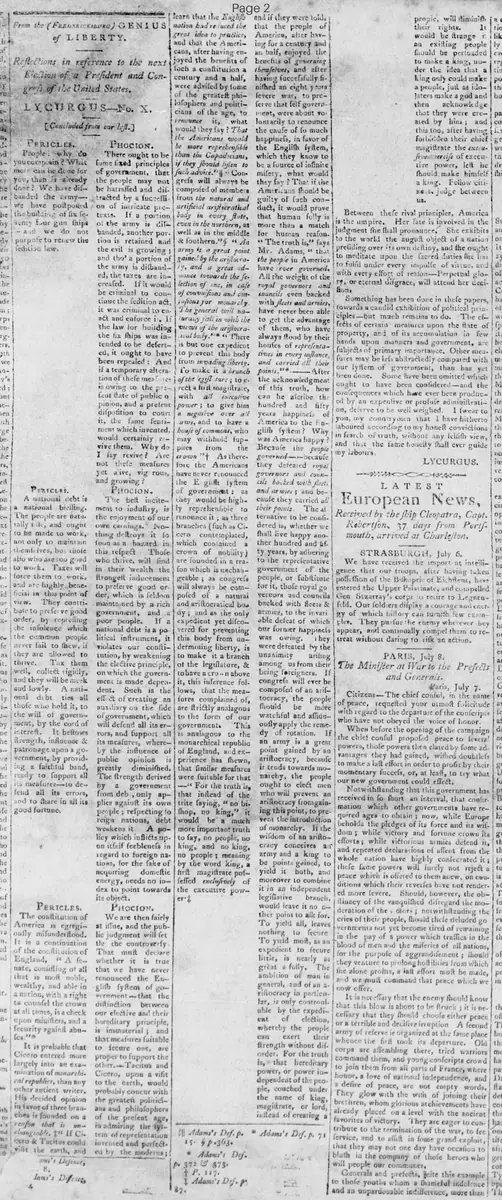
PERICLES.
People: why do you complain? What more can be done for you, than is already done? We have disbanded the army---we have postponed the building of six seventy-four gun ships---and we do not purpose to renew the sedition law.
A national debt is a national blessing. The people are naturally idle, and ought to be made to work, not only to maintain themselves, but those also who are too good to work. Taxes will force them to work, and are highly beneficial in this point of view.
They contribute to preserve good order, by repressing the insolence which the common people never fail to show, if they are allowed to thrive.
Tax them well, collect rigidly, and they will be meek and lowly. A national debt ties all those who hold it, to the will of government, by the cord of interest. It bestows strength, influence & patronage upon a government, by providing a faithful band, ready to support all its measures---to defend all its errors, and to share in all its good fortunes.
Pericles.
The constitution of America is egregiously misunderstood. It is a continuation of the constitution of England.
A senate, consisting of all that is most noble, wealthy, and able in a nation, with a right to counsel the crown at all times, is a check upon ministers, and a security against abuses.
It is probable that Cicero entered more largely into an examination of monarchical republics, than any other ancient writer. His decided opinion in favor of three branches is founded on a reason that is unchangeable. If Cicero & Tacitus could visit the earth, and see America's Defending 8: Jani's Defense
PHOCION.
There ought to be some fixed principles of government, that the people may not be harassed and distracted by a succession of intricate pretexts. If a portion of the army is disbanded, another portion is retained and the evil is growing; and tho' a portion of the army is disbanded, the taxes are increased. If it would be criminal to continue the sedition act, it was criminal to enact and enforce it. If the law for building the six ships was intended to be deserted, it ought to have been repealed: And if a temporary alteration of these measures is owing to the present state of public opinion, and a present disposition to court it, the same sentiment which invented, would certainly revive them. Why do I say revive? Are not these measures yet alive, vigorous, and growing?
PHOCION.
The best incitement to industry, is the enjoyment of our own earnings. Nothing destroys it so soon as a hazard in this respect. Those who thrive, will find in their wealth the strongest inducement to preserve good order, which is seldom maintained by a rich government, and a poor people. If a national debt is a political instrument, it violates our constitution, by weakening the elective principle, on which the government is made dependent. Such is the effect of creating an auxiliary on the side of government, which will defend all its errors, and support all its measures, whereby the influence of public opinion is greatly diminished.
The strength derived by a government from debt, only applies against its own people; respecting foreign nations, debt weakens it. A policy which inflicts upon itself feebleness in regard to foreign nations, for the sake of acquiring domestic energy, needs no index to point towards its object.
PHOCION.
We are then fairly at issue, and the public judgment will set the controversy. That must declare whether it is true that we have never renounced the English system of government---that the distinction between our elective and their hereditary principle, is immaterial; and that measures suitable to secure one, are proper to support the other.---Tacitus and Cicero, upon a visit to the earth, would probably concur with the greatest politicians and philosophers of the present age, in admiring the system of representation invented and perfected by the moderns; learn that the English nation had reduced the great idea to practice, and that the Americans, after having enjoyed the benefits of such a constitution a century and a half, were advised by some of the greatest philosophers and politicians of the age, to renounce it, what would they say? That the Americans would be more reprehensible than the Cappadocians, if they should listen to such advice. "Congress will always be composed of members from the natural and artificial aristocratical body in every state, even in the northern, as well as in the middle & southern." An army is a great point gained by the aristocracy, and a great advance towards the selection of one, in case of convulsions and confusions for monarchy. The general will naturally fall in with the views of the aristocratical body."* "There is but one expedient to prevent this body from invading liberty. To make it a branch of the legislature; to erect a first magistrate, with all executive power; to give him a negative over all laws, and to have a house of commons, who may withhold supplies from the crown." As therefore the Americans have never renounced the English system of government: as they would be highly reprehensible to renounce it; as three branches (such as Cicero contemplated, which contained a crown of nobility) are founded in a reason which is unchangeable; as congress will always be composed of a natural and aristocratical body; and as the only expedient yet discovered for preventing this body from undermining liberty, is to make it a branch of the legislature, & to have a crown above it, this inference follows, that the measures complained of, are strictly analogous to the form of our government.
This is analogous to the monarchical republic of England, and experience has shown, that similar measures were suitable for that __" For the truth is that instead of the trite saying, "no bishop, no king," it would be a much more important truth to say, no people, no king, and no king, no people; meaning by the word king, a first magistrate possessed exclusively of the executive power---and if they were told that the people of America, after having for a century and an half, enjoyed the benefits of governing themselves, and after having successfully finished an eight years severe war, to preserve that self government, were about voluntarily to renounce the cause of so much happiness, in favor of the English system, which they know to be a source of infinite misery, what would they say? That if the Americans should be guilty of such conduct, it would prove that human folly is more than a match for human reason.
"The truth is," says Mr. Adams, "that the people in America have ever governed. All the weight of the royal governors and councils even backed with fleets and armies have never been able to get the advantage of them, who have always stood by their houses of representatives in every instance, and carried all their points."*..
-After the acknowledgment of this truth, how can he ascribe the hundred and fifty years happiness of America to the English system? Why was America happy? Because the people governed---because they defeated royal governors and councils backed with fleet and armies; and because they carried all their points. The alternative to be considered is, whether we shall live happy another hundred and fifty years, by adhering to the representative government of the people, or substitute for it, those royal governors and councils backed with fleets & armies, to the invariable defeat of which our former happiness was owing. They were defeated by the unanimity arising among us from their being foreigners. If congress will ever be composed of an aristocracy, the people should be more watchful and assiduously apply the remedy of rotation. If an army is a great point gained by an aristocracy, because it tends towards monarchy, the people ought to elect men who will prevent an aristocracy from gaining this point, to prevent the introduction of monarchy. If the wisdom of an aristocracy conceives an army and a king to be points gained, to yield it both, and moreover to combine it in an independent legislative branch, would leave it no expedient to ask for. To yield all, leaves nothing to secure. To yield most, as an expedient to secure little, is nearly as great a folly. The ambition of man in general, and of an aristocracy in particular, is only controllable by the expedient of election, whereby the people can exert their strength without disorder. For the truth is, that hereditary power, or power independent of the people, couched under the name of king, magistrate, or lord, instead of creating people, will diminish their rights.
It would be strange if an existing people should be persuaded to make a king, under the idea that a king only could make a people, just as idolaters make a god and then acknowledge that they were created by him; and this too, after having forbidden their chief magistrate the exclusive exercise of executive power, lest he should make himself a king. Fellow citizens, judge between us.
Between these rival principles, America is the umpire. Her fate is involved in the judgment she shall pronounce. She exhibits to the world the august object of a nation presiding over its own destiny, and she ought to meditate upon the sacred duties she has to fulfil under every impulse of virtue, and with every effort of reason. Perpetual glory, or eternal disgrace, will attend her decision.
Something has been done in these papers, towards a candid exhibition of political principles---but much remains to do. The effects of certain measures upon the state of property, and of its accumulation in few hands upon manners and government, are subjects of primary importance. Other measures may be less abstractedly compared with our system of government, than has yet been done. Some have been omitted which ought to have been considered---and the consequences which have ever been produced by an expensive or profuse administration, deserve to be well weighed. I swear to you, my countrymen that I have hitherto laboured according to my honest convictions in search of truth, without any selfish view, and that the same honesty shall ever guide my labours,
LYCURGUS.
People: why do you complain? What more can be done for you, than is already done? We have disbanded the army---we have postponed the building of six seventy-four gun ships---and we do not purpose to renew the sedition law.
A national debt is a national blessing. The people are naturally idle, and ought to be made to work, not only to maintain themselves, but those also who are too good to work. Taxes will force them to work, and are highly beneficial in this point of view.
They contribute to preserve good order, by repressing the insolence which the common people never fail to show, if they are allowed to thrive.
Tax them well, collect rigidly, and they will be meek and lowly. A national debt ties all those who hold it, to the will of government, by the cord of interest. It bestows strength, influence & patronage upon a government, by providing a faithful band, ready to support all its measures---to defend all its errors, and to share in all its good fortunes.
Pericles.
The constitution of America is egregiously misunderstood. It is a continuation of the constitution of England.
A senate, consisting of all that is most noble, wealthy, and able in a nation, with a right to counsel the crown at all times, is a check upon ministers, and a security against abuses.
It is probable that Cicero entered more largely into an examination of monarchical republics, than any other ancient writer. His decided opinion in favor of three branches is founded on a reason that is unchangeable. If Cicero & Tacitus could visit the earth, and see America's Defending 8: Jani's Defense
PHOCION.
There ought to be some fixed principles of government, that the people may not be harassed and distracted by a succession of intricate pretexts. If a portion of the army is disbanded, another portion is retained and the evil is growing; and tho' a portion of the army is disbanded, the taxes are increased. If it would be criminal to continue the sedition act, it was criminal to enact and enforce it. If the law for building the six ships was intended to be deserted, it ought to have been repealed: And if a temporary alteration of these measures is owing to the present state of public opinion, and a present disposition to court it, the same sentiment which invented, would certainly revive them. Why do I say revive? Are not these measures yet alive, vigorous, and growing?
PHOCION.
The best incitement to industry, is the enjoyment of our own earnings. Nothing destroys it so soon as a hazard in this respect. Those who thrive, will find in their wealth the strongest inducement to preserve good order, which is seldom maintained by a rich government, and a poor people. If a national debt is a political instrument, it violates our constitution, by weakening the elective principle, on which the government is made dependent. Such is the effect of creating an auxiliary on the side of government, which will defend all its errors, and support all its measures, whereby the influence of public opinion is greatly diminished.
The strength derived by a government from debt, only applies against its own people; respecting foreign nations, debt weakens it. A policy which inflicts upon itself feebleness in regard to foreign nations, for the sake of acquiring domestic energy, needs no index to point towards its object.
PHOCION.
We are then fairly at issue, and the public judgment will set the controversy. That must declare whether it is true that we have never renounced the English system of government---that the distinction between our elective and their hereditary principle, is immaterial; and that measures suitable to secure one, are proper to support the other.---Tacitus and Cicero, upon a visit to the earth, would probably concur with the greatest politicians and philosophers of the present age, in admiring the system of representation invented and perfected by the moderns; learn that the English nation had reduced the great idea to practice, and that the Americans, after having enjoyed the benefits of such a constitution a century and a half, were advised by some of the greatest philosophers and politicians of the age, to renounce it, what would they say? That the Americans would be more reprehensible than the Cappadocians, if they should listen to such advice. "Congress will always be composed of members from the natural and artificial aristocratical body in every state, even in the northern, as well as in the middle & southern." An army is a great point gained by the aristocracy, and a great advance towards the selection of one, in case of convulsions and confusions for monarchy. The general will naturally fall in with the views of the aristocratical body."* "There is but one expedient to prevent this body from invading liberty. To make it a branch of the legislature; to erect a first magistrate, with all executive power; to give him a negative over all laws, and to have a house of commons, who may withhold supplies from the crown." As therefore the Americans have never renounced the English system of government: as they would be highly reprehensible to renounce it; as three branches (such as Cicero contemplated, which contained a crown of nobility) are founded in a reason which is unchangeable; as congress will always be composed of a natural and aristocratical body; and as the only expedient yet discovered for preventing this body from undermining liberty, is to make it a branch of the legislature, & to have a crown above it, this inference follows, that the measures complained of, are strictly analogous to the form of our government.
This is analogous to the monarchical republic of England, and experience has shown, that similar measures were suitable for that __" For the truth is that instead of the trite saying, "no bishop, no king," it would be a much more important truth to say, no people, no king, and no king, no people; meaning by the word king, a first magistrate possessed exclusively of the executive power---and if they were told that the people of America, after having for a century and an half, enjoyed the benefits of governing themselves, and after having successfully finished an eight years severe war, to preserve that self government, were about voluntarily to renounce the cause of so much happiness, in favor of the English system, which they know to be a source of infinite misery, what would they say? That if the Americans should be guilty of such conduct, it would prove that human folly is more than a match for human reason.
"The truth is," says Mr. Adams, "that the people in America have ever governed. All the weight of the royal governors and councils even backed with fleets and armies have never been able to get the advantage of them, who have always stood by their houses of representatives in every instance, and carried all their points."*..
-After the acknowledgment of this truth, how can he ascribe the hundred and fifty years happiness of America to the English system? Why was America happy? Because the people governed---because they defeated royal governors and councils backed with fleet and armies; and because they carried all their points. The alternative to be considered is, whether we shall live happy another hundred and fifty years, by adhering to the representative government of the people, or substitute for it, those royal governors and councils backed with fleets & armies, to the invariable defeat of which our former happiness was owing. They were defeated by the unanimity arising among us from their being foreigners. If congress will ever be composed of an aristocracy, the people should be more watchful and assiduously apply the remedy of rotation. If an army is a great point gained by an aristocracy, because it tends towards monarchy, the people ought to elect men who will prevent an aristocracy from gaining this point, to prevent the introduction of monarchy. If the wisdom of an aristocracy conceives an army and a king to be points gained, to yield it both, and moreover to combine it in an independent legislative branch, would leave it no expedient to ask for. To yield all, leaves nothing to secure. To yield most, as an expedient to secure little, is nearly as great a folly. The ambition of man in general, and of an aristocracy in particular, is only controllable by the expedient of election, whereby the people can exert their strength without disorder. For the truth is, that hereditary power, or power independent of the people, couched under the name of king, magistrate, or lord, instead of creating people, will diminish their rights.
It would be strange if an existing people should be persuaded to make a king, under the idea that a king only could make a people, just as idolaters make a god and then acknowledge that they were created by him; and this too, after having forbidden their chief magistrate the exclusive exercise of executive power, lest he should make himself a king. Fellow citizens, judge between us.
Between these rival principles, America is the umpire. Her fate is involved in the judgment she shall pronounce. She exhibits to the world the august object of a nation presiding over its own destiny, and she ought to meditate upon the sacred duties she has to fulfil under every impulse of virtue, and with every effort of reason. Perpetual glory, or eternal disgrace, will attend her decision.
Something has been done in these papers, towards a candid exhibition of political principles---but much remains to do. The effects of certain measures upon the state of property, and of its accumulation in few hands upon manners and government, are subjects of primary importance. Other measures may be less abstractedly compared with our system of government, than has yet been done. Some have been omitted which ought to have been considered---and the consequences which have ever been produced by an expensive or profuse administration, deserve to be well weighed. I swear to you, my countrymen that I have hitherto laboured according to my honest convictions in search of truth, without any selfish view, and that the same honesty shall ever guide my labours,
LYCURGUS.
What sub-type of article is it?
Constitutional
Partisan Politics
Economic Policy
What keywords are associated?
National Debt
American Constitution
Aristocracy
Republicanism
Standing Army
Sedition Law
English System
Elective Principle
Political Principles
What entities or persons were involved?
Pericles
Phocion
Lycurgus
Cicero
Tacitus
Mr. Adams
Congress
English System
Editorial Details
Primary Topic
Debate On Republicanism Versus Monarchical Aristocracy In American Government
Stance / Tone
Defensive Of Republican Self Government Against Aristocratic And Debt Based Influences
Key Figures
Pericles
Phocion
Lycurgus
Cicero
Tacitus
Mr. Adams
Congress
English System
Key Arguments
National Debt Binds Citizens To Government Interests And Represses The Idle Through Taxes.
American Constitution Continues English System With Noble Senate Checking Abuses.
Three Branches Of Government, As Per Cicero, Provide Unchangeable Stability.
Disbanding Army Partially While Increasing Taxes And Retaining Portions Grows Evil.
Enjoyment Of Earnings Incites Industry; Debt Weakens Elective Principle And Public Opinion.
Debt Strengthens Government Domestically But Weakens It Abroad.
Americans Should Reject English Monarchical System After Successful Self Rule.
People Governed America By Defeating Royal Authorities; Adhere To Representation.
Aristocracy Gains From Army And Seeks Monarchy; Control Via Elections And Rotation.
Yielding To Aristocratic Ambitions Risks Liberty; People Must Judge Rival Principles.