Thank you for visiting SNEWPapers!
Sign up free
Literary
October 12, 1803
The National Intelligencer And Washington Advertiser
Washington, District Of Columbia
What is this article about?
Extracts from Denon's travels describe opening ibis mummies from Saccara vaults, speculating on ancient Egyptian embalming practices and veneration of the ibis for destroying reptiles. Discusses Herodotus's accounts of ibis and winged serpents, and observes modern Psylli serpent handlers' tricks in Egypt.
Merged-components note: Continuation of the extract from Denon's travels across two components on the same page.
Clipping
OCR Quality
95%
Excellent
Full Text
NATIONAL INTELLIGENCER.
Further Extracts from Denon's travels.
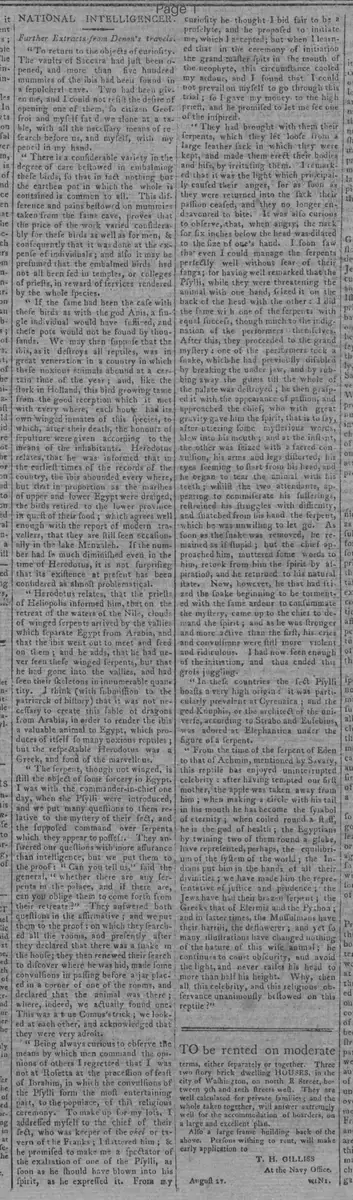
"To return to the objects of curiosity. The vaults of Saccara had just been opened, and more than five hundred mummies of the ibis had been found in a sepulchral cave. Two had been given me, and I could not resist the desire of opening one of them, so citizen Geo. from myself sat down alone at a table, with all the necessary means of research before us, and myself, with my pencil in my hand.
"There is a considerable variety in the degree of care bestowed in embalming these birds, so that in fact nothing but the earthen pot in which the whole is contained is common to all. This difference and pains bestowed on mummies taken from the same cave, proves that the price of the work varied considerably for these birds as well as for men, & consequently that it was done at the expense of individuals: and also it may be presumed that the embalmed birds had not all been fed in temples, or colleges of priests, in reward of services rendered by the whole species.
"If the same had been the case with these birds as with the god Apis, a single individual would have sufficed, and these pots would not be found by thousands. We may then suppose that the ibis, as it destroys all reptiles, was in great veneration in a country in which these noxious animals abound at a certain time of the year; and, like the stork in Holland, this bird growing tame from the good reception which it met with every where, each house had its own winged inmates of this species, to which, after their death, the honours of sepulture were given according to the means of the inhabitants. Herodotus relates, that he was informed that in the earliest times of the records of the country, the ibis abounded every where, but that in proportion as the marshes of upper and lower Egypt were drained, the birds retired to the lower province in quest of their food; which agrees well enough with the report of modern travellers, that they are still seen occasionally in the lake Menzaleh. If the number had so much diminished even in the time of Herodotus, it is not surprising that its existence at present has been considered as almost problematical.
"Herodotus relates, that the priests of Heliopolis informed him, that on the retreat of the waters of the Nile, clouds of winged serpents arrived by the vallies which separate Egypt from Arabia, and that the ibis went out to meet and feed on them; and he adds, that he had never seen these winged serpents, but that he had gone into the vallies, and had seen their skeletons in innumerable quantity. I think (with submission to the patriarch of history) that it was not necessary to create this fable of dragons from Arabia, in order to render the ibis a valuable animal to Egypt, which produces of itself so many noxious reptiles; but the respectable Herodotus was a Greek, and fond of the marvellous.
"The serpent, though not winged, is still the object of some sorcery in Egypt. I was with the commander-in-chief one day, when the Psylli were introduced, and we put many questions to them relative to the mystery of their sect, and the supposed command over serpents which they appear to possess. They answered our questions with more assurance than intelligence, but we put them to the proof: "Can you tell us," said the general, "whether there are any serpents in the palace, and if there are, can you oblige them to come forth from their retreats?" They answered both questions in the affirmative; and we put them to the proof: on which they searched all the rooms, and presently after they declared that there was a snake in the house: they then renewed their search to discover where he was hid, made some convulsions in passing before a jar placed in a corner of one of the rooms, and declared that the animal was there; where, indeed, we actually found one. This was a true Comus's trick; we looked at each other, and acknowledged that they were very adroit.
"Being always curious to observe the means by which men command the opinions of others I regretted that I was not at Rosetta at the procession of feast of Ibrahim, in which the convulsions of the Psylli form the most entertaining part, to the populace, of this religious ceremony. To make up for my loss, I addressed myself to the chief of their sect, who was keeper of the hotel or tavern of the Franks; I flattered him; & he promised to make me a spectator of the exaltation of one of the Psylli, as soon as he should have blown into his spirit, as he expressed it. From my
Curiosity he thought I bid fair to be a proselyte, and he proposed to initiate me, which I accepted; but when I learned that in the ceremony of initiation the grand master spits in the mouth of the neophyte, this circumstance cooled my ardour, and I found that I could not prevail on myself to go through this trial; so I gave my money to the high priest, and he promised to let me see one of the inspired.
"They had brought with them their serpents, which they let loose from a large leather sack in which they were kept, and made them erect their bodies and hiss, by irritating them. I remarked that it was the light which principally caused their anger, or as soon as they were returned into the sack their passion ceased, and they no longer endeavoured to bite. It was also curious to observe, that, when angry, the neck or six inches below the head was dilated to the size of one's hand. I soon saw that even I could manage the serpents perfectly well without fear of their fangs; for having well remarked that the Psylli, while they were threatening the animal with one hand, seized it on the back of the head with the other: I did the same with one of the serpents with equal success, though much to the indignation of the performers themselves.
After this, they proceeded to the grand mystery: one of the performers took a snake, which he had previously disabled by breaking the under jaw, and by rubbing away the gums till the whole of the palate was destroyed; he then grasped it with the appearance of passion, and approached the chief, who with great gravity gave him the spirit, that is to say, after muttering some mysterious words, blew into his mouth; and at the instant, the other was seized with a sacred convulsion, his arms and legs distorted, his eyes seeming to start from his head, and he began to tear the animal with his teeth; whilst the two attendants, appearing to commiserate his sufferings, restrained his struggles with difficulty, and snatched from his hand the serpent, which he was unwilling to let go. As soon as the snake was removed, he remained as if stupid; but the chief approached him, muttered some words to him, retook from him the spirit by aspiration, and he returned to his natural state. Now, however, he that had seized the snake beginning to be tormented with the same ardour to consummate the mystery, came up to the chief to demand the spirit; and as he was stronger and more active than the first, his cries and convulsions were still more violent and ridiculous. I had now seen enough of the initiation, and thus ended this gross juggling
"In these countries the Psylli boast a very high origin: it was particularly prevalent at Cyrenaica; and the god Knuphis, or the architect of the universe, according to Strabo and Eusebius, was adored at Elephantina under the figure of a serpent.
"From the time of the serpent of Eden to that of Achmin, mentioned by Savary, this reptile has enjoyed uninterrupted celebrity: after having tempted our first mother, the apple was taken away from him; when making a circle with his tail in his mouth he has become the symbol of eternity; when coiled round a staff, he is the god of health; the Egyptians by twining two of them round a globe, have represented, perhaps, the equilibrium of the system of the world; the Indians put him in the hands of all their divinities; we have made him the representative of justice and prudence; the Jews have had their brazen serpent: the Greeks that of Hermes and the Python; and in latter times, the Mussulmans have their harpy, the destroyer; and yet so many illustrations have changed nothing of the nature of this wise animal; he continues to court obscurity, and avoid the light, and never raises his head to more than half his height. Why, then all this celebrity, and this religious observance unanimously bestowed on this reptile?"
Further Extracts from Denon's travels.
"To return to the objects of curiosity. The vaults of Saccara had just been opened, and more than five hundred mummies of the ibis had been found in a sepulchral cave. Two had been given me, and I could not resist the desire of opening one of them, so citizen Geo. from myself sat down alone at a table, with all the necessary means of research before us, and myself, with my pencil in my hand.
"There is a considerable variety in the degree of care bestowed in embalming these birds, so that in fact nothing but the earthen pot in which the whole is contained is common to all. This difference and pains bestowed on mummies taken from the same cave, proves that the price of the work varied considerably for these birds as well as for men, & consequently that it was done at the expense of individuals: and also it may be presumed that the embalmed birds had not all been fed in temples, or colleges of priests, in reward of services rendered by the whole species.
"If the same had been the case with these birds as with the god Apis, a single individual would have sufficed, and these pots would not be found by thousands. We may then suppose that the ibis, as it destroys all reptiles, was in great veneration in a country in which these noxious animals abound at a certain time of the year; and, like the stork in Holland, this bird growing tame from the good reception which it met with every where, each house had its own winged inmates of this species, to which, after their death, the honours of sepulture were given according to the means of the inhabitants. Herodotus relates, that he was informed that in the earliest times of the records of the country, the ibis abounded every where, but that in proportion as the marshes of upper and lower Egypt were drained, the birds retired to the lower province in quest of their food; which agrees well enough with the report of modern travellers, that they are still seen occasionally in the lake Menzaleh. If the number had so much diminished even in the time of Herodotus, it is not surprising that its existence at present has been considered as almost problematical.
"Herodotus relates, that the priests of Heliopolis informed him, that on the retreat of the waters of the Nile, clouds of winged serpents arrived by the vallies which separate Egypt from Arabia, and that the ibis went out to meet and feed on them; and he adds, that he had never seen these winged serpents, but that he had gone into the vallies, and had seen their skeletons in innumerable quantity. I think (with submission to the patriarch of history) that it was not necessary to create this fable of dragons from Arabia, in order to render the ibis a valuable animal to Egypt, which produces of itself so many noxious reptiles; but the respectable Herodotus was a Greek, and fond of the marvellous.
"The serpent, though not winged, is still the object of some sorcery in Egypt. I was with the commander-in-chief one day, when the Psylli were introduced, and we put many questions to them relative to the mystery of their sect, and the supposed command over serpents which they appear to possess. They answered our questions with more assurance than intelligence, but we put them to the proof: "Can you tell us," said the general, "whether there are any serpents in the palace, and if there are, can you oblige them to come forth from their retreats?" They answered both questions in the affirmative; and we put them to the proof: on which they searched all the rooms, and presently after they declared that there was a snake in the house: they then renewed their search to discover where he was hid, made some convulsions in passing before a jar placed in a corner of one of the rooms, and declared that the animal was there; where, indeed, we actually found one. This was a true Comus's trick; we looked at each other, and acknowledged that they were very adroit.
"Being always curious to observe the means by which men command the opinions of others I regretted that I was not at Rosetta at the procession of feast of Ibrahim, in which the convulsions of the Psylli form the most entertaining part, to the populace, of this religious ceremony. To make up for my loss, I addressed myself to the chief of their sect, who was keeper of the hotel or tavern of the Franks; I flattered him; & he promised to make me a spectator of the exaltation of one of the Psylli, as soon as he should have blown into his spirit, as he expressed it. From my
Curiosity he thought I bid fair to be a proselyte, and he proposed to initiate me, which I accepted; but when I learned that in the ceremony of initiation the grand master spits in the mouth of the neophyte, this circumstance cooled my ardour, and I found that I could not prevail on myself to go through this trial; so I gave my money to the high priest, and he promised to let me see one of the inspired.
"They had brought with them their serpents, which they let loose from a large leather sack in which they were kept, and made them erect their bodies and hiss, by irritating them. I remarked that it was the light which principally caused their anger, or as soon as they were returned into the sack their passion ceased, and they no longer endeavoured to bite. It was also curious to observe, that, when angry, the neck or six inches below the head was dilated to the size of one's hand. I soon saw that even I could manage the serpents perfectly well without fear of their fangs; for having well remarked that the Psylli, while they were threatening the animal with one hand, seized it on the back of the head with the other: I did the same with one of the serpents with equal success, though much to the indignation of the performers themselves.
After this, they proceeded to the grand mystery: one of the performers took a snake, which he had previously disabled by breaking the under jaw, and by rubbing away the gums till the whole of the palate was destroyed; he then grasped it with the appearance of passion, and approached the chief, who with great gravity gave him the spirit, that is to say, after muttering some mysterious words, blew into his mouth; and at the instant, the other was seized with a sacred convulsion, his arms and legs distorted, his eyes seeming to start from his head, and he began to tear the animal with his teeth; whilst the two attendants, appearing to commiserate his sufferings, restrained his struggles with difficulty, and snatched from his hand the serpent, which he was unwilling to let go. As soon as the snake was removed, he remained as if stupid; but the chief approached him, muttered some words to him, retook from him the spirit by aspiration, and he returned to his natural state. Now, however, he that had seized the snake beginning to be tormented with the same ardour to consummate the mystery, came up to the chief to demand the spirit; and as he was stronger and more active than the first, his cries and convulsions were still more violent and ridiculous. I had now seen enough of the initiation, and thus ended this gross juggling
"In these countries the Psylli boast a very high origin: it was particularly prevalent at Cyrenaica; and the god Knuphis, or the architect of the universe, according to Strabo and Eusebius, was adored at Elephantina under the figure of a serpent.
"From the time of the serpent of Eden to that of Achmin, mentioned by Savary, this reptile has enjoyed uninterrupted celebrity: after having tempted our first mother, the apple was taken away from him; when making a circle with his tail in his mouth he has become the symbol of eternity; when coiled round a staff, he is the god of health; the Egyptians by twining two of them round a globe, have represented, perhaps, the equilibrium of the system of the world; the Indians put him in the hands of all their divinities; we have made him the representative of justice and prudence; the Jews have had their brazen serpent: the Greeks that of Hermes and the Python; and in latter times, the Mussulmans have their harpy, the destroyer; and yet so many illustrations have changed nothing of the nature of this wise animal; he continues to court obscurity, and avoid the light, and never raises his head to more than half his height. Why, then all this celebrity, and this religious observance unanimously bestowed on this reptile?"
What sub-type of article is it?
Essay
What themes does it cover?
Religious
Nature
What keywords are associated?
Egypt
Mummies
Ibis
Herodotus
Psylli
Serpents
Embalming
Rituals
What entities or persons were involved?
Denon
Literary Details
Title
Further Extracts From Denon's Travels
Author
Denon
Subject
Observations On Egyptian Mummies, Ibis Veneration, And Psylli Serpent Rituals
Key Lines
"The Ibis, As It Destroys All Reptiles, Was In Great Veneration In A Country In Which These Noxious Animals Abound At A Certain Time Of The Year"
"Herodotus Was A Greek, And Fond Of The Marvellous."
"This Was A True Comus's Trick; We Looked At Each Other, And Acknowledged That They Were Very Adroit."
"I Soon Saw That Even I Could Manage The Serpents Perfectly Well Without Fear Of Their Fangs"
"Why, Then All This Celebrity, And This Religious Observance Unanimously Bestowed On This Reptile?"