Thank you for visiting SNEWPapers!
Sign up free
Letter to Editor
April 1, 1826
Phenix Gazette
Alexandria, Virginia
What is this article about?
A speculative letter proposing improvements to balloons for human aerial navigation, including artificial wings for propulsion like birds, and using upper atmospheric layers for stationary observation or rapid westward travel around the Earth.
Clipping
OCR Quality
95%
Excellent
Full Text
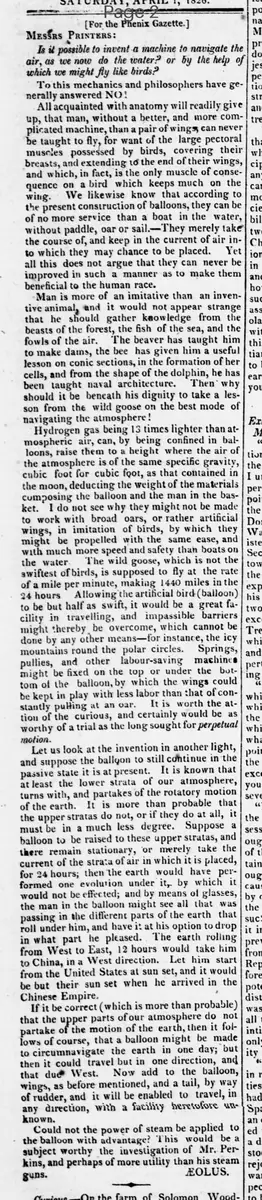
[For the Phenix Gazette.]
Messrs. Printers:
Is it possible to invent a machine to navigate the air, as we now do the water? or by the help of which we might fly like birds?
To this mechanics and philosophers have generally answered NO!
All acquainted with anatomy will readily give up, that man, without a better, and more complicated machine, than a pair of wings can never be taught to fly, for want of the large pectoral muscles possessed by birds, covering their breasts, and extending to the end of their wings, and which, in fact, is the only muscle of consequence on a bird which keeps much on the wing.
We likewise know that according to the present construction of balloons, they can be of no more service than a boat in the water, without paddle, oar or sail. They merely take the course of, and keep in the current of air into which they may chance to be placed.
Yet all this does not argue that they can never be improved in such a manner as to make them beneficial to the human race.
Man is more of an imitative than an inventive animal, and it would not appear strange that he should gather knowledge from the beasts of the forest, the fish of the sea, and the fowls of the air. The beaver has taught him to make dams, the bee has given him a useful lesson on conic sections, in the formation of her cells, and from the shape of the dolphin, he has been taught naval architecture. Then why should it be beneath his dignity to take a lesson from the wild goose on the best mode of navigating the atmosphere!
Hydrogen gas being 13 times lighter than atmospheric air, can, by being confined in balloons, raise them to a height where the air of the atmosphere is of the same specific gravity, cubic foot for cubic foot, as that contained in the balloon, deducting the weight of the materials composing the balloon and the man in the basket. I do not see why they might not be made to work with broad oars, or rather artificial wings, in imitation of birds, by which they might be propelled with the same ease, and with much more speed and safety than boats on the water. The wild goose, which is not the swiftest of birds, is supposed to fly at the rate of a mile per minute, making 1440 miles in the 24 hours. Allowing the artificial bird (balloon) to be but half as swift, it would be a great facility in travelling, and impassible barriers might thereby be overcome, which cannot be done by any other means-for instance, the icy mountains round the polar circles. Springs, pullies, and other labour-saving machine might be fixed on the top or under the bottom of the balloon, by which the wings could be kept in play with less labor than that of constantly pulling at an oar. It is worth the attention of the curious, and certainly would be as worthy of a trial as the long sought for perpetual motion.
Let us look at the invention in another light, and suppose the balloon to still continue in the passive state it is at present. It is known that at least the lower strata of our atmosphere, turns with, and partakes of the rotatory motion of the earth. It is more than probable that the upper stratas do not, or if they do at all, it must be in a much less degree. Suppose a balloon to be raised to these upper stratas, and there remain stationary, or merely take the current of the strata of air in which it is placed, for 24 hours; then the earth would have performed one evolution under it. by which it would not be affected; and by means of glasses, the man in the balloon might see all that was passing in the different parts of the earth that roll under him, and have it at his option to drop in what part he pleased. The earth rolling from West to East, 12 hours would take him to China, in a West direction. Let him start from the United States at sun set, and it would be but their sun set when he arrived in the Chinese Empire.
If it be correct (which is more than probable) that the upper parts of our atmosphere do not partake of the motion of the earth, then it follows of course, that a balloon might be made to circumnavigate the earth in one day; but then it could travel but in one direction, and that due West. Now add to the balloon, wings, as before mentioned, and a tail, by way of rudder, and it will be enabled to travel, in any direction, with facility heretoore unknown.
Could not the power of steam be applied to the balloon with advantage? This would be a subject worthy the investigation of Mr. Perkins, and perhaps of more utility than his steam guns.
EOLUS.
Messrs. Printers:
Is it possible to invent a machine to navigate the air, as we now do the water? or by the help of which we might fly like birds?
To this mechanics and philosophers have generally answered NO!
All acquainted with anatomy will readily give up, that man, without a better, and more complicated machine, than a pair of wings can never be taught to fly, for want of the large pectoral muscles possessed by birds, covering their breasts, and extending to the end of their wings, and which, in fact, is the only muscle of consequence on a bird which keeps much on the wing.
We likewise know that according to the present construction of balloons, they can be of no more service than a boat in the water, without paddle, oar or sail. They merely take the course of, and keep in the current of air into which they may chance to be placed.
Yet all this does not argue that they can never be improved in such a manner as to make them beneficial to the human race.
Man is more of an imitative than an inventive animal, and it would not appear strange that he should gather knowledge from the beasts of the forest, the fish of the sea, and the fowls of the air. The beaver has taught him to make dams, the bee has given him a useful lesson on conic sections, in the formation of her cells, and from the shape of the dolphin, he has been taught naval architecture. Then why should it be beneath his dignity to take a lesson from the wild goose on the best mode of navigating the atmosphere!
Hydrogen gas being 13 times lighter than atmospheric air, can, by being confined in balloons, raise them to a height where the air of the atmosphere is of the same specific gravity, cubic foot for cubic foot, as that contained in the balloon, deducting the weight of the materials composing the balloon and the man in the basket. I do not see why they might not be made to work with broad oars, or rather artificial wings, in imitation of birds, by which they might be propelled with the same ease, and with much more speed and safety than boats on the water. The wild goose, which is not the swiftest of birds, is supposed to fly at the rate of a mile per minute, making 1440 miles in the 24 hours. Allowing the artificial bird (balloon) to be but half as swift, it would be a great facility in travelling, and impassible barriers might thereby be overcome, which cannot be done by any other means-for instance, the icy mountains round the polar circles. Springs, pullies, and other labour-saving machine might be fixed on the top or under the bottom of the balloon, by which the wings could be kept in play with less labor than that of constantly pulling at an oar. It is worth the attention of the curious, and certainly would be as worthy of a trial as the long sought for perpetual motion.
Let us look at the invention in another light, and suppose the balloon to still continue in the passive state it is at present. It is known that at least the lower strata of our atmosphere, turns with, and partakes of the rotatory motion of the earth. It is more than probable that the upper stratas do not, or if they do at all, it must be in a much less degree. Suppose a balloon to be raised to these upper stratas, and there remain stationary, or merely take the current of the strata of air in which it is placed, for 24 hours; then the earth would have performed one evolution under it. by which it would not be affected; and by means of glasses, the man in the balloon might see all that was passing in the different parts of the earth that roll under him, and have it at his option to drop in what part he pleased. The earth rolling from West to East, 12 hours would take him to China, in a West direction. Let him start from the United States at sun set, and it would be but their sun set when he arrived in the Chinese Empire.
If it be correct (which is more than probable) that the upper parts of our atmosphere do not partake of the motion of the earth, then it follows of course, that a balloon might be made to circumnavigate the earth in one day; but then it could travel but in one direction, and that due West. Now add to the balloon, wings, as before mentioned, and a tail, by way of rudder, and it will be enabled to travel, in any direction, with facility heretoore unknown.
Could not the power of steam be applied to the balloon with advantage? This would be a subject worthy the investigation of Mr. Perkins, and perhaps of more utility than his steam guns.
EOLUS.
What sub-type of article is it?
Informative
Philosophical
Persuasive
What themes does it cover?
Science Nature
What keywords are associated?
Aerial Navigation
Balloons
Artificial Wings
Hydrogen Gas
Atmospheric Layers
Bird Imitation
Steam Application
What entities or persons were involved?
Eolus.
Messrs. Printers
Letter to Editor Details
Author
Eolus.
Recipient
Messrs. Printers
Main Argument
balloons can be improved with artificial wings, oars, and mechanisms to enable propulsion and navigation like birds, allowing faster and safer aerial travel; upper atmospheric layers, not rotating with earth, could facilitate stationary observation or rapid westward circumnavigation.
Notable Details
References Bird Anatomy And Pectoral Muscles
Cites Hydrogen Gas Properties
Proposes Speed Of Wild Goose At 1 Mile Per Minute
Suggests Using Atmospheric Rotation Differences For Travel
Mentions Applying Steam Power, Referencing Mr. Perkins