Thank you for visiting SNEWPapers!
Sign up free
Alexandria Daily Advertiser
Alexandria, Virginia
What is this article about?
In the US House of Representatives on January 6, Mr. Findley defends a motion by Mr. Randolph to appoint a committee inquiring into Justice Samuel Chase's official conduct, arguing its necessity for impeachment powers, citing precedents and public loss of confidence in Chase.
Merged-components note: Continuation of the congressional debate story across sequential components on the same page.
Clipping
OCR Quality
Full Text
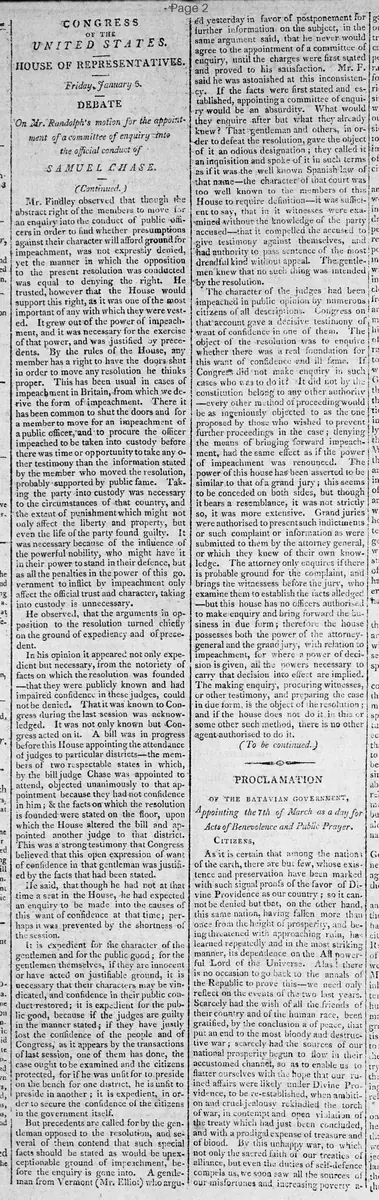
OF THE
UNITED STATES.
HOUSE OF REPRESENTATIVES.
Friday, January 6.
DEBATE
On Mr. Randolph's motion for the appointment of a committee of enquiry into the official conduct of SAMUEL CHASE.
(Continued.)
Mr. Findley observed that though the abstract right of the members to move for an enquiry into the conduct of public officers in order to find whether presumptions against their character will afford ground for impeachment, was not expressly denied, yet the manner in which the opposition to the present resolution was conducted was equal to denying the right. He trusted, however that the House would support this right, as it was one of the most important of any with which they were vested. It grew out of the power of impeachment, and it was necessary for the exercise of that power, and was justified by precedents. By the rules of the House, any member has a right to have the doors shut in order to move any resolution he thinks proper. This has been usual in cases of impeachment in Britain, from which we derive the form of impeachment. There it has been common to shut the doors and for a member to move for an impeachment of a public officer, and to procure the officer impeached to be taken into custody before there was time or opportunity to take any other testimony than the information stated by the member who moved the resolution, probably supported by public fame. Taking the party into custody was necessary to the circumstances of that country, and the extent of punishment which might not only affect the liberty and property, but even the life of the party found guilty. It was necessary because of the influence of the powerful nobility, who might have it in their power to stand in their defence, but as all the penalties in the power of this government to inflict by impeachment only affect the official trust and character, taking into custody is unnecessary.
He observed, that the arguments in opposition to the resolution turned chiefly on the ground of expediency and of precedent.
In his opinion it appeared not only expedient but necessary, from the notoriety of facts on which the resolution was founded—that they were publicly known and had impaired confidence in these judges, could not be denied. That it was known to Congress during the last session was acknowledged. It was not only known but Congress acted on it. A bill was in progress before this House appointing the attendance of judges to particular districts—the members of two respectable states in which, by the bill judge Chase was appointed to attend, objected unanimously to that appointment because they had not confidence in him; & the facts on which the resolution is founded were stated on the floor, upon which the House altered the bill and appointed another judge to that district.
This was a strong testimony that Congress believed that this open expression of want of confidence in that gentleman was justified by the facts that had been stated.
He said, that though he had not at that time a seat in the House, he had expected an enquiry to be made into the causes of this want of confidence at that time; perhaps it was prevented by the shortness of the session.
It is expedient for the character of the gentlemen and for the public good; for the gentlemen themselves, if they are innocent or have acted on justifiable ground, it is necessary that their characters may be vindicated, and confidence in their public conduct restored; it is expedient for the public good, because if the judges are guilty in the manner stated; if they have justly lost the confidence of the people and of Congress, as it appears by the transactions of last session, one of them has done, the case ought to be examined and the citizens protected, for if he was unfit to preside on the bench for one district, he is unfit to preside in another; it is expedient, in order to secure the confidence of the citizens in the government itself.
But precedents are called for by the gentleman opposed to the resolution, and several of them contend that such special facts should be stated as would be unexceptionable ground of impeachment, before the enquiry is gone into. A gentleman from Vermont (Mr. Elliot) who argued yesterday in favor of postponement for further information on the subject, in the same argument said, that he never would agree to the appointment of a committee of enquiry, until the charges were first stated and proved to his satisfaction. Mr. F. said he was astonished at this inconsistency. If the facts were first stated and established, appointing a committee of enquiry would be an absurdity. What would they enquire after but what they already knew? That gentleman and others, in order to defeat the resolution, gave the object of it an odious designation; they called it an inquisition and spoke of it in such terms as if it was the well known Spanish law of that name—the character of that court was too well known to the members of this House to require definition—it was sufficient to say, that in it witnesses were examined without the knowledge of the party accused—that it compelled the accused to give testimony against themselves, and had authority to pass sentence of the most dreadful kind without appeal. The gentlemen knew that no such thing was intended by the resolution.
The character of the judges had been impeached in public opinion by numerous citizens of all descriptions. Congress on that account gave a decisive testimony of want of confidence in one of them. The object of the resolution was to enquire whether there was a real foundation for this want of confidence and ill fame. If Congress did not make enquiry in such cases who was to do it? It did not by the constitution belong to any other authority—every other method of proceeding would be as ingeniously objected to as the one proposed by those who wished to prevent further proceedings in the case; denying the means of bringing forward impeachment, had the same effect as if the power of impeachment was renounced. The power of this house has been asserted to be similar to that of a grand jury; this seems to be conceded on both sides, but though it bears a resemblance, it was not strictly so, it was more extensive. Grand juries were authorised to present such indictments or such complaint or information as were submitted to them by the attorney general, or which they knew of their own knowledge. The attorney only enquires if there is probable ground for the complaint, and brings the witnesses before the jury, who examine them to establish the facts alledged—but this house has no officers authorised to make enquiry and bring forward the business in due form; therefore the house possesses both the power of the attorney-general and the grand jury, with relation to impeachment, for where a power of decision is given, all the powers necessary to carry that decision into effect are implied.
The making enquiry, procuring witnesses, or other testimony, and preparing the case in due form, is the object of the resolution; and if the house does not do it in this or some other such method, there is no other agent authorised to do it.
(To be continued.)
What sub-type of article is it?
What themes does it cover?
What keywords are associated?
What entities or persons were involved?
Where did it happen?
Story Details
Key Persons
Location
House Of Representatives, United States Congress
Event Date
Friday, January 6
Story Details
Mr. Findley argues in favor of appointing a committee to investigate Justice Samuel Chase's conduct, emphasizing the House's impeachment powers, precedents from Britain, public loss of confidence evidenced by prior congressional action, and the necessity for vindication or accountability to restore trust in the judiciary and government.