Thank you for visiting SNEWPapers!
Sign up free
Daily National Intelligencer
Washington, District Of Columbia
What is this article about?
Historical anecdote from Wraxall's Memoirs: In the late reign of George II, Lord Falmouth demanded the Order of the Garter from William Pitt, threatening to withdraw parliamentary support. Pitt refused and quoted Horace's Latin, which Falmouth misunderstood as an insult from Horace Walpole, leading to embarrassment.
Clipping
OCR Quality
Full Text
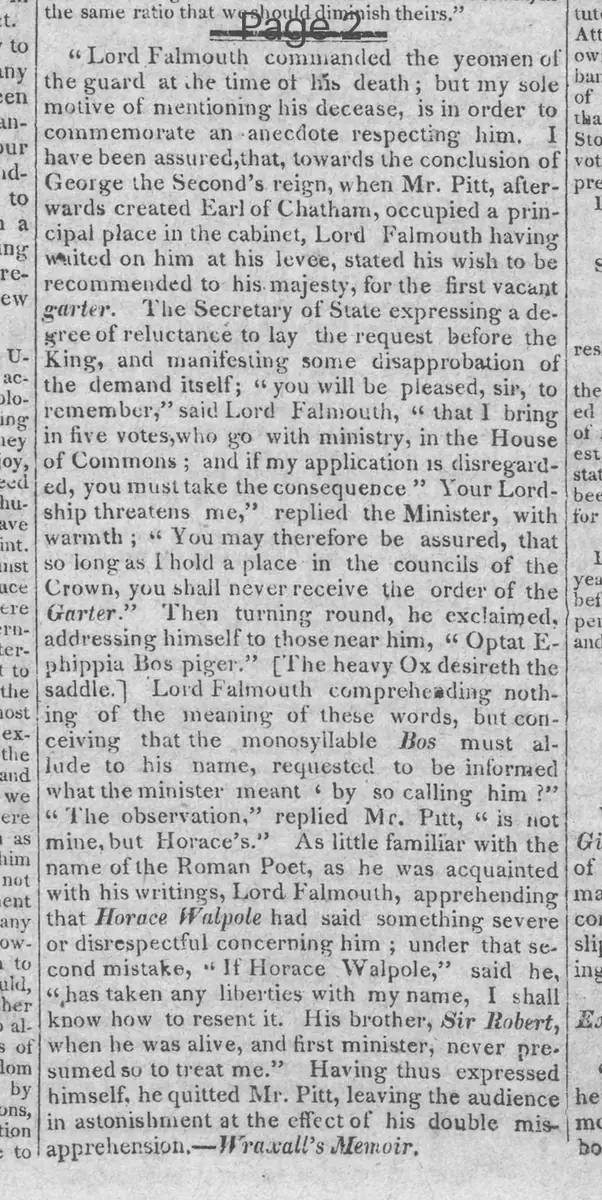
The Secretary of State expressing a degree of reluctance to lay the request before the King, and manifesting some disapprobation of the demand itself; "you will be pleased, sir, to remember," said Lord Falmouth, "that I bring in five votes, who go with ministry, in the House of Commons; and if my application is disregarded, you must take the consequence." "Your Lordship threatens me," replied the Minister, with warmth; "You may therefore be assured, that so long as I hold a place in the councils of the Crown, you shall never receive the order of the Garter." Then turning round, he exclaimed, addressing himself to those near him, "Optat Epippia Bos piger." [The heavy Ox desireth the saddle.]
Lord Falmouth comprehending nothing of the meaning of these words, but conceiving that the monosyllable Bos must allude to his name, requested to be informed what the minister meant by so calling him? "The observation," replied Mr. Pitt, "is not mine, but Horace's." As little familiar with the name of the Roman Poet, as he was acquainted with his writings, Lord Falmouth, apprehending that Horace Walpole had said something severe or disrespectful concerning him; under that second mistake, "If Horace Walpole," said he, "has taken any liberties with my name, I shall know how to resent it. His brother, Sir Robert, when he was alive, and first minister, never presumed so to treat me."
Having thus expressed himself, he quitted Mr. Pitt, leaving the audience in astonishment at the effect of his double misapprehension.—Wraxall's Memoir.
What sub-type of article is it?
What themes does it cover?
What keywords are associated?
What entities or persons were involved?
Where did it happen?
Story Details
Key Persons
Location
At Mr. Pitt's Levee
Event Date
Towards The Conclusion Of George The Second's Reign
Story Details
Lord Falmouth requests the Order of the Garter from William Pitt, threatens with loss of five parliamentary votes; Pitt refuses and quotes Horace's Latin 'Optat Epippia Bos piger,' which Falmouth misinterprets as an insult from Horace Walpole, leading to further embarrassment and his indignant departure.