Thank you for visiting SNEWPapers!
Sign up free
Story
January 12, 1930
Douglas Daily Dispatch
Douglas, Cochise County, Arizona
What is this article about?
Historical article on tipping in U.S. service industries, focusing on waitresses in Douglas cafes earning $40-$50/month from tips, surpassing some white-collar workers and challenging social class perceptions. (187 chars)
Clipping
OCR Quality
98%
Excellent
Full Text
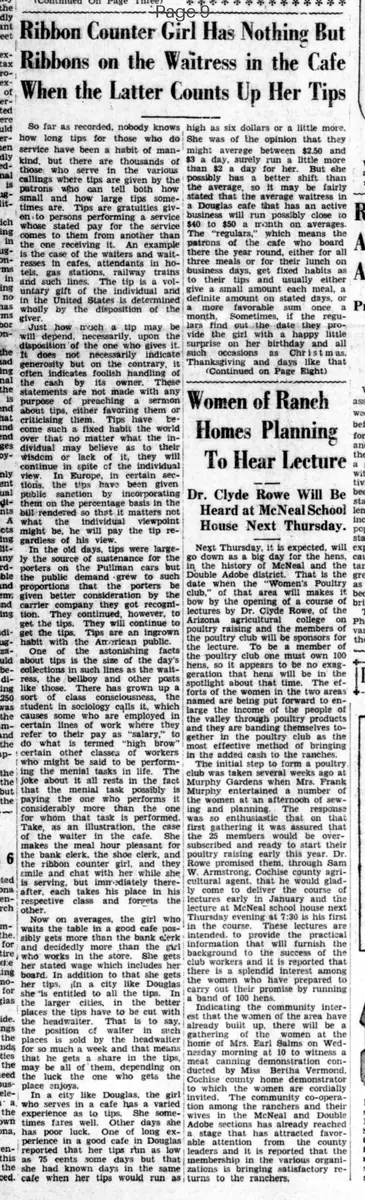
Ribbon Counter Girl Has Nothing But Ribbons on the Waitress in the Cafe When the Latter Counts Up Her Tips
So far as recorded, nobody knows how long tips for those who do service have been a habit of mankind, but there are thousands of those who serve in the various callings where tips are given by the patrons who can tell both how small and how large tips sometimes are. Tips are gratuities given to persons performing a service whose stated pay for the service comes to them from another than the one receiving it. An example is the case of the waiters and waitresses in cafes, attendants in hotels, gas stations, railway trains and such lines. The tip is a voluntary gift of the individual and in the United States is determined wholly by the disposition of the giver.
Just how much a tip may be will depend, necessarily, upon the disposition of the one who gives it. It does not necessarily indicate generosity but on the contrary, it often indicates foolish handling of the cash by its owner. These statements are not made with any purpose of preaching a sermon about tips, either favoring them or criticising them. Tips have become such a fixed habit the world over that no matter what the individual may believe as to their wisdom or lack of it, they will continue in spite of the individual view. In Europe, in certain sections, the tips have been given public sanction by incorporating them on the percentage basis in the bill rendered so that it matters not what the individual viewpoint might be, he will pay the tip regardless of his view.
In the old days, tips were largely the source of sustenance for the porters on the Pullman cars but the public demand grew to such proportions that the porters be given better consideration by the carrier company they got recognition. They continued, however, to get the tips. They will continue to get the tips. Tips are an ingrown habit with the American public.
One of the astonishing facts about tips is the size of the day's collections in such lines as the waitress, the bellboy and other posts like those. There has grown up a sort of class consciousness, the student in sociology calls it, which causes some who are employed in certain lines of work where they refer to their pay as "salary," to do what is termed "high brow" certain other classes of workers who might be said to be performing the menial tasks in life. The joke about it all rests in the fact that the menial task possibly is paying the one who performs it considerably more than the one for whom that task is performed.
Take, as an illustration, the case of the waiter in the cafe. She makes the meal hour pleasant for the bank clerk, the shoe clerk, and the ribbon counter girl, and they smile and chat with her while she is serving, but immediately thereafter, each takes his place in his respective class and forgets the other.
Now on averages, the girl who waits the table in a good cafe possibly gets more than the bank clerk and decidedly more than the girl who works in the store. She gets her stated wage which includes her board. In addition to that she gets her tips. In a city like Douglas she is entitled to all the tips. In the larger cities, in the better places the tips have to be cut with the headwaiter. That is to say, the position of waiter in such places is sold by the headwaiter for so much a week and that means that he gets a share in the tips, may be all of them, depending on the luck the one who gets the place enjoys.
In a city like Douglas, the girl who serves in a cafe has a varied experience as to tips. She sometimes fares well. Other days she has poor luck. One of long experience in a good cafe in Douglas reported that her tips run as low as 75 cents some days but that she had known days in the same cafe when her tips would run as high as six dollars or a little more.
She was of the opinion that they might average between $2.50 and $3 a day, surely run a little more than $2 a day for her. But she possibly has a better shift than the average, so it may be fairly stated that the average waitress in a Douglas cafe that has an active business will run possibly close to $40 to $50 a month on averages.
The "regulars," which means the patrons of the cafe who board there the year round, either for all three meals or for their lunch on business days, get fixed habits as to their tips and usually either give a small amount each meal, a definite amount on stated days, or a more favorable sum once a month. Sometimes, if the regulars find out the date they provide the girl with a happy little surprise on her birthday and all such occasions as Christmas, Thanksgiving and days like that
(Continued on Page Eight)
So far as recorded, nobody knows how long tips for those who do service have been a habit of mankind, but there are thousands of those who serve in the various callings where tips are given by the patrons who can tell both how small and how large tips sometimes are. Tips are gratuities given to persons performing a service whose stated pay for the service comes to them from another than the one receiving it. An example is the case of the waiters and waitresses in cafes, attendants in hotels, gas stations, railway trains and such lines. The tip is a voluntary gift of the individual and in the United States is determined wholly by the disposition of the giver.
Just how much a tip may be will depend, necessarily, upon the disposition of the one who gives it. It does not necessarily indicate generosity but on the contrary, it often indicates foolish handling of the cash by its owner. These statements are not made with any purpose of preaching a sermon about tips, either favoring them or criticising them. Tips have become such a fixed habit the world over that no matter what the individual may believe as to their wisdom or lack of it, they will continue in spite of the individual view. In Europe, in certain sections, the tips have been given public sanction by incorporating them on the percentage basis in the bill rendered so that it matters not what the individual viewpoint might be, he will pay the tip regardless of his view.
In the old days, tips were largely the source of sustenance for the porters on the Pullman cars but the public demand grew to such proportions that the porters be given better consideration by the carrier company they got recognition. They continued, however, to get the tips. They will continue to get the tips. Tips are an ingrown habit with the American public.
One of the astonishing facts about tips is the size of the day's collections in such lines as the waitress, the bellboy and other posts like those. There has grown up a sort of class consciousness, the student in sociology calls it, which causes some who are employed in certain lines of work where they refer to their pay as "salary," to do what is termed "high brow" certain other classes of workers who might be said to be performing the menial tasks in life. The joke about it all rests in the fact that the menial task possibly is paying the one who performs it considerably more than the one for whom that task is performed.
Take, as an illustration, the case of the waiter in the cafe. She makes the meal hour pleasant for the bank clerk, the shoe clerk, and the ribbon counter girl, and they smile and chat with her while she is serving, but immediately thereafter, each takes his place in his respective class and forgets the other.
Now on averages, the girl who waits the table in a good cafe possibly gets more than the bank clerk and decidedly more than the girl who works in the store. She gets her stated wage which includes her board. In addition to that she gets her tips. In a city like Douglas she is entitled to all the tips. In the larger cities, in the better places the tips have to be cut with the headwaiter. That is to say, the position of waiter in such places is sold by the headwaiter for so much a week and that means that he gets a share in the tips, may be all of them, depending on the luck the one who gets the place enjoys.
In a city like Douglas, the girl who serves in a cafe has a varied experience as to tips. She sometimes fares well. Other days she has poor luck. One of long experience in a good cafe in Douglas reported that her tips run as low as 75 cents some days but that she had known days in the same cafe when her tips would run as high as six dollars or a little more.
She was of the opinion that they might average between $2.50 and $3 a day, surely run a little more than $2 a day for her. But she possibly has a better shift than the average, so it may be fairly stated that the average waitress in a Douglas cafe that has an active business will run possibly close to $40 to $50 a month on averages.
The "regulars," which means the patrons of the cafe who board there the year round, either for all three meals or for their lunch on business days, get fixed habits as to their tips and usually either give a small amount each meal, a definite amount on stated days, or a more favorable sum once a month. Sometimes, if the regulars find out the date they provide the girl with a happy little surprise on her birthday and all such occasions as Christmas, Thanksgiving and days like that
(Continued on Page Eight)
What sub-type of article is it?
Curiosity
What themes does it cover?
Social Manners
What keywords are associated?
Tipping Practices
Waitress Tips
Service Earnings
Class Consciousness
Douglas Cafe
Where did it happen?
Douglas
Story Details
Location
Douglas
Story Details
Article explores tipping customs in service roles, noting waitresses in Douglas cafes earn $40-$50 monthly from tips, often exceeding bank clerks or ribbon counter girls, despite class distinctions.