Thank you for visiting SNEWPapers!
Sign up free
Editorial
June 26, 1954
The Detroit Tribune
Detroit, Wayne County, Michigan
What is this article about?
Fritz Pollard's column reflects on racial integration in baseball, noting how opponents like Dixie Walker and Bobby Bragan, who resisted Jackie Robinson's 1947 breakthrough with the Dodgers, have faded into obscurity while integration succeeds.
Clipping
OCR Quality
95%
Excellent
Full Text
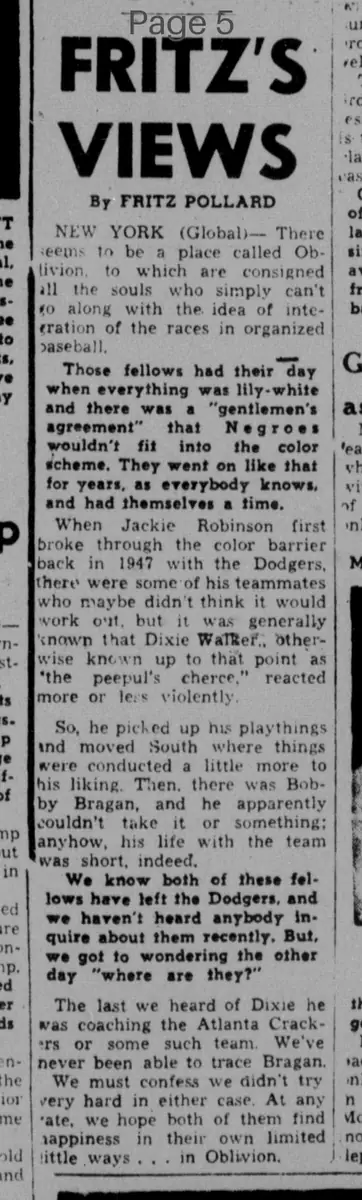
FRITZ'S VIEWS
By FRITZ POLLARD
NEW YORK (Global)— There seems to be a place called Oblivion, to which are consigned all the souls who simply can't go along with the idea of integration of the races in organized baseball.
Those fellows had their day when everything was lily-white and there was a "gentlemen's agreement" that Negroes wouldn't fit into the color scheme. They went on like that for years, as everybody knows, and had themselves a time.
When Jackie Robinson first broke through the color barrier back in 1947 with the Dodgers, there were some of his teammates who maybe didn't think it would work out, but it was generally known that Dixie Walker.. otherwise known up to that point as 'the people's choice." reacted more or less violently
So, he picked up his playthings and moved South where things were conducted a little more to his liking. Then, there was Bobby Bragan, and he apparently couldn't take it or something; anyhow, his life with the team was short, indeed.
We know both of these fellows have left the Dodgers, and we haven't heard anybody inquire about them recently. But, we got to wondering the other day "where are they?"
The last we heard of Dixie he was coaching the Atlanta Crackers or some such team. We've never been able to trace Bragan.
We must confess we didn't try very hard in either case. At any rate, we hope both of them find happiness in their own limited little ways . . . in Oblivion.
By FRITZ POLLARD
NEW YORK (Global)— There seems to be a place called Oblivion, to which are consigned all the souls who simply can't go along with the idea of integration of the races in organized baseball.
Those fellows had their day when everything was lily-white and there was a "gentlemen's agreement" that Negroes wouldn't fit into the color scheme. They went on like that for years, as everybody knows, and had themselves a time.
When Jackie Robinson first broke through the color barrier back in 1947 with the Dodgers, there were some of his teammates who maybe didn't think it would work out, but it was generally known that Dixie Walker.. otherwise known up to that point as 'the people's choice." reacted more or less violently
So, he picked up his playthings and moved South where things were conducted a little more to his liking. Then, there was Bobby Bragan, and he apparently couldn't take it or something; anyhow, his life with the team was short, indeed.
We know both of these fellows have left the Dodgers, and we haven't heard anybody inquire about them recently. But, we got to wondering the other day "where are they?"
The last we heard of Dixie he was coaching the Atlanta Crackers or some such team. We've never been able to trace Bragan.
We must confess we didn't try very hard in either case. At any rate, we hope both of them find happiness in their own limited little ways . . . in Oblivion.
What sub-type of article is it?
Social Reform
What keywords are associated?
Baseball Integration
Racial Barrier
Jackie Robinson
Dixie Walker
Bobby Bragan
Segregation Opposition
Color Line
What entities or persons were involved?
Fritz Pollard
Jackie Robinson
Dixie Walker
Bobby Bragan
Brooklyn Dodgers
Atlanta Crackers
Editorial Details
Primary Topic
Racial Integration In Organized Baseball
Stance / Tone
Supportive Of Integration, Dismissive Of Segregationists
Key Figures
Fritz Pollard
Jackie Robinson
Dixie Walker
Bobby Bragan
Brooklyn Dodgers
Atlanta Crackers
Key Arguments
Segregation In Baseball Relied On A 'Gentlemen's Agreement' Excluding Negroes
Jackie Robinson Broke The Color Barrier In 1947 With The Dodgers
Opponents Like Dixie Walker And Bobby Bragan Reacted Violently And Left The Team
Such Opponents Have Faded Into Obscurity Or 'Oblivion'
Integration Has Succeeded While Resisters Find Limited Happiness Elsewhere