Thank you for visiting SNEWPapers!
Sign up free
The National Republican And Ohio Political Register
Cincinnati, Hamilton County, Ohio
What is this article about?
The Annual Treasury Report details the US public debt as of October 1, 1825, totaling $80,985,537.72 in funded debt, plus minor Treasury Notes and Mississippi Stock. It outlines redemption schedules for various loans from 1826 to 1835, mostly at 6% interest, and recommends new loans at 5% or 4.5% to manage redemptions in 1826 and 1827, aiming for equalized payments and reduced interest costs.
Clipping
OCR Quality
Full Text
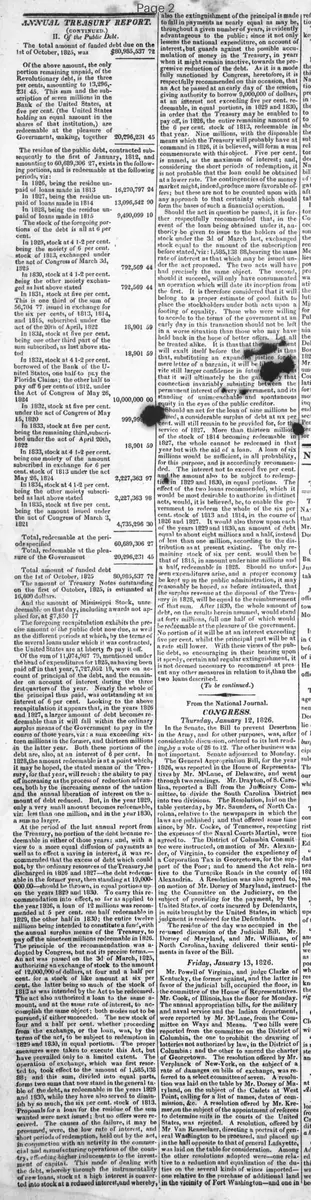
(continued.)
II. Of the Public Debt.
The total amount of funded debt due on the 1st of October, 1825, was $80,985,537 72.
Of the above amount, the only portion remaining unpaid, of the Revolutionary debt, is the three per cents, amounting to $13,296,231 45. This sum and the subscription of seven millions in the Bank of the United States, at five per cent. (the United States holding an equal amount in the shares of that institution,) are redeemable at the pleasure of Government, making, together $20,296,231 45.
The residue of the public debt, contracted subsequently to the first of January, 1812, and amounting to $60,689,306 27, exists in the following portions, and is redeemable at the following periods, viz:
In 1826, being the residue unpaid of loans made in 1813 $16,270,797 24
In 1827, being the residue unpaid of loans made in 1814 $13,096,542 90
In 1828, being the residue unpaid of loans made in 1815 $9,490,099 10
The stock of the foregoing portions of the debt is all at 6 per cent.
In 1829, stock at 4 1-2 per cent. being the moiety of 6 per cent. stock of 1813, exchanged under the act of Congress of March 3d. 1825 $792,569 44
In 1830, stock at 4 1-2 per cent. being the other moiety exchanged as last above stated $792,569 44
In 1831, stock at five per cent. This is one third of the sum of $56,704 77, issued in exchange for the six per cents, of 1813, 1814, and 1815, subscribed under the act of the 20th of April, 1822 $18,901 59
In 1832, stock at five per cent. being one other third part of the sum subscribed, as last above stated $18,901 59
In 1832, stock at 4 1-2 per cent. borrowed of the Bank of the United States, one half to pay the Florida Claims: the other half to pay off 6 per cents of 1812, under the Act of Congress of May 26, 1824 $10,000,000 00
In 1832, stock at five per cent. under the act of Congress of May 15, 1820 $999,999
In 1833, stock at five per cent. being the remaining third, subscribed under the act of April 20th, 1822 $18,901 59
In 1833, stock at 4 1-2 per cent. being one moiety of the amount subscribed in exchange for 6 per cent. stock of 1813 under the act May 26, 1824 $2,227,363 97
In 1834, stock at 4 1-2 per cent. being the other moiety subscribed as last above stated $2,227,363 98
In 1835, stock at five per cent. being the amount issued under the act of Congress of March 3, 1821 $4,735,296 30
Total, redeemable at the periods specified $60,689,306 27
Total, redeemable at the pleasure of the Government $20,296,231 45
Total amount of funded debt on the 1st of October, 1825 $80,985,537 72
The amount of Treasury Notes outstanding on the first of October, 1825, is estimated at $16,600 dollars.
And the amount of Mississippi Stock, unredeemable on that day, including awards not applied for, at $7,850 17
The foregoing recapitulation exhibits the precise amount of the public debt now due, as well as the different periods at which, by the terms of the several loans under which it was contracted, the United States are at liberty to pay it off.
Of the sum of $11,074,987 79, mentioned under the head of expenditures for 1825, as having been paid off in that year, $7,727,052 19, were on account of principal of the debt, and the remainder on account of interest during the three first quarters of the year. Nearly the whole of the principal thus paid, was outstanding at an interest of 6 per cent. Looking to the above recapitulation it appears that, in the years 1826 and 1827, a larger amount of debt becomes redeemable than it will fall within the ordinary surplus means of the Government to pay in the course of those years, viz: a sum exceeding sixteen millions in the former, and thirteen millions in the latter year. Both these portions of the debt are, also, at an interest of 6 per cent. In 1828, the amount redeemable is at a point which, it may be hoped, the stated means of the Treasury, for that year, will reach: the ability to pay off increasing as the process of reduction advances, both by the increasing means of the nation and the annual liberation of interest on the amount of debt reduced. But, in the year 1829, only a very small amount becomes redeemable, viz: less than one million, and in the year 1830, a sum no larger.
At the period of the last annual report from the Treasury, no portion of the debt became redeemable in either of those years: and, with a view to a more equal diffusion of payments as well as to effect a saving in interest, it was recommended that the excess of debt which could not, by the ordinary resources of the Treasury, be discharged in 1826 and 1827—the debt redeemable in the former year, then standing at $19,000,000—should be thrown, in equal portions upon the years 1829 and 1830. To carry this recommendation into effect, so far as applied to the year 1826, a loan of 12 millions was recommended at 5 per cent. one half redeemable in 1829, the other half in 1830; the entire twelve millions being intended to constitute a fund, with the annual surplus means of the Treasury, to pay off the nineteen millions redeemable in 1826. The principle of the recommendation was adopted by Congress, but not its precise terms.—An act was passed on the 3d of March, 1825, authorizing an exchange of stock to the amount of $12,000,000 of dollars, at four and a half per cent. for a stock of like amount at six per cent. the latter being so much of the stock of 1813 as was intended by the Act to be redeemed. The act also authorized a loan to the same amount, and at the same rate of interest, to accomplish the same object; both modes not to be pursued, if either succeeded. The new stock of four and a half per cent. whether proceeding from the exchange, or the loan, was, by the terms of the act, to be subject to redemption in 1829 and 1830, in equal portions. The proper measures were taken to execute this Act, but have prevailed only to a limited extent. The operation of exchange, which was first resorted to, took effect to the amount of $1,585,138 88; and this sum, divided into equal parts, forms two sums that now stand in the general table of the debt, as redeemable in the years 1829 and 1830, while they have also served to diminish by so much, the six per cent. stock of 1813. Proposals for a loan for the residue of the sum wanted were next issued; but no offers were received. The causes of the failure, it may be presumed, were, the low rate of interest, and short periods of redemption, held out by the act. in conjunction with an activity in the commercial and manufacturing operations of the country, affording higher inducements to the investment of capital. This mode of dealing with the debt, whereby through the instrumentality of new loans, stock at a high interest is converted into stock at a reduced interest, and whereby also the extinguishment of the principal is made to fall in payments as nearly equal as may be, throughout a given number of years, is evidently advantageous to the public; since it not only lessens the national expenditure, on account of interest, but guards against the possible accumulation of money in the Treasury, in years when it might remain inactive, towards the progressive reduction of the debt. As it is a mode fully sanctioned by Congress, heretofore, it is respectfully recommended on this occasion, that an Act be passed at an early day of the session, giving authority to borrow $9,000,000 of dollars, at an interest not exceeding five per cent. redeemable, in equal portions, in 1829 and 1830, in order that the Treasury may be enabled to pay off, in 1826, the entire remaining amount of the 6 per cent. stock of 1813, redeemable in that year. Nine millions, with the disposable means which the Treasury will probably have at command in 1826, it is believed, will form a sum commensurate with this object. Five per cent. is named, as the maximum of interest; and, considering the short periods of redemption, it is not probable that the loan could be obtained at a lower rate. The contingencies of the money market might, indeed, produce more favorable offers; but these are not to be counted upon with any approach to that certainty which should form the basis of such a financial operation.
Should the act in question be passed, it is further respectfully recommended that, in the event of the loan being obtained under it, authority be given to issue to the holders of the stock under the 3d of March last, exchanged stock equal to the amount of the subscription before stated, viz: $1,585,138 88, bearing the same rate of interest as that which may be issued under the act proposed. The two acts will have had precisely the same object. The second, should it succeed, will only have consummated an operation which will date its inception from the first. It is therefore considered that it will belong to a proper estimate of good faith to place the stockholders under both acts upon a footing of equality. Those who were willing to accede to the terms of the government at an early day in this transaction should not be left in a worse situation than those who may have held back in the hope of better offers. Let all be treated alike. It is thus that the government will exalt itself before the nation; is thus that, substituting an expanded justice for the mere letter of a bargain, it will be likely still larger confidence in future; that it will ultimately be the gainer by that connection invariably subsisting between the permanent interest of every government, and its standing of unimpeachable and spontaneous equity in the eyes of the public creditor.
Should an act for the loan of nine millions be passed, a considerable surplus of debt at six per cent. will still remain to be provided for, for the service of 1827. More than thirteen millions of the stock of 1814 becoming redeemable in 1827, the whole cannot be redeemed in that year but with the aid of a loan. A loan of six millions would be sufficient, in all probability, for this purpose, and is accordingly recommended. The interest not to exceed five per cent and the amount also to be subject to redemption in 1829 and 1830, in equal portions. The effect of the two loans recommended, which it would be most desirable to authorize in distinct acts, would, it is believed, be, to enable the government to redeem the whole of the six per cent. stock of 1813 and 1814, in the course of 1826 and 1827. It would also throw upon each of the years 1829 and 1830, an amount of debt equal to about eight millions and a half, instead of less than one million, according to the distribution as at present existing. The only remaining stock of six per cent. would then be that of 1815, in amount under nine millions and a half, redeemable in 1828. Should no unforeseen expenditures arise, and a proper economy be kept up in the public administration, it may reasonably be hoped, as before intimated, that the surplus revenue at the disposal of the Treasury in 1828, will be equal to the reimbursement of that sum. After 1830, the whole amount of debt, on the results herein assumed, would stand at forty millions, full one half of which would be redeemable at the pleasure of the government. No portion of it will be at an interest exceeding five per cent. whilst the principal part will be at a rate still lower. With these views of the public debt, so encouraging in their bearing upon its speedy, certain and regular extinguishment, it is not deemed necessary to recommend at present any other measures in relation to it, than the two loans described.
(To be continued.)
What sub-type of article is it?
What keywords are associated?
Domestic News Details
Event Date
1st Of October, 1825
Outcome
total funded debt: $80,985,537.72; treasury notes: $16,600; mississippi stock: $7,850.17. recommendations for $9m loan in 1826 and $6m in 1827 at up to 5% interest, redeemable 1829-1830, to cover $16m+ redemptions at 6%.
Event Details
Report on public debt structure, including Revolutionary debt ($13,296,231.45 at 3%) and post-1812 loans ($60,689,306.27 at 6%, 5%, 4.5%). Details redemption periods from 1826 ($16,270,797.24) to 1835 ($4,735,296.30). Discusses $11M paid in 1825, mostly principal. Recommends loans to handle 1826-1827 redemptions and equalize future payments, with authority to equalize terms for prior exchanges.