Thank you for visiting SNEWPapers!
Sign up free
Story
February 11, 1877
The Morning Star And Catholic Messenger
New Orleans, Orleans County, Louisiana
What is this article about?
Arctic expedition observations highlight climate's influence on plant germination and resilience: seeds from cold climates grow faster in warmer areas; wheat endured four years in polar cold; a rose tree survived Arctic freeze and bloomed upon warming.
Clipping
OCR Quality
98%
Excellent
Full Text
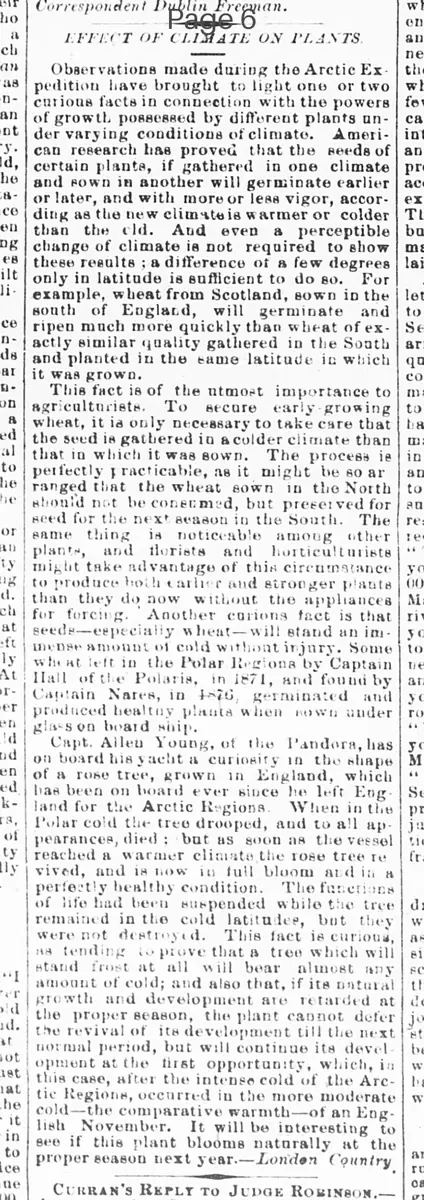
EFFECT OF CLIMATE ON PLANTS
Observations made during the Arctic Expedition have brought to light one or two curious facts in connection with the powers of growth possessed by different plants under varying conditions of climate. American research has proved that the seeds of certain plants, if gathered in one climate and sown in another will germinate earlier or later, and with more or less vigor, according as the new climate is warmer or colder than the old. And even a perceptible change of climate is not required to show these results; a difference of a few degrees only in latitude is sufficient to do so. For example, wheat from Scotland, sown in the south of England, will germinate and ripen much more quickly than wheat of exactly similar quality gathered in the South and planted in the same latitude in which it was grown.
This fact is of the utmost importance to agriculturists. To secure early-growing wheat, it is only necessary to take care that the seed is gathered in a colder climate than that in which it was sown. The process is perfectly practicable, as it might be so arranged that the wheat sown in the North should not be consumed, but preserved for seed for the next season in the South. The same thing is noticeable among other plants, and florists and horticulturists might take advantage of this circumstance to produce both earlier and stronger plants than they do now without the appliances for forcing.
Another curious fact is that seeds—especially wheat—will stand an immense amount of cold without injury. Some wheat left in the Polar Regions by Captain Hall of the Polaris, in 1871, and found by Captain Nares, in 1875, germinated and produced healthy plants when sown under glass on board ship.
Capt. Allen Young, of the Pandora, has on board his yacht a curiosity in the shape of a rose tree, grown in England, which has been on board ever since he left England for the Arctic Regions. When in the Polar cold the tree drooped, and to all appearances, died; but as soon as the vessel reached a warmer climate the rose tree revived, and is now in full bloom and in a perfectly healthy condition. The functions of life had been suspended while the tree remained in the cold latitudes, but they were not destroyed. This fact is curious, as tending to prove that a tree which will stand frost at all will bear almost any amount of cold; and also that, if its natural growth and development are retarded at the proper season, the plant cannot defer the revival of its development till the next normal period, but will continue its development at the first opportunity, which, in this case, after the intense cold of the Arctic Regions, occurred in the more moderate cold—the comparative warmth—of an English November. It will be interesting to see if this plant blooms naturally at the proper season next year.—London Country.
Observations made during the Arctic Expedition have brought to light one or two curious facts in connection with the powers of growth possessed by different plants under varying conditions of climate. American research has proved that the seeds of certain plants, if gathered in one climate and sown in another will germinate earlier or later, and with more or less vigor, according as the new climate is warmer or colder than the old. And even a perceptible change of climate is not required to show these results; a difference of a few degrees only in latitude is sufficient to do so. For example, wheat from Scotland, sown in the south of England, will germinate and ripen much more quickly than wheat of exactly similar quality gathered in the South and planted in the same latitude in which it was grown.
This fact is of the utmost importance to agriculturists. To secure early-growing wheat, it is only necessary to take care that the seed is gathered in a colder climate than that in which it was sown. The process is perfectly practicable, as it might be so arranged that the wheat sown in the North should not be consumed, but preserved for seed for the next season in the South. The same thing is noticeable among other plants, and florists and horticulturists might take advantage of this circumstance to produce both earlier and stronger plants than they do now without the appliances for forcing.
Another curious fact is that seeds—especially wheat—will stand an immense amount of cold without injury. Some wheat left in the Polar Regions by Captain Hall of the Polaris, in 1871, and found by Captain Nares, in 1875, germinated and produced healthy plants when sown under glass on board ship.
Capt. Allen Young, of the Pandora, has on board his yacht a curiosity in the shape of a rose tree, grown in England, which has been on board ever since he left England for the Arctic Regions. When in the Polar cold the tree drooped, and to all appearances, died; but as soon as the vessel reached a warmer climate the rose tree revived, and is now in full bloom and in a perfectly healthy condition. The functions of life had been suspended while the tree remained in the cold latitudes, but they were not destroyed. This fact is curious, as tending to prove that a tree which will stand frost at all will bear almost any amount of cold; and also that, if its natural growth and development are retarded at the proper season, the plant cannot defer the revival of its development till the next normal period, but will continue its development at the first opportunity, which, in this case, after the intense cold of the Arctic Regions, occurred in the more moderate cold—the comparative warmth—of an English November. It will be interesting to see if this plant blooms naturally at the proper season next year.—London Country.
What sub-type of article is it?
Curiosity
Historical Event
What themes does it cover?
Nature
Exploration
What keywords are associated?
Climate Effects
Plant Growth
Arctic Expedition
Wheat Seeds
Rose Tree Revival
What entities or persons were involved?
Captain Hall
Captain Nares
Capt. Allen Young
Where did it happen?
Arctic Regions, Polar Regions, England, Scotland, South Of England
Story Details
Key Persons
Captain Hall
Captain Nares
Capt. Allen Young
Location
Arctic Regions, Polar Regions, England, Scotland, South Of England
Event Date
1871, 1875
Story Details
Observations from Arctic expeditions show climate impacts plant growth: seeds from colder climates germinate faster in warmer ones; wheat seeds survived four years in Polar cold and grew; a rose tree on Capt. Allen Young's yacht suspended life in Arctic cold but revived in warmer climate.