Thank you for visiting SNEWPapers!
Sign up free
Letter to Editor
April 8, 1852
The Lancaster Ledger
Lancaster, Lancaster County, South Carolina
What is this article about?
This letter examines the Free School system in South Carolina, acknowledging its benefits in educating poor children while critiquing its organizational defects, particularly the fund distribution based on legislative representation, and calls for reorganization on principles of justice and equality.
Clipping
OCR Quality
95%
Excellent
Full Text
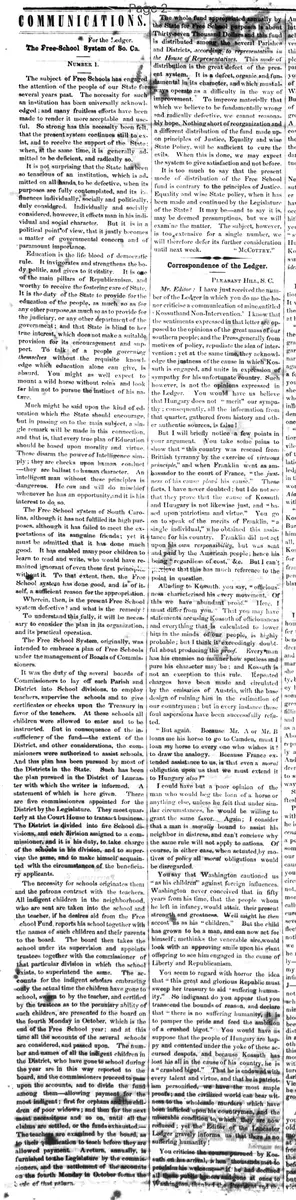
COMMUNICATIONS.
For the Ledger.
The Free-School System of So. Ca.
Number 1.
The subject of Free Schools has engaged the attention of the people of our State for several years past. The necessity for such an institution has been universally acknowledged; and many fruitless efforts have been made to render it more acceptable and useful. So strong has this necessity been felt, that the present system continues still to exist, and to receive the support of the State: when, at the same time, it is generally admitted to be deficient, and radically so.
It is not surprising that the State has been so tenacious of an institution, which is admitted on all hands to be defective, when its purposes are fully contemplated, and its influences individually, socially and politically, duly considered. Individually and socially considered, however, it affects man in his individual and social character. But it is in a political point of view, that it justly becomes a matter of governmental concern and of paramount importance.
Education is the life blood of democratic rule. It invigorates and strengthens the body politic, and gives to it vitality. It is one of the main pillars of Republicanism, and worthy to receive the fostering care of State. It is the duty of the State to provide for the education of the people, as much so as for any other purpose, as much so as to provide for the judiciary, or any other department of the government; and that State is blind to her true interest, which does not make a suitable provision for its encouragement and support. To talk of a people governing themselves without the requisite knowledge which education alone can give, is absurd. You might as well expect to mount a wild horse without reins and look for him not to pursue the instinct of his nature.
Much might be said upon the kind of education which the State should encourage, but in passing on to the main subject, a single remark will be made in this connection, and that is, that every true plan of Education should be based upon morality and virtue. These disarm the power of Intelligence simply; they are checks upon human conduct—they are ballast to human character. An intelligent man without these principles is dangerous. He can and will do mischief whenever he has an opportunity, and it is his interest to do so.
The Free School system of South Carolina, although it has not fulfilled its high purposes, although it has failed to meet the expectations of its sanguine friends; yet it must be admitted that it has done much good. It has enabled many poor children to learn to read and write, who would have remained ignorant of even these first principles without it. To that extent, then, the Free School system has done good, and is of itself, a sufficient reason for the appropriation.
Wherein, then, is the present Free School system defective? and what is the remedy?
To understand this fully, it will be necessary to consider the plan in its organization, and its practical operation.
The Free School System, originally, was intended to embrace a plan of Free Schools under the management of Boards of Commissioners.
It was the duty of the several boards of Commissioners to lay off each Parish and District into School divisions, to employ teachers, supervise the schools and to give certificates or checks upon the Treasury in favor of the teachers. At these schools all children were allowed to enter and to be instructed. But in consequence of the insufficiency of the fund, the extent of the District, and other considerations, the commissioners were authorized to assist schools. And this plan has been pursued by most of the Districts in the State. Such has been the plan pursued in the District of Lancaster with which the writer is informed. A statement of which is here given. There are five commissioners appointed for the District by the Legislature. They meet quarterly at the Court House to transact business. The District is divided into five School divisions, and each division assigned to a commissioner, and it is his duty, to take charge of the schools in his division, and to supervise the same, and to make himself acquainted with the circumstances of the beneficiary applicants.
The necessity for schools originates them and the patrons contract with the teachers. All indigent children in the neighborhood, who are sent are taken into the school and the teacher, if he desires aid from the Free School Fund, reports his school together with the names of such children and their parents to the board. The board then takes the school under its supervision and appoints trustees together with the commissioner of that particular division in which the school exists, to superintend the same. The accounts for the indigent scholars embracing only the actual time the children have gone to school, sworn to by the teacher, and certified by the trustees as to the pecuniary ability of such children, are presented to the board on the fourth Monday in October, which is the end of the Free School year; and at this time all the accounts of the several schools are considered, and passed upon. The number and names of all the indigent children in the District, who have gone to school during the year are in this way reported to the board, and the commissioners proceed to pass upon the accounts, and to divide the fund among them—allowing payment for the most indigent; first for orphans and the children of poor widows; and then for the next most necessitous and so on, until all the claims are settled, or the funds exhausted. The teachers are examined by the board, as to their qualification to teach before they are allowed payment. A return, annually, is furnished to the Legislature by the commissioners, and the settlement of the accounts on the fourth Monday in October forms the basis of that return.
The whole fund appropriated annually by the State for Free School purposes is about Thirty-seven Thousand Dollars and this fund is distributed among the several Parishes and Districts, according to representation in the House of Representatives. This mode of distribution is the great defect of the present system. It is a defect, organic and fundamental in its character, and which must always operate as a difficulty in the way of improvement. To improve materially that which we believe to be fundamentally wrong and radically defective, we cannot reasonably hope. Nothing short of reorganization and a different distribution of the fund made upon principles of Justice, Equality and wise State Policy, will be sufficient to cure the evils. When this is done, we may expect the system to give satisfaction and not before.
It is too much to say that the present mode of distribution of the Free School fund is contrary to the principles of Justice. Equality and wise State policy, when it has been made and continued by the Legislature of the State? It may be—and to say it is may be deemed presumptuous, but we will examine the matter. The subject, however, is too extensive for a single number, we will therefore defer its further consideration until next week.
McCOTTRY.
For the Ledger.
The Free-School System of So. Ca.
Number 1.
The subject of Free Schools has engaged the attention of the people of our State for several years past. The necessity for such an institution has been universally acknowledged; and many fruitless efforts have been made to render it more acceptable and useful. So strong has this necessity been felt, that the present system continues still to exist, and to receive the support of the State: when, at the same time, it is generally admitted to be deficient, and radically so.
It is not surprising that the State has been so tenacious of an institution, which is admitted on all hands to be defective, when its purposes are fully contemplated, and its influences individually, socially and politically, duly considered. Individually and socially considered, however, it affects man in his individual and social character. But it is in a political point of view, that it justly becomes a matter of governmental concern and of paramount importance.
Education is the life blood of democratic rule. It invigorates and strengthens the body politic, and gives to it vitality. It is one of the main pillars of Republicanism, and worthy to receive the fostering care of State. It is the duty of the State to provide for the education of the people, as much so as for any other purpose, as much so as to provide for the judiciary, or any other department of the government; and that State is blind to her true interest, which does not make a suitable provision for its encouragement and support. To talk of a people governing themselves without the requisite knowledge which education alone can give, is absurd. You might as well expect to mount a wild horse without reins and look for him not to pursue the instinct of his nature.
Much might be said upon the kind of education which the State should encourage, but in passing on to the main subject, a single remark will be made in this connection, and that is, that every true plan of Education should be based upon morality and virtue. These disarm the power of Intelligence simply; they are checks upon human conduct—they are ballast to human character. An intelligent man without these principles is dangerous. He can and will do mischief whenever he has an opportunity, and it is his interest to do so.
The Free School system of South Carolina, although it has not fulfilled its high purposes, although it has failed to meet the expectations of its sanguine friends; yet it must be admitted that it has done much good. It has enabled many poor children to learn to read and write, who would have remained ignorant of even these first principles without it. To that extent, then, the Free School system has done good, and is of itself, a sufficient reason for the appropriation.
Wherein, then, is the present Free School system defective? and what is the remedy?
To understand this fully, it will be necessary to consider the plan in its organization, and its practical operation.
The Free School System, originally, was intended to embrace a plan of Free Schools under the management of Boards of Commissioners.
It was the duty of the several boards of Commissioners to lay off each Parish and District into School divisions, to employ teachers, supervise the schools and to give certificates or checks upon the Treasury in favor of the teachers. At these schools all children were allowed to enter and to be instructed. But in consequence of the insufficiency of the fund, the extent of the District, and other considerations, the commissioners were authorized to assist schools. And this plan has been pursued by most of the Districts in the State. Such has been the plan pursued in the District of Lancaster with which the writer is informed. A statement of which is here given. There are five commissioners appointed for the District by the Legislature. They meet quarterly at the Court House to transact business. The District is divided into five School divisions, and each division assigned to a commissioner, and it is his duty, to take charge of the schools in his division, and to supervise the same, and to make himself acquainted with the circumstances of the beneficiary applicants.
The necessity for schools originates them and the patrons contract with the teachers. All indigent children in the neighborhood, who are sent are taken into the school and the teacher, if he desires aid from the Free School Fund, reports his school together with the names of such children and their parents to the board. The board then takes the school under its supervision and appoints trustees together with the commissioner of that particular division in which the school exists, to superintend the same. The accounts for the indigent scholars embracing only the actual time the children have gone to school, sworn to by the teacher, and certified by the trustees as to the pecuniary ability of such children, are presented to the board on the fourth Monday in October, which is the end of the Free School year; and at this time all the accounts of the several schools are considered, and passed upon. The number and names of all the indigent children in the District, who have gone to school during the year are in this way reported to the board, and the commissioners proceed to pass upon the accounts, and to divide the fund among them—allowing payment for the most indigent; first for orphans and the children of poor widows; and then for the next most necessitous and so on, until all the claims are settled, or the funds exhausted. The teachers are examined by the board, as to their qualification to teach before they are allowed payment. A return, annually, is furnished to the Legislature by the commissioners, and the settlement of the accounts on the fourth Monday in October forms the basis of that return.
The whole fund appropriated annually by the State for Free School purposes is about Thirty-seven Thousand Dollars and this fund is distributed among the several Parishes and Districts, according to representation in the House of Representatives. This mode of distribution is the great defect of the present system. It is a defect, organic and fundamental in its character, and which must always operate as a difficulty in the way of improvement. To improve materially that which we believe to be fundamentally wrong and radically defective, we cannot reasonably hope. Nothing short of reorganization and a different distribution of the fund made upon principles of Justice, Equality and wise State Policy, will be sufficient to cure the evils. When this is done, we may expect the system to give satisfaction and not before.
It is too much to say that the present mode of distribution of the Free School fund is contrary to the principles of Justice. Equality and wise State policy, when it has been made and continued by the Legislature of the State? It may be—and to say it is may be deemed presumptuous, but we will examine the matter. The subject, however, is too extensive for a single number, we will therefore defer its further consideration until next week.
McCOTTRY.
What sub-type of article is it?
Informative
Persuasive
Political
What themes does it cover?
Education
Politics
What keywords are associated?
Free Schools
South Carolina
Education System
Fund Distribution
School Commissioners
Indigent Children
State Policy
What entities or persons were involved?
Mccottry.
For The Ledger.
Letter to Editor Details
Author
Mccottry.
Recipient
For The Ledger.
Main Argument
the free school system in south carolina is necessary and beneficial but fundamentally defective due to its fund distribution based on legislative representation; it requires reorganization on principles of justice, equality, and wise state policy to be effective.
Notable Details
Fund Appropriation: About Thirty Seven Thousand Dollars Annually
Distributed According To Representation In The House Of Representatives
Details On Lancaster District Operations: Five Commissioners, Quarterly Meetings, Aid To Indigent Children Prioritized By Need