Thank you for visiting SNEWPapers!
Sign up free
The Organized Farmer
Red Wing, Goodhue County, Minnesota
What is this article about?
John Meintz of Luverne, Minn., supporter of the Nonpartisan League, was tarred, feathered, and flogged by a mob on Aug. 19, 1918, near the South Dakota border. He sued 32 local men for $100,000; after losing initially, the U.S. Circuit Court of Appeals in St. Louis orders a new trial.
Clipping
OCR Quality
Full Text
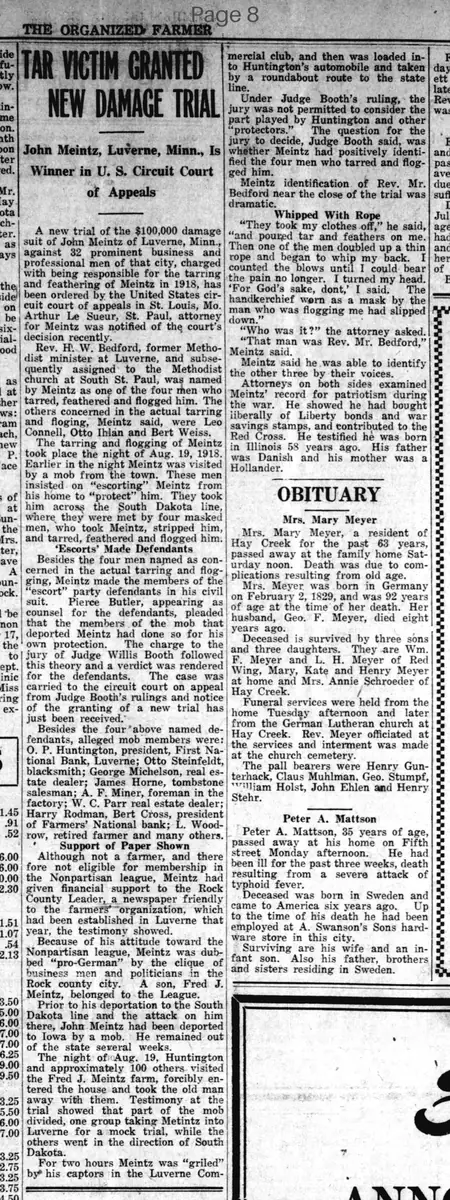
TAR VICTIM GRANTED NEW DAMAGE TRIAL
John Meintz, Luverne, Minn., Is Winner in U. S. Circuit Court of Appeals
A new trial of the $100,000 damage suit of John Meintz of Luverne, Minn., against 32 prominent business and professional men of that city, charged with being responsible for the tarring and feathering of Meintz in 1918, has been ordered by the United States circuit court of appeals in St. Louis, Mo. Arthur Le Sueur, St. Paul, attorney for Meintz was notified of the court's decision recently.
Rev. H. W. Bedford, former Methodist minister at Luverne, and subsequently assigned to the Methodist church at South St. Paul, was named by Meintz as one of the four men who tarred, feathered and flogged him. The others concerned in the actual tarring and flogging, Meintz said, were Leo Connell, Otto Ihlan and Bert Weiss.
The tarring and flogging of Meintz took place the night of Aug. 19, 1918. Earlier in the night Meintz was visited by a mob from the town. These men insisted on "escorting" Meintz from his home to "protect" him. They took him across the South Dakota line, where they were met by four masked men, who took Meintz, stripped him, and tarred, feathered and flogged him.
'Escorts' Made Defendants
Besides the four men named as concerned in the actual tarring and flogging, Meintz made the members of the "escort" party defendants in his civil suit. Pierce Butler, appearing as counsel for the defendants, pleaded that the members of the mob that deported Meintz had done so for his own protection. The charge to the jury of Judge Willis Booth followed this theory and a verdict was rendered for the defendants. The case was carried to the circuit court on appeal from Judge Booth's rulings and notice of the granting of a new trial has just been received.
Besides the four above named defendants, alleged mob members were: O. P. Huntington, president, First National Bank, Luverne; Otto Steinfeldt, blacksmith; George Michelson, real estate dealer; James Horne, tombstone salesman; A. F. Miner, foreman in the factory; W. C. Parr real estate dealer; Harry Rodman, Bert Cross, president of Farmers' National bank; L. Woodrow, retired farmer and many others.
Support of Paper Shown
Although not a farmer, and therefore not eligible for membership in the Nonpartisan league, Meintz had given financial support to the Rock County Leader, a newspaper friendly to the farmers organization, which had been established in Luverne that year, the testimony showed.
Because of his attitude toward the Nonpartisan league, Meintz was dubbed "pro-German" by the clique of business men and politicians in the Rock county city. A son, Fred J. Meintz, belonged to the League.
Prior to his deportation to the South Dakota line and the attack on him there, John Meintz had been deported to Iowa by a mob. He remained out of the state several weeks.
The night of Aug. 19, Huntington and approximately 100 others visited the Fred J. Meintz farm, forcibly entered the house and took the old man away with them. Testimony at the trial showed that part of the mob divided, one group taking Meintz into Luverne for a mock trial, while the others went in the direction of South Dakota.
For two hours Meintz was "grilled" by his captors in the Luverne Commercial club, and then was loaded into Huntington's automobile and taken by a roundabout route to the state line.
Under Judge Booth's ruling, the jury was not permitted to consider the part played by Huntington and other "protectors."
The question for the jury to decide, Judge Booth said, was whether Meintz had positively identified the four men who tarred and flogged him.
Meintz identification of Rev. Mr. Bedford near the close of the trial was dramatic.
Whipped With Rope
"They took my clothes off," he said, "and poured tar and feathers on me. Then one of the men doubled up a thin rope and began to whip my back. I counted the blows until I could bear the pain no longer. I turned my head. 'For God's sake, don't,' I said. The handkerchief worn as a mask by the man who was flogging me had slipped down."
"Who was it?" the attorney asked.
"That man was Rev. Mr. Bedford," Meintz said.
Meintz said he was able to identify the other three by their voices.
Attorneys on both sides examined Meintz' record for patriotism during the war. He showed he had bought liberally of Liberty bonds and war savings stamps, and contributed to the Red Cross. He testified he was born in Illinois 58 years ago. His father was Danish and his mother was a Hollander.
What sub-type of article is it?
What themes does it cover?
What keywords are associated?
What entities or persons were involved?
Where did it happen?
Story Details
Key Persons
Location
Luverne, Minn.; South Dakota Line; St. Louis, Mo.
Event Date
Aug. 19, 1918
Story Details
John Meintz, supporter of the Nonpartisan League, was abducted by a mob, taken across the South Dakota line, tarred, feathered, and flogged by four men including Rev. H. W. Bedford. He sued 32 men for $100,000 damages; after initial verdict for defendants, appeals court orders new trial.