Thank you for visiting SNEWPapers!
Sign up free
Letter to Editor
October 23, 1779
The Virginia Gazette
Richmond, Williamsburg, Richmond County, Virginia
What is this article about?
In a letter dated October 12, 1779, from Virginia, C. Braxton defends his public conduct and private character against Arthur Lee's accusations, while attacking Lee's diplomatic indiscretions, treachery in secret communications regarding the Franco-American treaty, and his dismissal by Congress as ambassador.
Clipping
OCR Quality
95%
Excellent
Full Text
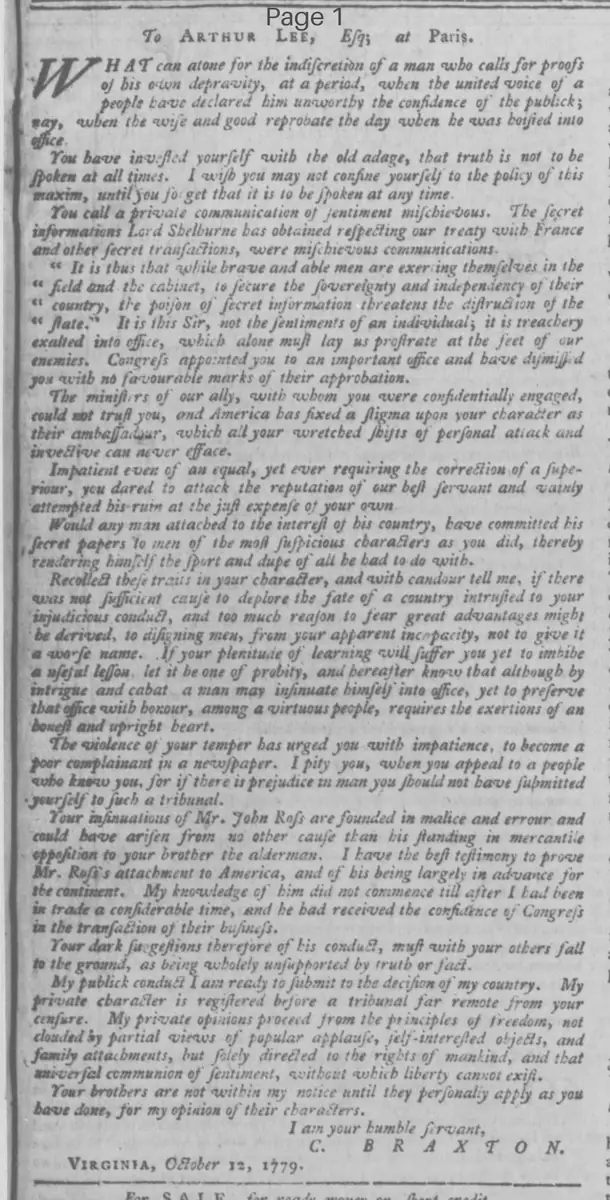
To ARTHUR LEE, Esq. at Paris.
What can atone for the indiscretion of a man who calls for proofs of his own depravity, at a period, when the united voice of a people have declared him unworthy the confidence of the publick; ay, when the wise and good reprobate the day when he was hoisted into office.
You have invested yourself with the old adage, that truth is not to be spoken at all times. I wish you may not confine yourself to the policy of this maxim, until you so forget that it is to be spoken at any time.
You call a private communication of sentiment mischievous. The secret informations Lord Shelburne has obtained respecting our treaty with France and other secret transactions, were mischievous communications.
It is thus that while brave and able men are exerting themselves in the field and the cabinet, to secure the sovereignty and independency of their country, the poison of secret information threatens the destruction of the state. It is this Sir, not the sentiments of an individual; it is treachery exalted into office, which alone must lay us prostrate at the feet of our enemies. Congress appointed you to an important office and have dismissed you with no favourable marks of their approbation.
The ministers of our ally, with whom you were confidentially engaged, could not trust you, and America has fixed a stigma upon your character as their ambassador, which all your wretched shifts of personal attack and invective can never efface.
Impatient even of an equal, yet ever requiring the correction of a superior, you dared to attack the reputation of our best servant and vainly attempted his ruin at the just expense of your own.
Would any man attached to the interest of his country, have committed his secret papers to men of the most suspicious characters as you did, thereby rendering himself the sport and dupe of all he had to do with.
Recollect these traits in your character, and with candour tell me, if there was not sufficient cause to deplore the fate of a country intrusted to your injudicious conduct, and too much reason to fear great advantages might be derived, to designing men, from your apparent incapacity, not to give it a worse name. If your plenitude of learning will suffer you yet to imbibe a useful lesson, let it be one of probity, and hereafter know that although by intrigue and cabal a man may insinuate himself into office, yet to preserve that office with honour, among a virtuous people, requires the exertions of an honest and upright heart.
The violence of your temper has urged you with impatience, to become a poor complainant in a newspaper. I pity you, when you appeal to a people who know you, or if there is prejudice in man you should not have submitted yourself to such a tribunal.
Your insinuations of Mr. John Ross are founded in malice and error and could have arisen from no other cause than his standing in mercantile opposition to your brother the alderman. I have the best testimony to prove Mr. Ross's attachment to America, and of his being largely in advance for the continent. My knowledge of him did not commence till after I had been in trade a considerable time, and he had received the confidence of Congress in the transaction of their business.
Your dark suggestions therefore of his conduct, must with your others fall to the ground, as being wholly unsupported by truth or fact.
My publick conduct I am ready to submit to the decision of my country. My private character is registered before a tribunal far remote from your censure. My private opinions proceed from the principles of freedom, not clouded by partial views of popular applause, self-interested objects, and family attachments, but solely directed to the rights of mankind, and that universal communion of sentiment, without which liberty cannot exist.
Your brothers are not within my notice until they personally apply as you have done, for my opinion of their characters.
I am your humble servant,
C. BRAXTON.
VIRGINIA, October 12, 1779.
What can atone for the indiscretion of a man who calls for proofs of his own depravity, at a period, when the united voice of a people have declared him unworthy the confidence of the publick; ay, when the wise and good reprobate the day when he was hoisted into office.
You have invested yourself with the old adage, that truth is not to be spoken at all times. I wish you may not confine yourself to the policy of this maxim, until you so forget that it is to be spoken at any time.
You call a private communication of sentiment mischievous. The secret informations Lord Shelburne has obtained respecting our treaty with France and other secret transactions, were mischievous communications.
It is thus that while brave and able men are exerting themselves in the field and the cabinet, to secure the sovereignty and independency of their country, the poison of secret information threatens the destruction of the state. It is this Sir, not the sentiments of an individual; it is treachery exalted into office, which alone must lay us prostrate at the feet of our enemies. Congress appointed you to an important office and have dismissed you with no favourable marks of their approbation.
The ministers of our ally, with whom you were confidentially engaged, could not trust you, and America has fixed a stigma upon your character as their ambassador, which all your wretched shifts of personal attack and invective can never efface.
Impatient even of an equal, yet ever requiring the correction of a superior, you dared to attack the reputation of our best servant and vainly attempted his ruin at the just expense of your own.
Would any man attached to the interest of his country, have committed his secret papers to men of the most suspicious characters as you did, thereby rendering himself the sport and dupe of all he had to do with.
Recollect these traits in your character, and with candour tell me, if there was not sufficient cause to deplore the fate of a country intrusted to your injudicious conduct, and too much reason to fear great advantages might be derived, to designing men, from your apparent incapacity, not to give it a worse name. If your plenitude of learning will suffer you yet to imbibe a useful lesson, let it be one of probity, and hereafter know that although by intrigue and cabal a man may insinuate himself into office, yet to preserve that office with honour, among a virtuous people, requires the exertions of an honest and upright heart.
The violence of your temper has urged you with impatience, to become a poor complainant in a newspaper. I pity you, when you appeal to a people who know you, or if there is prejudice in man you should not have submitted yourself to such a tribunal.
Your insinuations of Mr. John Ross are founded in malice and error and could have arisen from no other cause than his standing in mercantile opposition to your brother the alderman. I have the best testimony to prove Mr. Ross's attachment to America, and of his being largely in advance for the continent. My knowledge of him did not commence till after I had been in trade a considerable time, and he had received the confidence of Congress in the transaction of their business.
Your dark suggestions therefore of his conduct, must with your others fall to the ground, as being wholly unsupported by truth or fact.
My publick conduct I am ready to submit to the decision of my country. My private character is registered before a tribunal far remote from your censure. My private opinions proceed from the principles of freedom, not clouded by partial views of popular applause, self-interested objects, and family attachments, but solely directed to the rights of mankind, and that universal communion of sentiment, without which liberty cannot exist.
Your brothers are not within my notice until they personally apply as you have done, for my opinion of their characters.
I am your humble servant,
C. BRAXTON.
VIRGINIA, October 12, 1779.
What sub-type of article is it?
Persuasive
Provocative
Political
What themes does it cover?
Politics
Morality
What keywords are associated?
Arthur Lee
C Braxton
Congress Dismissal
Franco American Treaty
Secret Communications
Diplomatic Treachery
John Ross Defense
American Revolution
What entities or persons were involved?
C. Braxton
Arthur Lee, Esq. At Paris
Letter to Editor Details
Author
C. Braxton
Recipient
Arthur Lee, Esq. At Paris
Main Argument
c. braxton condemns arthur lee's diplomatic indiscretions, secret leaks, and incapacity, which led to his dismissal by congress, while defending his own integrity and that of john ross against lee's malicious attacks.
Notable Details
References To Lord Shelburne Obtaining Secret Informations On Franco American Treaty
Congress's Appointment And Dismissal Of Lee
Lee's Attack On 'Our Best Servant'
Defense Of Mr. John Ross's Loyalty And Financial Support To The Continent
Emphasis On Probity And Honest Heart For Honorable Office