Thank you for visiting SNEWPapers!
Sign up free
The Arkansas Banner
Little Rock, Pulaski County, Arkansas
What is this article about?
Article detailing operations of the US Dead Letter Office under J. Mardon, including statistics on returned letters (est. 24 million/year), handling of unclaimed money ($1700 for half-year 1850), preservation of valuables, and an anecdote of a gentleman recovering lost documents worth $10,000 in minutes.
Clipping
OCR Quality
Full Text
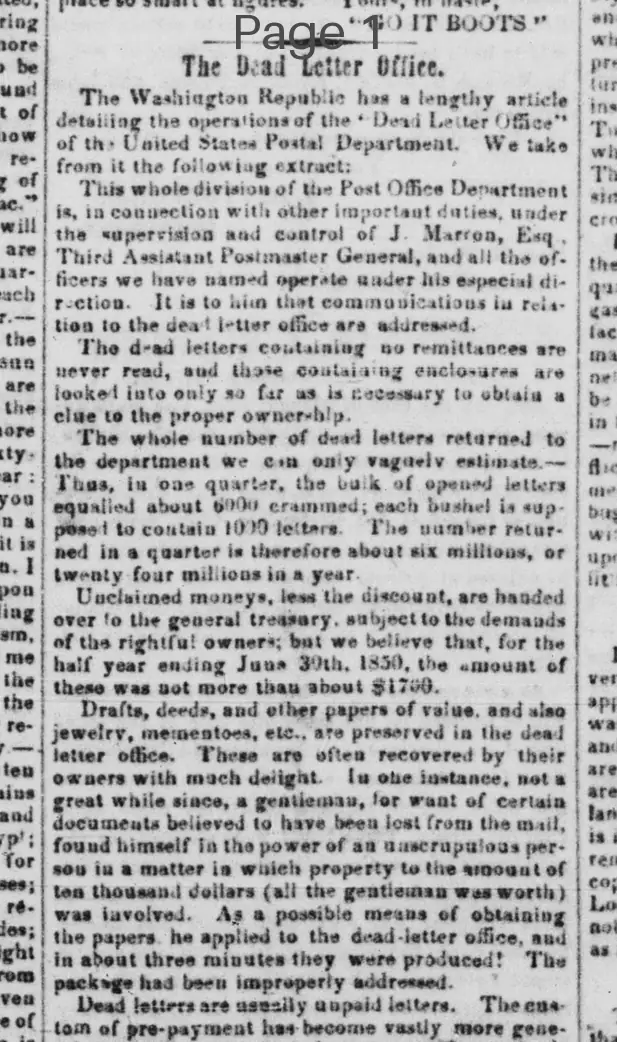
The Washington Republic has a lengthy article detailing the operations of the 'Dead Letter Office' of the United States Postal Department. We take from it the following extract:
This whole division of the Post Office Department is, in connection with other important duties, under the supervision and control of J. Mardon, Esq., Third Assistant Postmaster General, and all the officers we have named operate under his especial direction. It is to him that communications in relation to the dead letter office are addressed.
The dead letters containing no remittances are never read, and those containing enclosures are looked into only so far as is necessary to obtain a clue to the proper ownership.
The whole number of dead letters returned to the department we can only vaguely estimate.—Thus, in one quarter, the bulk of opened letters equalled about 600 bushels; each bushel is supposed to contain 1000 letters. The number returned in a quarter is therefore about six millions, or twenty four millions in a year.
Unclaimed moneys, less the discount, are handed over to the general treasury, subject to the demands of the rightful owners; but we believe that, for the half year ending June 30th, 1850, the amount of these was not more than about $1700.
Drafts, deeds, and other papers of value, and also jewelry, mementoes, etc., are preserved in the dead letter office. These are often recovered by their owners with much delight. In one instance, not a great while since, a gentleman, for want of certain documents believed to have been lost from the mail, found himself in the power of an unscrupulous person in a matter in which property to the amount of ten thousand dollars (all the gentleman was worth) was involved. As a possible means of obtaining the papers, he applied to the dead-letter office, and in about three minutes they were produced! The package had been improperly addressed.
Dead letters are usually unpaid letters. The custom of pre-payment has become vastly more general since the reduction of postage to five and ten cents. In the fourth quarter of 1850 the number of dead letters received from Cincinnati, not pre-paid, was 8700; the number pre-paid, 1300. In the third quarter of 1850 the pre-paid letters from the Boston post-office numbered 1612; of letters not pre-paid, 910. These instances are taken at random.
What sub-type of article is it?
What themes does it cover?
What keywords are associated?
What entities or persons were involved?
Where did it happen?
Story Details
Key Persons
Location
United States Postal Department
Event Date
1850
Story Details
Description of Dead Letter Office operations: supervision by J. Mardon, policy on reading letters, estimated 24 million dead letters yearly, unclaimed money to treasury ($1700 for half-year 1850), preservation of valuables; anecdote of gentleman recovering misaddressed documents in minutes, averting $10,000 loss; statistics on prepaid vs. unpaid dead letters from Cincinnati and Boston.