Thank you for visiting SNEWPapers!
Sign up free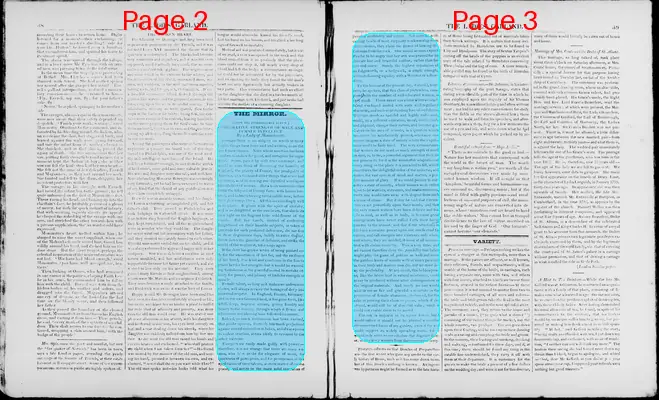
The Ladies' Garland
Harpers Ferry, Jefferson County, West Virginia
What is this article about?
An essay by a Lady of Massachusetts compares male and female intellect, arguing that women's talents excel in elegance and quickness but lack the profundity and vigor of men's, suited to their societal roles. It praises female achievements while cautioning against claims of equality in male domains like science and politics.
Merged-components note: Continuation of the opinion essay on the comparative strength of male and female intellect across page 2 and 3; relabeled to editorial due to its argumentative and opinionated nature.
Clippings
1 of 2
OCR Quality
Full Text
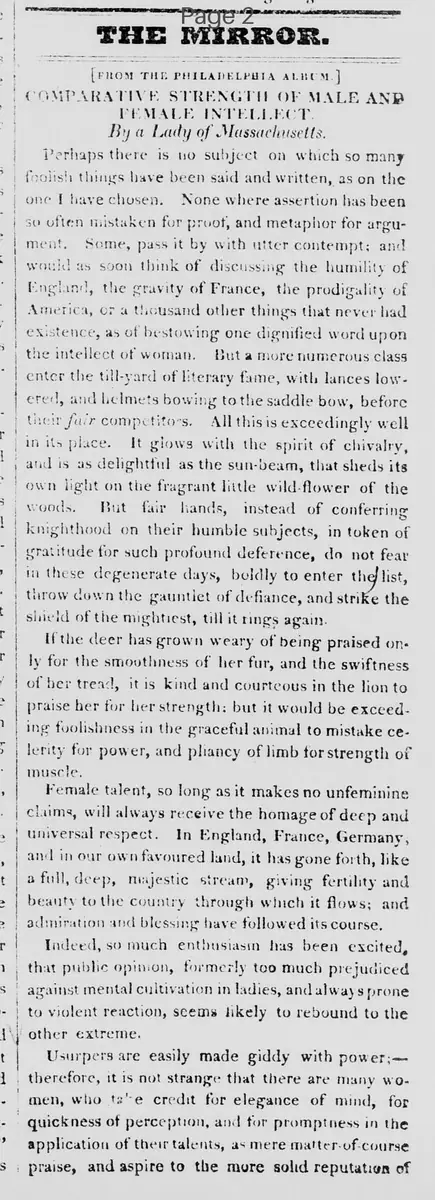
[FROM THE PHILADELPHIA ALBUM.]
COMPARATIVE STRENGTH OF MALE AND FEMALE INTELLECT
By a Lady of Massachusetts.
Perhaps there is no subject on which so many foolish things have been said and written, as on the one I have chosen. None where assertion has been so often mistaken for proof, and metaphor for argu- ment. Some, pass it by with utter contempt; and would as soon think of discussing the humility of England, the gravity of France, the prodigality of America, or a thousand other things that never had existence, as of bestowing one dignified word upon the intellect of woman. But a more numerous class enter the tilt-yard of literary fame, with lances low- ered, and helmets bowing to the saddle bow, before their fair competitors. All this is exceedingly well in its place. It glows with the spirit of chivalry, and is as delightful as the sun-beam, that sheds its own light on the fragrant little wild-flower of the woods. But fair hands, instead of conferring knighthood on their humble subjects, in token of gratitude for such profound deference, do not fear in these degenerate days, boldly to enter the list, throw down the gauntlet of defiance, and strike the shield of the mightiest, till it rings again.
If the deer has grown weary of being praised on- ly for the smoothness of her fur, and the swiftness of her tread, it is kind and courteous in the lion to praise her for her strength: but it would be exceed- ing foolishness in the graceful animal to mistake ce- lerity for power, and pliancy of limb for strength of muscle.
Female talent, so long as it makes no unfeminine claims, will always receive the homage of deep and universal respect. In England, France, Germany, and in our own favoured land, it has gone forth, like a full, deep, majestic stream, giving fertility and beauty to the country through which it flows; and ad- miration and blessing have followed its course. Indeed, so much enthusiasm has been excited, that public opinion, formerly too much prejudiced against mental cultivation in ladies, and always prone to violent reaction, seems likely to rebound to the other extreme.
Usurpers are easily made giddy with power;- therefore, it is not strange that there are many wo- men, who take credit for elegance of mind, for quickness of perception, and for promptness in the application of their talents, as mere matter-of-course praise, and aspire to the more solid reputation of
peculiar profundity and vigour. Not content with carving heads of most exquisite workmanship from cherry-stones, they claim the power of hewing the Colossus from the rock. One would as soon expect Psyche to be angry that her arm was praised for its delicate hue and beautiful outline, rather than for size and sinew. Surely the highest reputation of an Edgeworth, or a Sedgwick, is ample enough, without claiming equality with a Webster or a Boaditch. To the honour of the present day, it should, however, be spoken, that this class of pretenders, compared with the number of well-educated women, is very small. There never was a time when so much talent was found united with such well-regulated character, and such unpretending love of usefulness. Whether minds so tasteful and highly cultivated, could, by a different education, moral, intellectual, and physical, change their nature, and become gladiators on the arena of science, is a question which can never be satisfactorily proved,--because one cannot imagine a state of society where the experiment could be fairly tried. The very circumstance that women do not need as much strength of mind as men, is, to me, a powerful argument that they do not possess it; for it is the wonderful adaptation of every thing to the place it is intended to fill, which constitutes the delightful order of the universe, and makes the vast system of mind and matter, a perfect mansion of glory. If we could picture to ourselves a state of society, where women were called upon to be warriors, statesmen, and mathematicians, every one would turn away with disgust from such a scene of chaos. But it may be said that circumstances act powerfully upon their minds, and that the very reason women have been delicate and fragile in soul, as well as in body, is because great emergencies have never called forth their latent powers to the utmost; and that if our situations in life have a creative power upon our intellectual faculties, and call energies into existence only when, and where, they are needed, it is not at all inconsistent with divine economy. This is very true: and we cannot therefore deny the possibility that ladies might play the game of politics as well and untie the gordian knots of science with as much patience as their lords and masters now do; but we must deny the probability. At any event, this hidden power, like the latent heat in natural substances, could never be produced without utter decomposition of the original materials. And surely no one would wish to see so fair and graceful a structure as the perfection of female character, destroyed, for the sake of proving their claim to praise, which if deserved, would still be of doubtful value, since it could not enable them to be useful. The oak is majestic in its native forest; but I would rather it should not be planted within the circumscribed limits of my garden, even if the soil could support its widely spreading roots: for it would only serve to overshadow the fragrant flowers, or, and to keep warmth from the strawberry.
What sub-type of article is it?
What keywords are associated?
What entities or persons were involved?
Editorial Details
Primary Topic
Comparative Strength Of Male And Female Intellect
Stance / Tone
Defense Of Distinct Female Intellectual Strengths Without Claiming Equality To Male Profundity
Key Figures
Key Arguments