Thank you for visiting SNEWPapers!
Sign up free
The New York Herald
New York, New York County, New York
What is this article about?
The August 10, 1868, Sing Sing Methodist camp meeting featured sermons, conversions, and Dr. Newman's report on rebuilding the church in Louisiana, Texas, and Mississippi post-Civil War, including missions, conferences, schools, a newspaper, and an orphan asylum for 110 children, with expected visits from prominent clergy.
Clipping
OCR Quality
Full Text
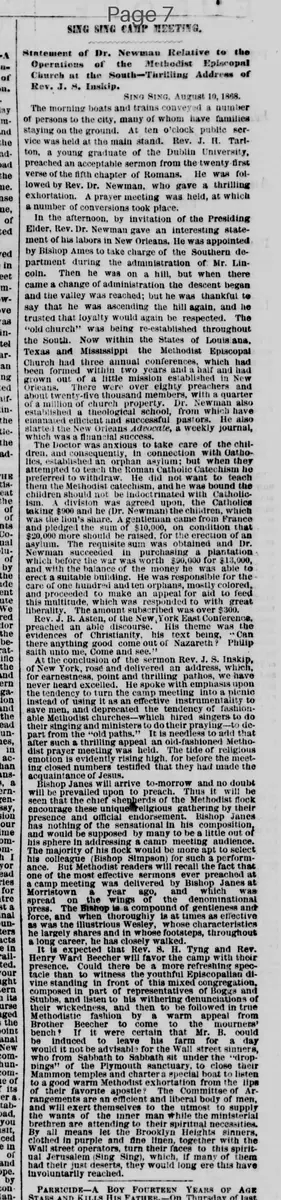
Statement of Dr. Newman Relative to the Operations of the Methodist Episcopal Church at the South—Thrilling Address of Rev. J. S. Inskip.
Sing Sing, August 10, 1868.
The morning boats and trains conveyed a number of persons to the city, many of whom have families staying on the ground. At ten o'clock public service was held at the main stand. Rev. J. H. Tartton, a young graduate of the Dublin University, preached an acceptable sermon from the twenty-first verse of the fifth chapter of Romans. He was followed by Rev. Dr. Newman, who gave a thrilling exhortation. A prayer meeting was held, at which a number of conversions took place.
In the afternoon, by invitation of the Presiding Elder, Rev. Dr. Newman gave an interesting statement of his labors in New Orleans. He was appointed by Bishop Ames to take charge of the Southern department during the administration of Mr. Lincoln. Then he was on a hill, but when there came a change of administration the descent began and the valley was reached; but he was thankful to say that he was ascending the hill again, and he trusted that loyalty would again be respected. The "old church" was being re-established throughout the South. Now within the States of Louisiana, Texas and Mississippi the Methodist Episcopal Church had three annual conferences, which had been formed within two years and a half and had grown out of a little mission established in New Orleans. There were over eighty preachers and about twenty-five thousand members, with a quarter of a million of church property. Dr. Newman also established a theological school, from which have emanated efficient and successful pastors. He also started the New Orleans Advocate, a weekly journal, which was a financial success.
The Doctor was anxious to take care of the children, and consequently, in connection with Catholics, established an orphan asylum; but when they attempted to teach the Roman Catholic Catechism he preferred to withdraw. He did not want to teach them the Methodist catechism, and he was bound the children should not be indoctrinated with Catholicism. A division was agreed upon, the Catholics taking $500 and he (Dr. Newman) the children, which was the lion's share. A gentleman came from France and pledged the sum of $10,000, on condition that $20,000 more should be raised, for the erection of an asylum. The requisite sum was obtained and Dr. Newman succeeded in purchasing a plantation which before the war was worth $90,000 for $13,000, and with the balance of the money he was able to erect a suitable building. He was responsible for the care of one hundred and ten orphans, mostly colored, and proceeded to make an appeal for aid to feed this multitude, which was responded to with great liberality. The amount subscribed was over $300.
Rev. J. B. Asten, of the New York East Conference, preached an able discourse. His theme was the evidences of Christianity, his text being, "Can there anything good come out of Nazareth?" Philip saith unto me, Come and see."
At the conclusion of the sermon Rev. J. S. Inskip, of New York, rose and delivered an address, which, for earnestness, point and thrilling pathos, we have never heard excelled. He spoke with emphasis upon the tendency to turn the camp meeting into a picnic instead of using it as an effective instrumentality to save men, and deprecated the tendency of fashionable Methodist churches—which hired singers to do their singing and ministers to do their praying—to depart from the "old paths." It is needless to add that after such a thrilling appeal an old-fashioned Methodist prayer meeting was held. The tide of religious emotion is evidently rising high, for before the meeting closed numbers testified that they had made the acquaintance of Jesus.
Bishop Janes will arrive to-morrow and no doubt will be prevailed upon to preach. Thus it will be seen that the chief shepherds of the Methodist flock encourage these unique religious gatherings by their presence and official endorsement. Bishop Janes has nothing of the sensational in his composition, and would be supposed by many to be a little out of his sphere in addressing a camp meeting audience. The majority of his flock would be more apt to select his colleague (Bishop Simpson) for such a performance. But Methodist readers will recall the fact that one of the most effective sermons ever preached at a camp meeting was delivered by Bishop Janes at Morristown a year ago, and which was spread on the wings of the denominational press. The Bishop is a compound of gentleness and force, and when thoroughly aroused is at times as effective as was the illustrious Wesley, whose characteristics he largely shares and in whose footsteps, throughout a long career, he has closely walked.
It is expected that Rev. S. H. Tyng and Rev. Henry Ward Beecher will favor the camp with their presence. Could there be a more refreshing spectacle than to witness the youthful Episcopalian divine standing in front of this mixed congregation, composed in part of representatives of Boggs and Stubbs, and listen to his withering denunciations of their wickedness, and then to be followed in true Methodistic fashion by a warm appeal from Brother Beecher to come to the mourners' bench? If it were certain that Mr. B. could be induced to leave his farm for a day would it not be advisable for the Wall street sinners, who from Sabbath to Sabbath sit under the "droppings" of the Plymouth sanctuary, to close their Mammon temples and charter a special boat to listen to a good warm Methodist exhortation from the lips of their favorite apostle? The Committee of Arrangements are an efficient and liberal body of men, and will exert themselves to the utmost to supply the wants of the inner man while the ministerial brethren are attending to their spiritual necessities. By all means let the Brooklyn Heights sinners, clothed in purple and fine linen, together with the Wall street operators, turn their faces to this spiritual Jerusalem (Sing Sing), which, if many of them had their just deserts, they would long ere this have involuntarily reached.
What sub-type of article is it?
What themes does it cover?
What keywords are associated?
What entities or persons were involved?
Where did it happen?
Story Details
Key Persons
Location
Sing Sing
Event Date
August 10, 1868
Story Details
Report on the Sing Sing Methodist camp meeting activities, including sermons by Rev. J. H. Tartton and Rev. J. B. Asten, Dr. Newman's account of re-establishing the Methodist Episcopal Church in the South with conferences, preachers, members, a theological school, newspaper, and orphan asylum, conversions during prayer meetings, and anticipation of addresses by Bishop Janes, Rev. S. H. Tyng, and Rev. Henry Ward Beecher.