Thank you for visiting SNEWPapers!
Sign up free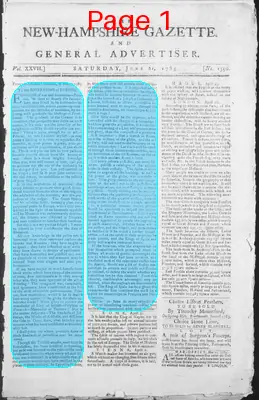
Literary
June 21, 1783
The New Hampshire Gazette And General Advertiser
Portsmouth, Exeter, Rockingham County, New Hampshire
What is this article about?
An anonymous address from the Chester Chronicle urges European sovereigns to end wars, promote peace, and fund searches for lost ancient Greek and Roman manuscripts in places like Turkey, Italy, and Herculaneum to enrich literature and benefit humanity.
Clipping
OCR Quality
95%
Excellent
Full Text
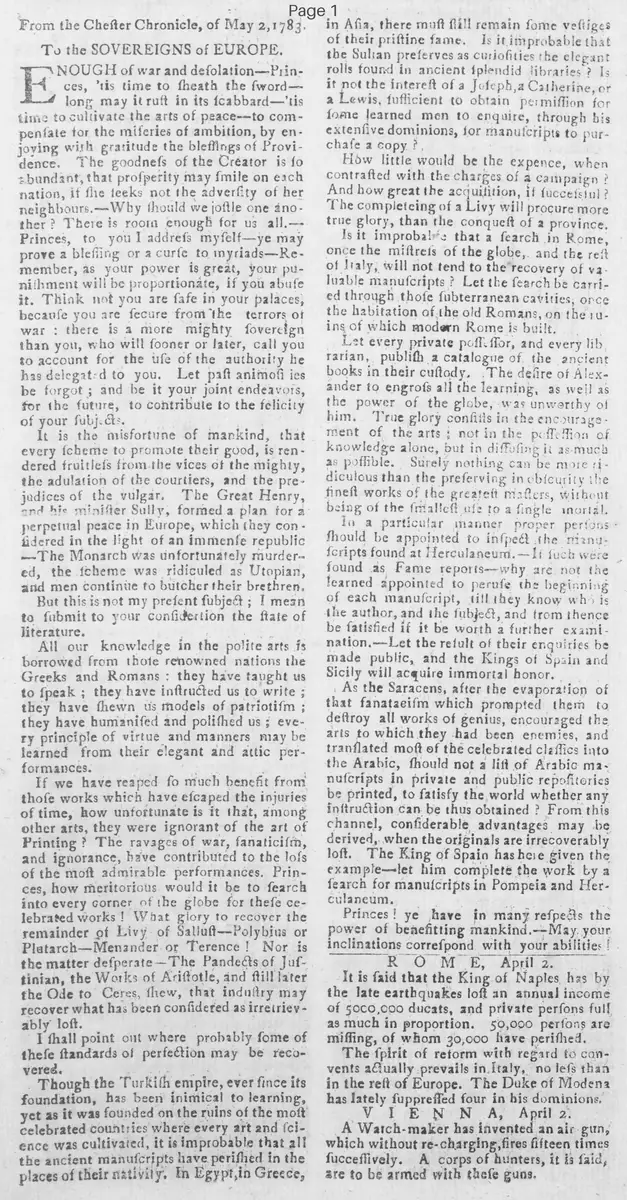
From the Chester Chronicle, of May 2, 1783.
To the SOVEREIGNS of EUROPE.
ENOUGH of war and desolation--Princes, 'tis time to sheath the sword--long may it rust in its scabbard--'tis time to cultivate the arts of peace--to compensate for the miseries of ambition, by enjoying with gratitude the blessings of Providence.
The goodness of the Creator is so abundant, that prosperity may smile on each nation, if she seeks not the adversity of her neighbours.--Why should we jostle one another? There is room enough for us all.--Princes, to you I address myself--ye may prove a blessing or a curse to myriads--Remember, as your power is great, your punishment will be proportionate, if you abuse it. Think not you are safe in your palaces. War: there is a more mighty sovereign than you, who will sooner or later, call you to account for the use of the authority he has delegated to you. Let past animosities be forgot; and be it your joint endeavours for the future, to contribute to the felicity of your subjects.
It is the misfortune of mankind, that every scheme to promote their good, is rendered fruitless from the vices of the mighty, the adulation of the courtiers, and the prejudices of the vulgar. The Great Henry, and his minister Sully, formed a plan for a perpetual peace in Europe, which they considered in the light of an immense republic--The Monarch was unfortunately murdered, the scheme was ridiculed as Utopian, and men continue to butcher their brethren.
But this is not my present subject: I mean to submit to your consideration the state of literature.
All our knowledge in the polite arts is borrowed from those renowned nations the Greeks and Romans: they have taught us to speak; they have instructed us to write; they have shewn us models of patriotism; they have humanised and polished us; every principle of virtue and manners may be learned from their elegant and attic performances.
If we have reaped so much benefit from those works which have escaped the injuries of time, how unfortunate is it that, among other arts, they were ignorant of the art of Printing? The ravages of war, fanaticism, and ignorance, have contributed to the loss of the most admirable performances. Princes, how meritorious would it be to search into every corner of the globe for these celebrated works! What glory to recover the remainder of Livy or Sallust--Polybius or Plutarch--Menander or Terence! Nor is the matter desperate. The Pandects of Justinian, the Works of Aristotle, and till later the Ode to Ceres, shew, that industry may recover what has been considered as irretrievably lost.
I shall point out where probably some of these standards of perfection may be recovered.
Though the Turkish empire, ever since its foundation, has been inimical to learning, yet as it was founded on the ruins of the most celebrated countries where every art and science was cultivated, it is improbable that all the ancient manuscripts have perished in the places of their nativity. In Egypt, in Greece, in Asia, there must still remain some vestiges of their pristine fame. Is it improbable that the Sultan preserves as curiosities the elegant rolls found in ancient splendid libraries? Is it not the interest of a Joseph, a Catherine, or a Lewis, sufficient to obtain permission for some learned men to enquire, through his extensive dominions, for manuscripts to purchase a copy?
How little would be the expence, when contrasted with the charges of a campaign? And how great the acquisition, if successful? The completing of a Livy will procure more true glory, than the conquest of a province.
Is it improbable that a search in Rome, once the mistress of the globe, and the rest of Italy, will not tend to the recovery of valuable manuscripts? Let the search be carried through those subterranean cavities, once the habitation of the old Romans, on the ruins of which modern Rome is built.
Let every private possessor, and every librarian, publish a catalogue of the ancient books in their custody. The desire of Alexander to engross all the learning, as well as the power of the globe, was unworthy of him. True glory consists in the encouragement of the arts: not in the possession of knowledge alone, but in diffusing it as much as possible. Surely nothing can be more ridiculous than the preserving in obscurity the finest works of the greatest masters, without being of the smallest use to a single mortal.
In a particular manner proper persons should be appointed to inspect the manuscripts found at Herculaneum.--If such were found as Fame reports--why are not the learned appointed to peruse the beginning of each manuscript, till they know who is the author, and the subject, and from thence be satisfied if it be worth a further examination.--Let the result of their enquiries be made public, and the Kings of Spain and Sicily will acquire immortal honour.
As the Saracens, after the evaporation of that fanaticism which prompted them to destroy all works of genius, encouraged the arts to which they had been enemies, and translated most of the celebrated classics into the Arabic, should not a list of Arabic manuscripts in private and public repositories be printed, to satisfy the world whether any instruction can be thus obtained? From this channel, considerable advantages may be derived, when the originals are irrecoverably lost. The King of Spain has here given the example--let him complete the work by a search for manuscripts in Pompeia and Herculaneum.
Princes! ye have in many respects the power of benefitting mankind.--May your inclinations correspond with your abilities!
To the SOVEREIGNS of EUROPE.
ENOUGH of war and desolation--Princes, 'tis time to sheath the sword--long may it rust in its scabbard--'tis time to cultivate the arts of peace--to compensate for the miseries of ambition, by enjoying with gratitude the blessings of Providence.
The goodness of the Creator is so abundant, that prosperity may smile on each nation, if she seeks not the adversity of her neighbours.--Why should we jostle one another? There is room enough for us all.--Princes, to you I address myself--ye may prove a blessing or a curse to myriads--Remember, as your power is great, your punishment will be proportionate, if you abuse it. Think not you are safe in your palaces. War: there is a more mighty sovereign than you, who will sooner or later, call you to account for the use of the authority he has delegated to you. Let past animosities be forgot; and be it your joint endeavours for the future, to contribute to the felicity of your subjects.
It is the misfortune of mankind, that every scheme to promote their good, is rendered fruitless from the vices of the mighty, the adulation of the courtiers, and the prejudices of the vulgar. The Great Henry, and his minister Sully, formed a plan for a perpetual peace in Europe, which they considered in the light of an immense republic--The Monarch was unfortunately murdered, the scheme was ridiculed as Utopian, and men continue to butcher their brethren.
But this is not my present subject: I mean to submit to your consideration the state of literature.
All our knowledge in the polite arts is borrowed from those renowned nations the Greeks and Romans: they have taught us to speak; they have instructed us to write; they have shewn us models of patriotism; they have humanised and polished us; every principle of virtue and manners may be learned from their elegant and attic performances.
If we have reaped so much benefit from those works which have escaped the injuries of time, how unfortunate is it that, among other arts, they were ignorant of the art of Printing? The ravages of war, fanaticism, and ignorance, have contributed to the loss of the most admirable performances. Princes, how meritorious would it be to search into every corner of the globe for these celebrated works! What glory to recover the remainder of Livy or Sallust--Polybius or Plutarch--Menander or Terence! Nor is the matter desperate. The Pandects of Justinian, the Works of Aristotle, and till later the Ode to Ceres, shew, that industry may recover what has been considered as irretrievably lost.
I shall point out where probably some of these standards of perfection may be recovered.
Though the Turkish empire, ever since its foundation, has been inimical to learning, yet as it was founded on the ruins of the most celebrated countries where every art and science was cultivated, it is improbable that all the ancient manuscripts have perished in the places of their nativity. In Egypt, in Greece, in Asia, there must still remain some vestiges of their pristine fame. Is it improbable that the Sultan preserves as curiosities the elegant rolls found in ancient splendid libraries? Is it not the interest of a Joseph, a Catherine, or a Lewis, sufficient to obtain permission for some learned men to enquire, through his extensive dominions, for manuscripts to purchase a copy?
How little would be the expence, when contrasted with the charges of a campaign? And how great the acquisition, if successful? The completing of a Livy will procure more true glory, than the conquest of a province.
Is it improbable that a search in Rome, once the mistress of the globe, and the rest of Italy, will not tend to the recovery of valuable manuscripts? Let the search be carried through those subterranean cavities, once the habitation of the old Romans, on the ruins of which modern Rome is built.
Let every private possessor, and every librarian, publish a catalogue of the ancient books in their custody. The desire of Alexander to engross all the learning, as well as the power of the globe, was unworthy of him. True glory consists in the encouragement of the arts: not in the possession of knowledge alone, but in diffusing it as much as possible. Surely nothing can be more ridiculous than the preserving in obscurity the finest works of the greatest masters, without being of the smallest use to a single mortal.
In a particular manner proper persons should be appointed to inspect the manuscripts found at Herculaneum.--If such were found as Fame reports--why are not the learned appointed to peruse the beginning of each manuscript, till they know who is the author, and the subject, and from thence be satisfied if it be worth a further examination.--Let the result of their enquiries be made public, and the Kings of Spain and Sicily will acquire immortal honour.
As the Saracens, after the evaporation of that fanaticism which prompted them to destroy all works of genius, encouraged the arts to which they had been enemies, and translated most of the celebrated classics into the Arabic, should not a list of Arabic manuscripts in private and public repositories be printed, to satisfy the world whether any instruction can be thus obtained? From this channel, considerable advantages may be derived, when the originals are irrecoverably lost. The King of Spain has here given the example--let him complete the work by a search for manuscripts in Pompeia and Herculaneum.
Princes! ye have in many respects the power of benefitting mankind.--May your inclinations correspond with your abilities!
What sub-type of article is it?
Essay
What themes does it cover?
War Peace
Political
What keywords are associated?
European Sovereigns
Perpetual Peace
Ancient Manuscripts
Literary Recovery
Greek Roman Classics
Herculaneum
Pompeii
Literary Details
Title
To The Sovereigns Of Europe.
Subject
Urging Peace And Recovery Of Ancient Literature
Key Lines
Enough Of War And Desolation Princes, 'Tis Time To Sheath The Sword Long May It Rust In Its Scabbard 'Tis Time To Cultivate The Arts Of Peace To Compensate For The Miseries Of Ambition, By Enjoying With Gratitude The Blessings Of Providence.
Princes, How Meritorious Would It Be To Search Into Every Corner Of The Globe For These Celebrated Works! What Glory To Recover The Remainder Of Livy Or Sallust Polybius Or Plutarch Menander Or Terence!
The Completing Of A Livy Will Procure More True Glory, Than The Conquest Of A Province.
True Glory Consists In The Encouragement Of The Arts: Not In The Possession Of Knowledge Alone, But In Diffusing It As Much As Possible.
Princes! Ye Have In Many Respects The Power Of Benefitting Mankind. May Your Inclinations Correspond With Your Abilities!