Thank you for visiting SNEWPapers!
Sign up free
Daily State Sentinel
Indianapolis, Marion County, Indiana
What is this article about?
Indiana editorial analyzes Supreme Court ruling that state officers cannot pay July 1863 debt interest without legislative appropriation, blames Republican walkout in 1863 legislature advised by Gov. Morton for blocking bills, urges special session to maintain state credit and avoid repudiation.
Merged-components note: Merged across pages as continuation of the same article on state debt interest and Supreme Court opinions; relabeled to 'editorial' due to opinionated political analysis.
Clippings
1 of 2
OCR Quality
Full Text
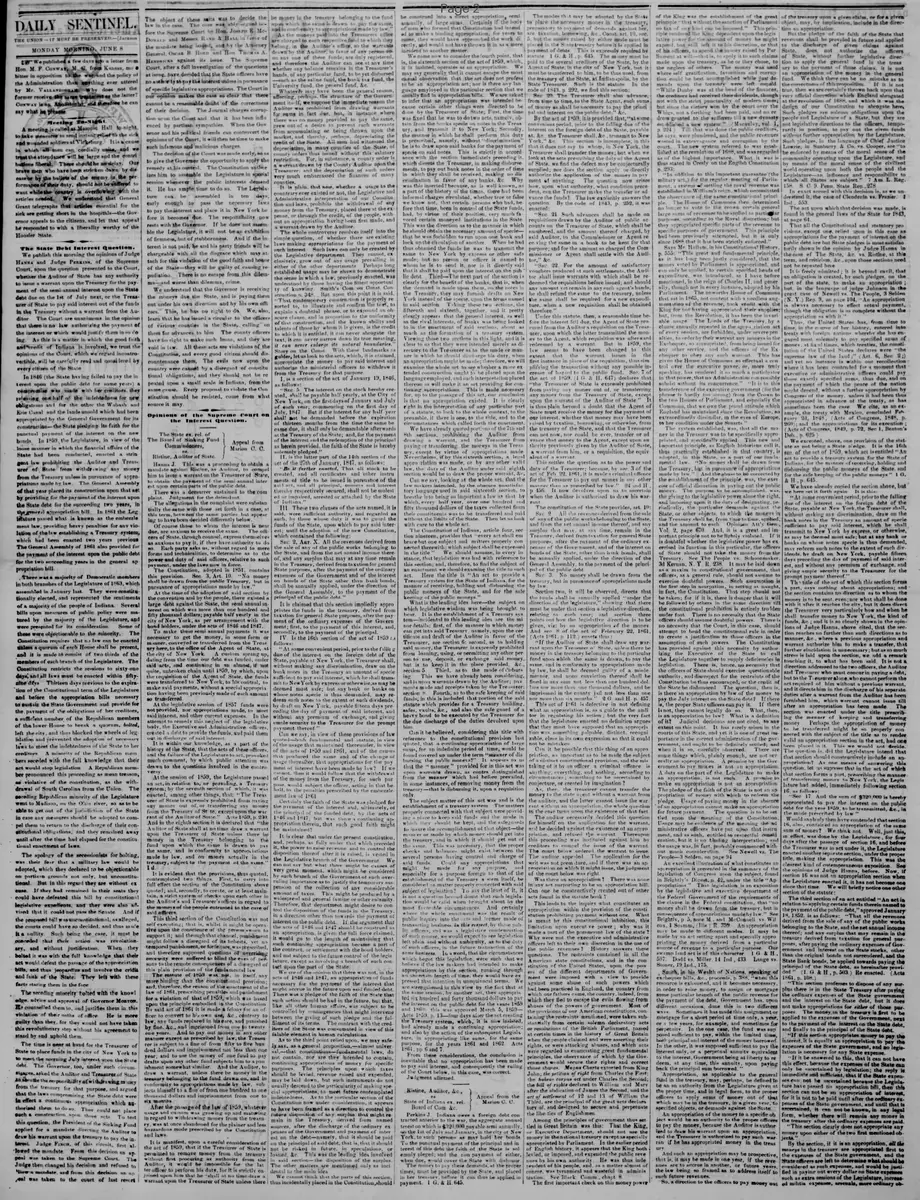
We publish this morning the opinions of Judge
Hanna and Judge Perkins, of the Supreme
Court, upon the question presented to the Court,
whether the Auditor of State has any authority
to issue a warrant upon the Treasury for the pay-
ment of the semi-annual interest upon the State
debt due on the 1st of July next, or the Treas-
urer of State to pay said interest out of the funds
in the Treasury without a warrant from the Au-
ditor. The Court are unanimous in the opinion
that there is no law authorizing the payment of
the interest or which would justify them in so do-
ing. As this is a matter in which the good faith
and credit of Indiana is involved, we trust the
opinions of the Court, which we regard incontro-
vertible, will be carefully read and considered by
every citizen of the State.
In 1846 (the State having failed to pay the in-
terest upon the public debt for some years) a
compromise was made with her creditors. they
releasing one half of the indebtedness for new
obligations and for the other the Wabash and
Erie Canal and the lands unsold which had been
appropriated by the General Government for its
construction—the State pledging its faith for the
punctual payment of the interest on the new
bonds. In 1859, the Legislature, in view of the
loose manner in which the financial affairs of the
State had been conducted, enacted a stringent
law prohibiting the Auditor and Treasurer
from withdrawing any money from the Treasury unless in pursuance of appro-
priations made by law. The General Assembly
of that year placed its construction upon that act
by providing for the payment of the interest upon
the State debt for the succeeding two years, in
the general appropriation bill. In 1861 the Leg-
islature passed what is known as the embezzle-
ment law, providing heavy penalties for any vio-
lation of the law establishing a Treasury system,
which had been enacted two years previous.
The General Assembly of 1861 also provided for
the payment of the interest upon the public debt
for the two succeeding years in the general ap-
propriation bill.
There was a majority of Democratic members
in both branches of the Legislature of 1863, which
assembled in January last. They were constitu-
tionally elected, and represented the sentiments
of a majority of the people of Indiana. Several
bills upon measures of public policy were ma-
tured by the majority of the Legislature, and
were presented for its consideration. Some of
these were objectionable to the minority. The
Constitution requires that no law can be enacted
unless a quorum of each House shall be present
and it is made to consist of two-thirds of the
members of each branch of the Legislature. The
Constitution restricts the sessions to sixty-one
days, and all laws must be enacted within fifty
ine days. Thirteen days previous to the expira-
tion of the Constitutional term of the Legislature
and before the appropriation bills necessary
to sustain the State Government and provide for
the payment of the obligations of her creditors,
sufficient number of the Republican members
of the lower House to break a quorum, bolted,
left the city, and thus blocked the wheels of leg-
islation and prevented the adoption of necessary
laws to meet the indebtedness of the State to her
creditors. A minority of the Republican mem-
bers seceded with the full knowledge that their
act would stop legislation. A Republican mem-
ber pronounced this proceeding as mean treason,
as violative of the constitution, as the with-
drawal of South Carolina from the Union. The
seceding Republican minority of the Legislature
went to Madison, on the Ohio river, so as to be
able to get out of the jurisdiction of the State
in case any measures should be adopted to com-
pel them to return to the discharge of their con-
stitutional obligations, and they remained away
until after the time had elapsed for the constitu-
tional enactment of laws.
The apology of the secessionists for bolting.
was their fear that a military law would be
adopted, which they declared to be objectionable
on partisan grounds not only, but unconstitu-
tional. But in this regard they are without ex-
cuse. If they had remained in their seats they
could have defeated this bill by constitutional
legislative expedients, and they were also ad-
vised that it could not pass the Senate. And if
the proposed bill was unconstitutional, as alleged,
the courts could have so decided, and thus twice
it a nullity. Such being the case, it must be
conceded that their action was revolution-
ary, and without justification. When they
bolted it was with the full knowledge that their
act would defeat the passage of the appropriation
bills, and thus jeopardize and involve the credit
and faith of the State. They left with these
facts staring them in the face.
The seceding minority bolted with the knowl-
edge, advice and approval of Governor Morton.
He counselled them to, and justifies them in this
violation of their oaths of office. He is more
guilty than they, for they would not have taken
this revolutionary step without his agreement to
stand by and uphold them.
The time is near at hand for the Treasurer of
State to place funds in the city of New York to
to meet the accruing July interest upon the State
debt. The Governor, too, under such circum-
stances, asked the Auditor and Treasurer of State
to assume the responsibility of withdrawing money
from the treasury for that purpose, and argued
that the laws compromising the State debt were
in effect a continuous appropriation which au-
thorized them to do so. They could not place
such a construction upon those acts. To test
this question, the President of the Sinking Fund
applied for a mandate directing the Auditor to
draw his warrant upon the treasury to pay the in-
terest. Judge Finch, of this circuit, first al-
lowed the mandate. From this decision an ap-
peal was taken to the Supreme Court. The
Judge then changed his decision and refused to
allow a mandate, and from this decision an ap-
peal was taken to the court of last resort.
The object of these suits was to decide the
law in the case. The case was ably argued be-
fore the Supreme Court by Hon. Joseph E. Mc-
Donald and Messrs. Rand & Hall in favor of
the mandate being issued, and by the Attorney
General, Oscar B. Hord and Hon. Thomas A.
Hendricks against its issue. The Supreme
Court, after a full investigation of the questions
at issue, have decided that the State officers have
no authority to pay the interest unless in pursuance
of specific legislative appropriations. The Court in
our opinion makes the case so clear that there
cannot be a reasonable doubt of the correctness
of their decision. The Journal charges corrup-
tion upon the Court and that it has been influ-
enced by partisan sympathies. When the Gov-
ernor and his political friends can controvert the
opinions of the Court, it will then be time to make
such infamous and malicious charges.
The decision of the Court was made early, so as
to give the Governor the opportunity to apply the
remedy at his control. The Constitution author-
izes him to assemble the Legislature in special
session whenever the public interests demand
it. He has ample time to do so. The Legisla-
ture can be assembled in ten days,
early enough to pass the necessary laws to pay the interest and place it in New York be-
fore it becomes due. The responsibility now
rests with the Governor. If he does not assem-
ble the Legislature, it will not be an exhibition
of firmness, but of stubbornness. And if the in-
terest is not paid, he and his party friends will be
chargeable with all the disgrace which may at-
tach for this violation of the good faith and honor
of the State—they will be guilty of causing re-
pudiation. There is no escape from this dilem-
ma—and worse than dilemma, crime.
We understand that the Governor is receiving
the moneys due the State, and is paying them
out under his own direction and by his own offi-
cers. This, he has no right to do. We, also,
learn that he has issued a circular to the officers
of various counties in the State, calling on
them for advances to him. The county officers
have no right to make such loans, and they are
void in law. All these acts are violations of the
Constitution, and every good citizen should dis-
countenance them. The evils now upon the
country were caused by a disregard of constitu-
tional obligations, and they should not be re-
peated upon a small scale in Indiana, from the
same cause. Every proposal to violate the Con-
stitution should be resisted, come from what
source it may.
Opinions of the Supreme Court on
the Interest Question.
The State ex. rel. of The Board of Sinking Fund
Appeal from Commissioners,
Marion C. C. vs. Ristine, Auditor of State.
Hanna, J. This was a proceeding to obtain a
mandate against Ristine, as Auditor, to compel
him to issue a warrant on the Treasurer of State,
to obtain the payment of the semi-annual inter-
est upon certain parts of the public debt.
There was a demurrer sustained to the com-
plaint. Judgment for the defendant.
The allegations in the complaint were substan-
tially the same with those set forth in a case, at
this term, between the same parties, but appear-
ing to have been decided differently below.
Of course those to whom the interest is near
due, are anxious to receive the same.
The officers of State, through counsel, express themselves
as anxious to pay it, if they have authority to do
so. Each party asks us, without regard to mere
forms and technicalities, to determine as to the
power and duty of said officers, relative to such
payment, under the laws now in force.
The Constitution, adopted in 1851, contains
this provision. Sec. 3, Art. 10. "No money
shall be drawn from the public Treasury, but in
pursuance of appropriations made by law."
At the time of the adoption of said section by
the convention and by the people, there existed a
large debt against the State, the semi-annual in-
terest on which was more than one hundred and
fifty thousand dollars; payable half yearly in the
city of New York, as per arrangement with the
bond holders, under the acts of 1846 and 1847.
To make these semi-annual payments it was
necessary to get the money, in some form or
manner, conveyed or transferred from the Treas-
ury here, to the office of the Agent of State, at
the city of New York. A custom sprang up,
dating from the time our debt was funded, under
said acts, and continuing in an almost, if not
quite, unbroken chain until 1859, by which, upon
the requisition of the Agent of State, the funds
were transferred to New York, to his control, to
make said payments, without a special appropria-
tion having been previously made of each amount
so transferred.
At the legislative session of 1857 funds were
not provided, nor appropriations made, to meet
said interest, and other current expenses. In the
attempt to remedy this neglect of the legislative
body, the Executive and Administrative officers,
created a debt to provide the funds, and paid them
out in discharge of said interest.
It is within our knowledge, as a part of the
history of the State, that the acts of these officers,
and the failure of the Legislature to act, provoked
much comment, by which public attention was
drawn to the questions involved in the contro-
versy.
At the session of 1859, the Legislature passed
an act, in relation to, or providing, a Treasury
system; by the seventh section of which, it was
enacted, among other things, that: "The Treas-
urer of State is expressly prohibited from paying
any money out of, or transferring any money
from the Treasury of State, except upon the war-
rant of the Auditor of State." Acts 1859, p. 230.
And in the eighth section it is declared that "the
Auditor of State shall at no time draw a warrant
upon the Treasurer of State unless there be
money in the Treasury belonging to the
fund upon which the same is drawn to pay
the same, and in conformity to appropriations
made by law, and on money actually in the
treasury, subject to the payment of the same."
Id.
It is evident that the provisions, thus quoted,
contemplated two things. First, to carry into
full effect the section of the Constitution above
quoted; and, secondly, to create, or at least main-
tain, a strict system of checks upon each other in
the Auditor's and Treasurer's offices in regard to
the moneys of the people entrusted to the care of
said officers.
This third section of the Constitution was not
self executing; that is, whilst it might be opera-
tive upon the conscience of the person sworn to
support it; and through that channel, punishment
might follow a disregard of its behests, yet no
temporal punishment, or forfeiture, was prescribed,
and therefore supposed questions of overriding
necessity were suffered to blind the eyes of per-
sons to the remote consequences of a disregard of
this plain provision of the fundamental law.
The statute of 1859 was not, in itself, any
more binding than the constitutional provision;
and, therefore, the reason of the enactment of the
law of 1861, prescribing penalties and punishment
for a violation of that of 1859, which was based
upon the principle embodied in the Constitution.
By said act of 1861 it is made a felony for an of-
ficer to convert to his own use, &c., contrary to
law, any funds reposed in his care, and punished
by fine, &c., and imprisoned from one to twenty
one years. And to pay out money in any other
manner except as prescribed by law, the Treasu-
rer is subject to a fine of from fifty to five hun-
dred dollars and imprisonment not less than one
year; and to use the money of one fund to pay
drafts upon any other fund subjects him to a pun-
ishment somewhat similar. And the Auditor, to
draw a warrant, unless there be money in the
treasury belonging to the fund drawn on, and in
conformity to appropriations made by law, sub-
jects himself to a fine of from one hundred to one
thousand dollars and imprisonment from one to
six months.
After the passage of the law of 1859, whatever
usage and custom was growing up and maturing
in regard to withdrawing money from the treasu-
ry, was at once abandoned for the plainer and less
hazardous mode prescribed by the Constitution
and laws.
It is manifest, upon a careful consideration of
the act of 1859, that if the Treasurer of State is
permitted to remove money from the treasury
without first procuring a warrant from the Auditor, it would be impossible for the latter officer to perform his duty, for it is strictly en-
joined upon him that he shall at no time draw a
warrant upon the Treasurer of State unless there
be money in the treasury belonging to the fund
upon which the same is drawn to pay the same,
and in conformity to appropriations made by law."
As the moneys paid into the Treasurer's office
are charged to each respective fund to which they
belong, in the Auditor's office, so the warrants
drawn by the Auditor, in favor of any person up-
on any one of these funds, are duly registered,
and therefore the Auditor can see at any time
whether any balance remains in the Treasurer's
hands, of any particular fund, to be yet disbursed
—such as the saline fund, the bank tax fund, the
University fund, the general fund, &c.
Whatever may have been the general reason,
affecting, perhaps, the structure of the Govern-
ment itself, we suppose the immediate reason the
Auditor was prohibited from drawing warrants
for sums in fact due, but, in instance where
there was no money provided to pay the same,
grew out of a desire to prevent such warrants
from accumulating or being thrown upon the
market, and thereby, perhaps, depreciating the
credit of the State. All men had witnessed the
depreciation, in many counties of the State, of
county orders thus issued without this salutary
restriction. For, in substance, a county order is
a warrant drawn by the County Auditor upon the
Treasurer; and the depreciation of such orders
very much embarrassed the finances of many
counties.
It is plain, that none, whether a usage to the
contrary ever existed or not, the Legislative and
Administrative interpretation of our Constitu-
tion and laws, prohibits the withdrawal of any
money from the Treasury, placed there at the ex-
pense, or through the credit, of the people, with-
out an appropriation having been first made, and
a warrant drawn by the Auditor.
The whole controversy resolves itself into the
simple question, of whether there are existing
laws making appropriations for the payment of
such interest. Such laws can only be created by
the Legislative department. They cannot, ex-
clusively, grow out of any usage prevailing in
either of the other departments. Perhaps long
established usage may be shown to demonstrate
the sense in which a law, previously enacted, was
understood by those having the fittest opportuni-
ties of knowing. Smith's Com. on Const. Con-
struction, p. 348. But upon this point it is said,
"That contemporary construction is properly re-
sorted to, to illustrate and confirm the text, to
explain a doubtful phrase, or to expound an ob-
scure clause, and in proportion to the uniformity
of that construction, and the known ability and
talents of those by whom it is given, is the credit
to which it is entitled. It can never abrogate the
text, it can never narrow down its true meaning.
It can never enlarge its natural boundaries?"
Story on the Const. With these landmarks as
guides, let us look to the acts, which, it is claimed,
appropriate the money to pay said interest and
authorize the ministerial officers to withdraw it
from the Treasury for that purpose.
I. is a section of the act of January 19, 1846,
as follows:
"Sec. 5. The interest on the stock hereby cre-
ated, shall be payable half yearly, at the City of
New York, on the first days of January and July
of each year; commencing on the first day of
July, 1847. But if the interest for any half year
shall not be demanded before the expiration
of thirteen months from the time the same be-
came due, it shall only be demandable afterwards
at the Treasury of the State; and, for the payment
of the interest and the redemption of the principal
as herein provided, the faith of the State is hereby
solemnly pledged."
II. is the latter part of the 14th section of the
act of the 27th of January, 1847, as follows:
"Be it further enacted, That all stock to be
created, and all certificates and other instru-
ments of title to be issued in pursuance of the
said act, and all principal, moneys and interest
thereby respectively secured, shall not be molest-
ed or impaired, arrested or attached by the State
of Indiana."
III. These two clauses of the acts named, it is
said, were sufficient authority, and regarded as
such, by those whose duty it was to guard the
funds of the State, upon which to pay said inter-
est: until the adoption of the new Constitution,
which contained the following:
Sec. 2, Art. X. All the revenues derived from
the sale of any of the public works belonging to
the State, and from the net annual income there-
sof, and any surplus that may at any time remain
in the Treasury, derived from taxation for general
State purposes, after the payment of the ordinary
expenses of the Government and of the interest
on bonds of the State other than bank bonds,
shall be annually applied, under the direction of
the General Assembly, to the payment of the
principal of the public debt."
It is claimed that this section impliedly appro-
priates the funds in the treasury, derived from
taxation for general State purposes, after the pay-
ment of the ordinary expenses of the Govern-
ment; first, to the payment of this interest, and
secondly, to the payment of the principal.
IV. Is the 16th section of the act of 1859.
follows:
"At some convenient period, prior to the falling
due of the interest on the foreign debt of the
State, payable at New York, the Treasurer shall,
without making any discrimination, draw on the
bank notes in the Treasury an amount of specie
sufficient to pay said interest, which he shall trans-
mit to New York by express or otherwise, as may be
deemed most safe; but any bank or banks on
whose notes specie is thus demanded, may re-
deem such notes to the extent of such dividends,
by draft on New York, payable fifteen days pre-
ceding the day of payment of said interest, and
without any premium of exchange, and giving
ample security to the Treasurer for the prompt
payment thereof."
Can we say, in view of these provisions of law
quoted—both fundamental and statute, in view
of the usage that maintained thereunder, in view
of the acts of 1859 and 1861, and of the causes
that produced the same and of the change of
usage thereafter, that appropriations for the pay-
ment of interest have been made by law? If we
cannot, then it would follow that the withdrawal
of the money from the Treasury, for such pur-
pose, would subject the officer, acting in that be-
half, to the penalties prescribed by the embezzle-
ment law of 1861.
Certainly the faith of the State was pledged for
the payment of the interest and, ultimately, of
the principal of the funded debt, by the acts of
1846 and 1847; but was there a continuing ap-
propriation therein, that such good faith might
be maintained?
It is clear that under the present constitution,
and, perhaps, as fully under that which preceded
it, the power to raise revenue and to control the
disposition thereof after it is raised, is vested in
the Legislative branch of the Government. We
can not say but what there might be causes of
very great moment, which might be considered
by such branch of the Government of such over-
ruling importance as to justify the temporary sus-
pension of the collection of any considerable
amount of taxes. This might be produced by a
widespread and general famine or other calamity.
Therefore, that department might desire to con-
trol the disposition of the funds in the Treasury,
in a direction other than towards the payment of
interest on the public debt. If the argument that
the acts of 1846 and 1847 should be construed as
an appropriation, is given the full force claimed,
it would go to the length of maintaining that
such continuing appropriation became a part of
the contract, or settlement with the bond holders,
and not subject to the future control of the legis-
lature, except as involving a breach of such con-
tract upon the part of the State.
We are of the opinion that there was not, in the
acts of 1846 and 1847, an appropriation of funds
necessary for the payment of the interest that
might accrue in the future upon said funded debt.
There was a pledge of the faith of the State that
such action should be had in the future, but that,
like all other human affairs, was subject to be
controlled by contingencies that might intervene
between the giving of such pledge and the ful-
fillment of its terms. The contract with the cred-
itors of the State was consummated in view of this
fallible element in human calculations.
As to the third point relied upon, we may safe-
ly say, as a general proposition,—almost univer-
sal,—that constitutions—fundamental laws, do
not contain, nor are they intended to contain,
continuing appropriations of money for specific
purposes. The principles upon which taxes
should be levied, revenue raised and expended,
may be laid down, but such instruments do not
usually descend to the particularity of making spe-
cial appropriations, to meet future contemplated
indebtedness. As to the particular section of the
Constitution now under consideration, it appears
to have been framed as a direction to control the
future disposition of any surplus that might re-
main in the Treasury, derived from named
sources, after the discharge of the ordinary ex-
penses of the Government and payment of inter-
est on the debt—namely, that it should be paid
on the principal of said debt, that is, that it should
not be risked in future, in speculations, or
loaned, &c. This was the leading idea involved
in said section—the disposition of the surplus.
The other matters are mentioned only as inci-
dental to the main idea.
We cannot think that the parts of this section
thus incidentally placed in the Constitution, should
be construed into a direct appropriation, semi-
annually, of large sums. Certainly if the body
of men who formed that Constitution had intend-
ed to make a binding appropriation, for years to
come, they would have approached the work di-
rectly, and would not have thrown it in as a mere
incident to another matter.
We come now to consider the fourth point, that
is, the sixteenth section of the act of 1859, which,
it is insisted, operates as an appropriation. We
may say generally that it cannot escape the most
casual observation that the act does not profess
to be an appropriation act; nor is there any lan-
guage employed in this particular section that we
usually find in appropriation bills. We are asked
to infer that an appropriation was intended be-
cause certain other things were directed to be
done by the Treasurer of State; First, the time
was fixed that he was to do two acts, namely, ob-
tain from the banks specie on notes in the Treas-
ury, and transmit it to New York; Secondly,
the manner in which he shall perform this duty
is prescribed, namely, without "discrimination"
he is to draw upon said banks for the payment of
specie on said notes. This is strictly in accord-
ance with the section immediately preceding it,
which directs the Treasurer, in making disburse-
ments, to pay out bank notes in the order of time
in which they shall be received, making no dis-
crimination in favor of any banks, &c. Why
was this inserted? because, as is well known, as
a part of the history of the times, there had been
informal charges circulated, whether true or false
we know not, that certain persons who had, be-
fore that time, been in control of the State funds,
had, by virtue of their position, very much fa-
vored certain moneyed institutions in the State.
This was the direction as to the manner in which
he should obtain the necessary amount of specie—
that he was forbidden to run upon one bank and
lock up the circulation of another. When he had
thus obtained the funds he was to transmit the
same to New York by express or other safe
mode: but no person or officer is named to
whom he is to send it, nor is it directly said
that it shall be paid upon the interest on the pub-
lic debt. Third—The next part of the section is
clearly for the benefit of the banks, that is, when
the demand is made upon them, on the notes in
the Treasury, they may furnish drafts on New
York instead of the specie, upon the terms named
in said section. Taking these two sections, the
fifteenth and sixteenth, together, and it pretty
clearly appears that the general interest, as well
as the rival interests, of banks was being looked
to in the enactment of said sections, about as
much as the formation of a treasury system.
Viewing these two sections in this light, and it is
clear to us that they were intended merely as di-
rectory to the Treasurer as to the mode or man-
ner in which he should discharge his duty, when
an appropriation might be made; therefore, we will
examine the whole act to see whether a more ex-
tended construction ought to be placed upon the
language employed, and such interpretation placed
thereon as will make it an act providing for con-
tinuing appropriations. This is made necessary
for, up to the passage of this act, our conclusion
is that no appropriation existed. It is clearly
right in the interpretation of any particular part
of a statute, to look to the whole context, to the
preamble, if there is one, to the title, and to the
circumstances which called forth the enactment.
We have already quoted portions of the 7th and
8th sections, prohibiting the Auditor from
drawing a warrant, and the Treasurer from
paying or transferring the moneys in the Treas-
ury, except by virtue of appropriations made
by law. Nevertheless, if by this sixteenth section, a legal appro-
priation was made, or by any other valid
law, the duty of the Auditor under said eighth
section would be to draw the proper warrant, &c.
Can we say, looking at the whole act, that the
law makers intended, by the obscure unsatisfac-
tory language used in said sixteenth section, to
breathe into being so important a law as that by
which, every half year, over one hundred and
fifty thousand dollars of the taxes collected from
their constituents was to be transferred and paid
without the limits of the State.
Then let us look with care to the whole act.
The Constitution of Indiana, article four, sec-
tion nineteen, provides that "every act shall em-
brace but one subject and matters properly con-
nected therewith; which subject shall be expressed
in the title."
We should assume, in every in-
stance, that legislation was had with reference to
this section; and, therefore, to find the subject of
an enactment we should examine the title to such
act. Here the title is "An act to provide a
Treasury system for the State of Indiana, for the
manner of receiving, holding and disbursing the
public moneys of the State, and for the safe
keeping of the public moneys."
What is the leading idea here—the subject on
which legislative wisdom was being brought to
bear. It is the establishment of a Treasury sys-
tem—incidental to this leading idea are the mi-
nor details: first, of the manner in which money
can get into said Treasury, namely, upon the cer-
tificate and draft of the Auditor in favor of the
Treasurer, see section 6: second, as to holding
said money, the Treasurer is expressly prohibited
from loaning, using, or permitting any other per-
son to use, deposit, or exchange said money,
but is to keep it in the place provided, &c., sec-
tion 5. Third, as to the mode of disburs-
ing. This we have already been considering,
and is upon warrants drawn by the Auditor; pay-
ments made and receipts taken by the Treasurer;
section 8. Fourth, as to the safe keeping of said
funds, in this is included that portion of the said
statute which provides for a Treasury building,
safes, vaults, &c., and also the safe guard of a
heavy bond to be executed by the Treasurer for
the due discharge of the duties devolved upon
him.
Can it be believed, considering this title with
reference to the constitutional provision last
quoted, that a continuing appropriation of large
sums, for an indefinite period of time, would be
found covered up under the term "manner of dis-
bursing the public moneys?"
It appears to us that the "manner" provided for in this act was
upon warrants drawn, as contra distinguished
from the manner which had before prevailed,
in some instances, of removing money from the
treasury—that is disbursing it, upon a requisition
only.
The subject matter of this act was and is the
establishment of a treasury system. The matters
properly connected with that subject were provid-
ing a place to keep said funds and the mode in
which they should be kept, and the safeguards
to insure the accomplishment of that object—the
manner or mode by which money should get into
the treasury, and in which it should get out of
the same. This was necessary, that the proper
checks and balances might exist between the
several persons having control and charge of
said funds.
Could any appropriations that
might be made for any purpose, and
especially for a purpose foreign to that of the
establishment of the Treasury system itself, be
considered as matter properly connected with said
subject of legislation? To say the least of it, it
is not a question beyond doubt that such legisla-
tion would be valid when brought about by the
most favorable circumstances. And certainly
where the whole enactment was the result of
public inquiry into the acts and former mode of
transacting business, in this respect, by these pub-
lic officers, and was a legislative condemnation
of such course, we would expect to see legislation
left plain and without ambiguity, as to the duty
of such officers, in the future transaction of the
same business. In a word, that the circumstances
which begot this legislation, were such that we
believe if the law makers had intended to make
appropriations by this section, running through
an uncertain length of time, they would have ex-
pressed that intention in unequivocal terms. We
are strengthened in this view by the fact that at
the same session, by another act, they appropria-
ted six hundred and forty thousand dollars to pay
the interest on the public debt for the years 1859
and 1860: this was approved March 5, 1859—
Acts 1859, p. 13—four days after the act creating
the Treasury system, which, it is now insisted,
had already made a continuing appropriation;
and also by the action of the subsequent Legisla-
ture, in appropriating like sums, for the same
purpose, for the years 1861 and 1862. Acts
1861, pp. 6 and 7.
From these considerations, the conclusion is
inevitable that no appropriation has been made
to pay said interest, and consequently the ruling
of the Court below, in this case, was correct.
Judgment affirmed.
Ristine, Auditor, &c.,
as.
Appeal from the State of Indiana ex. rel.
Marion C. C. Board of Com. &c.
Perkins, J. Indiana owes a foreign debt con-
tracted anterior to the war, the aggregate annual
interest on which is $320,000, payable semi-annually,
on the 1st of July and January, in the city of New
York, to such persons as may hold her bonds.
To the punctual payment of the principal and in-
terest of this debt the faith of the State is sol-
emnly pledged; and the non-payment of either,
when due, would cover the State with dishonor.
The money to pay these demands, at the proper
times, must be provided by the State, and placed
in her treasury, before it can thus be applied in
payment. 1 G. & H. 645.
The modes that may be adopted by the State
to place the necessary money in the treasury,
preparatory to payment of demands against her,
are taxation, borrowing, &c. Const. art. 10, sec.
5, but the money raised by either mode must be
placed in the State treasury before it is applied in
payment of debts. This is expressly required by
statute. 1 G. & H. p. 645. The money must be
paid to the several creditors of the State, by the
Agent of State, in the city of New York, but it
must be transferred to him, to be thus used, from
the treasury of the State, at Indianapolis, by the
State Treasurer. Such is the statute. In the
code of 1843, p. 292, we find this section:
Sec. 20. The Treasurer shall also advance,
from time to time, to the State Agent, such sums
of money as shall be necessary to pay the princi-
pal and interest on the public debt," &c.
By the act of 1859, it is provided that, "at some
convenient period, prior to the falling due of the
interest on the foreign debt of the State, payable
at, &c., the Treasurer shall, &c., transmit to New
York," &c. This section is incomplete, in this
that it does not say to whom, in New York, the
Treasurer shall transfer the money: but when we
look at the acts prescribing the duty of the Agent
of State, we find the defect may be conjecturally
supplied: nor does the section apply or directly
authorize the application of the money in pay-
ment of anything. The question now arises
how, upon what authority, what condition prece-
dent, can the Treasurer make the transfer or ad-
vance the funds? The law explicitly answers the
question.
By the code of 1843, p. 252, it was
enacted:
"Sec. 21. Such advances shall be made on
requisitions drawn by the Auditor of public ac-
counts on the Treasurer of State, which shall be
numbered, and the amount thereof charged, by
said Auditor, to the Commissioner or Agent re-
ceiving the same in a book to be kept for that
purpose; and for the amount so charged the Com-
missioner or Agent shall settle with the Audi-
tor," &c.
"Sec. 22. For the amount of satisfactory
vouchers produced at such settlements, the Audi-
tor shall issue warrants with which shall be re-
deemed the requisitions before issued; and should
any amount yet remain in any such agent's hands,
he shall refund the same to the treasury, unless
the same shall be required for a new expendi-
ture, when a new requisition shall be obtained
therefore."
Under this statute, then, a reasonable time be-
fore the interest fell due, the Agent of State pro-
cured from the Auditor a requisition on the Treas-
urer, upon which the latter transmitted the mon-
ey to the Agent, which requisition was afterward
redeemed by a warrant. But in 1859, the
law seems to have been changed to this
extent that the warrant issues in the
first instance in place of the requisition, thus sim-
plifying the transaction without any possible in-
crease of hazard to the public fund." Sec. 7 of
the act of 1859. (1 G. & H. 647) declares that
"the Treasurer of State is expressly prohibited
from paying any money out of, or transferring
any money from the Treasury of State, except
upon the warrant of the Auditor of State." It
is thus plain beyond a doubt that the Agent of
State must receive the money for the payment of
our interest, whether that money may have been
raised by taxation, borrowing, or otherwise, from
the treasury of the State, and that the Treasurer
can not now, nor could he ever, transfer or ad-
vance that money to the Agent, except upon au-
thority previously given by the Auditor of State
a warrant from him, or a requisition, the equiv-
alent of a warrant.
This settles the question as to the power and
duty of the Treasurer: because, by sec. 3 of the
act of Feb. 22, 1861, it is made a criminal offence
for the Treasurer to pay out money in any other
manner than as prescribed by law." 2 G. & H.
p. 456. It now devolves upon us to ascertain
when the Auditor is authorized to draw his war-
rant.
The constitution of the State provides, art. 10:
Sec. 2. All the revenues derived from the sale
of any of the public works belonging to the State,
and from the net annual income thereof, and any
surplus that may, at any time, remain in the
Treasury, derived from taxation for general State
purposes, after the payment of the ordinary ex-
penses of the Government, and of the interest on
bonds of the State, other than bank bonds, shall
be annually applied, under the direction of the
General Assembly, to the payment of the princi-
pal of the public debt.
Sec. 3. "No money shall be drawn from the
treasury, but in pursuance of appropriations made
by law."
Section two, it will be observed, directs that
the funds shall be annually applied "under the
direction of the legislature," showing that there
must be under that section a legislative direction,
relating to each year; and section three
points out how the legislative direction is to be
given, viz: by an appropriation of the money.
And sec. 8 of the act of February 22, 1861
(Acts 1861, p. 112) enacts thus:
"If the Auditor of State shall draw any war-
rant upon the Treasurer of State, unless there be
money in the treasury belonging to the particular
fund upon which the same is drawn, to pay the
same, and in conformity to appropriations made
by law, he shall be deemed guilty of a misde-
meanor, and upon conviction thereof shall be
fined in any sum not less than one hundred dol-
lars nor more than one thousand dollars, and be
imprisoned in the county jail not less than one
nor more than six months." 2 G. & H. p. 457.
This act of 1861 is defective in not defining
what an appropriation is, as a guide to the audi-
tor in regulating his action: but the very fact
that the legislature enacted no definition argues
that they must have supposed that an appropria-
tion was something palpable, distinct, recogni-
zable, clear in its own expression so that it could
not be mistaken.
Can it be possible that this thing of an appro-
priation, so important as to be made the subject
of a distinct constitutional provision, and the mis-
taking of it by an officer a criminal offence is
anything, everything, and nothing, according to
circumstances; something to be ascertained by
conjecture, or created by imagination?
As, therefore, the treasurer cannot transfer the
money to the state agent without a warrant from
the auditor, and the latter cannot issue the war-
rant without an appropriation, the whole question
in the case turns upon the existence of that fact.
The auditor necessarily decided this question
for himself on the application for the warrant,
and he decided against the existence of an appro-
priation, and refused the warrant. Thereupon
this proceeding was instituted against him by
creditors to compel the issue of the warrant.
The court below ordered the warrant to issue.
The auditor appealed. The application for the
writ was not premature, and if there was an ap-
propriation on which it might issue, the judgment
of the court below was right.
Was there an appropriation? There was none
in any act purporting to be an appropriation bill.
Can one be constructively created out of other
acts found in the statute book?
This leads to the inquiry what constitutes an
appropriation within the provision of the consti-
tution prohibiting payment without one. What
is meant by this constitutional inhibition, this
limitation upon executive power; why was it
made a part of the paramount law of the state?
Why were not the executive and administrative
officers left to their own discretion in the use of
the public revenues? History answers these
questions. The restraints contained in all the
American state constitutions, and in the con-
stitution of the United States, upon the pow-
ers of the different departments of Govern-
ment were imposed with a view to provide
against some abuse of such powers which
had been practiced in England, the country from
which our fathers came, the country, indeed, from
which they fled to escape the evils flowing from
abuses of the powers of government. Most of
the provisions of our American constitutions, con-
taining the restraints mentioned, were taken sub-
stantially from certain solemn declaratory acts
or resolutions of the British Parliament, passed
at certain times in the history of Great Britain
when the people claimed and were asserting their
rights, or were attacking abuses, and which acts
were regarded as enunciating great fundamental
principles, the observance of which by the Gov-
ernment would secure their rights and correct
those abuses. Magna Charta extorted from King
John; the petition of right from Charles the First;
the habeas corpus act under Charles the Second;
the bill of rights declared to William and Mary
after the abdication of James the Second, and the
act of settlement of 12 and 13 of William the
Third, are the principal of the great acts declara-
tory of, and designed to secure and perpetuate
the liberties of Englishmen.
Among the principles of government thus set-
tled in Great Britain was this: That the King,
or Executive Department, should not use the
money in the national treasury except as specially
appropriated by Parliament. In the earlier period
of English history, it appears that the King both
levied, or imposed, and expended the public reve-
nues by his own authority. He was thus inde-
pendent of his people, and, as a matter almost of
course, was tyrannical and wasteful in adminis-
tration. See Black. Comm. chapt. 8.
The first important check on this money power
of the King was the establishment of the great
principle "that without the sanction of Parliament
no tax of any kind can be imposed." This prin-
ciple rendered the King dependent upon the legis-
lative power for the amount of money he might
expend, but still left it to his discretion, or that
of his officers, to spend the money raised by Par-
liament at will—that is, to apply it to such claims
made upon the treasury, as he or they chose, to
the neglect of others."
The money was used
where self-gratification, favoritism and corrup-
tion could be best accomplished while just de-
mands upon the treasury were left unpaid.
"While Danby was at the head of the finances,
the creditors had received their dividends, though
not with the strict punctuality of modern times;
but since the victory won by the court over the
Whigs, not a farthing had been paid, and no re-
dress granted to the sufferers till a new dynasty
established a new system." (Macaulay, vol. 1,
p. 224.) Till that was done the public creditors,
he says, were plundered, and the public revenues
wasted in extravagance and corruption by the
court. The new system referred to was estab-
lished at the revolution of 1688, and was regarded
as of the highest importance.
What it was is
thus stated in Cresly on the English Constitution,
p. 293:
"In addition to this important guarantee (the
military act.) for the regular meeting of Parlia-
ment, a system of settling the royal revenue was
established in William's reign, which necessitated
the observance of the same constitutional princi-
ple. The House of Commons then determined
no longer to vote to the crown certain general
large sums of revenues to be applied to particu-
lar purposes according to the Royal discretion; but
they appropriated specific parts of the revenue to
specific purposes of government. This principle
had been previously attempted, but it is only
since 1688 that it has been strictly enforced."
Says Mr. Hallam, in his Constitutional History,
p. 555: "This great and fundamental principle,
as it has long been justly considered, that the
money voted by Parliament is appropriated, and
can only be applied, to certain specified heads of
expenditure, was introduced, as I have before
mentioned, in the reign of Charles II, and gener-
ally, though not in every instance, adopted by his
Parliament. The unworthy House of Commons
that sat in 1665, not content with a needless aug-
mentation of the revenue, took credit with the
King for not having appropriated their supplies;
but, from the Revolution, it has been the invari-
able usage. The Lords of the Treasury, by a
clause annually repeated in the appropriation act
of every session, are forbidden, under severe pen-
alties, to order by their warrant any moneys in the
Exchequer, so appropriated, from being issued for
any other service, and the officers of the Ex-
chequer to obey any such warrant. This has
given the House of Commons so effectual a con-
trol over the executive power, or, more truly
speaking, has rendered it so much a participator
in that power, that no Administration can possibly
subsist without its concurrence." "It is to this
transference of the executive government (for the
phrase is hardly too strong) from the Crown to
the two Houses of Parliament, and especially the
Commons, that we owe the proud attitude which
England has maintained since the Revolution, so
extraordinarily dissimilar, in the eyes of Europe,
to her condition under the Stuarts.
The system established, was, that all the mo-
ey in the Treasury was to be specifically appro-
priated, and specifically applied. This new and
important principle, as English historians call it,
thus, practically established in that country, is
adopted, in this State, as a part of our funda-
mental law. "No money shall be drawn from
the Treasury, but in pursuance of appropriations
made by law."
And the abuse to be corrected by
the establishment of the principle, was, the exer-
cise of official discretion in paying out the public
money. The purpose to be accomplished, was,
the giving to the legislative power alone the right,
and imposing upon it the duty of designating, pe-
riodically, the particular demands against the
State, or other objects, to which the moneys in
the Treasury shall be, from time to time, applied,
and the amount to each. Opinions Att'y Gen.
Vol. 2, page 670. And, it is a great and im-
portant principle not to be lightly violated. If it
is doubtful whether the legislative power has ex-
ercised its function in this particular, the officers
of State should not take the money from the
Treasury. See The People vs. Schoonmaker,
3d Kernan, N. Y. R. 238. It may be laid down
as a maxim in constitutional government, that
officers, as a general rule, should not assume to
exercise doubtful powers. Such assumption is
the first step in usurpation, in setting at naught,
in fact, the Constitution. That step should not
be taken; for if it is, there is danger that it will
be followed by others in the same direction till
the constitutional prohibition is entirely trodden
under foot. There is no necessity that the State
officers should assume doubtful powers. There is
no necessity that the Court, in this case, should
attempt to bend the constitutional rule in order
to create a justification to those officers in the
assumption of such powers. The Constitution
has provided against this necessity by author-
izing the Executive of the State to call
the Legislature together to supply deficiencies in
legislation. There is, hence, no necessity that
the officers of State should exercise questionable
authority, and disrespect for the restraints of the
Constitution be thus encouraged, or the credit of
the State be dishonored. The question, then is,
is there an appropriation by law of the money to
pay the July interest on the State debt? If there
is, the proper State officers can pay it. If there
is not, they cannot legally do so. What, then,
is an appropriation by law? What is a definition
of it? Judicial decisions are not cited, to any
great extent on this point. It has rarely arisen in the
courts of this State, and yet it is one of great im-
portance in the correct administration of the gov-
ernment, and ought to be definitely settled; and
when it is so, carefully observed.
There are some things which, plainly enough, are not sev-
erally an appropriation. A promise by the Gov-
ernment to pay money is not an appropriation.
A duty on the part of the Legislature to make
an appropriation, is not such. A promise to
make an appropriation is not an appropriation.
The pledge of the faith of the State is not an ap-
propriation of money with which to redeem the
pledge. Usage of paying money in the absence
of an appropriation cannot make an appropriation
for future payment.
The question is to be set-
tled upon the meaning of the Constitution.
Usage may be evidence of the meaning the ad-
ministrative officers have put upon that instru-
ment, and as such, entitled to respectful consid-
eration, but it is no binding interpretation; and
the usage was, in fact, probably commenced with-
out much consideration.
See Newell vs. The People—3 Selden, on page 94.
An excellent illustration of what constitutes an
appropriation is presented in the summary of the
legislation of Congress upon the subject, found
in Brightly's Digest, n. 4, under the title "Ap-
propriations." That legislation is an exposition
by the legislative and executive department of
the Federal Government of the requirements of
the clause in the Federal constitution, that "no
money shall be drawn from the treasury, but in
consequence of appropriations made by law." See
Brightly, p. 5, note M. and McConnell vs. Wil-
cox, 1 Scamm. (Ills.) R. 359. An appropriation
may be made in different modes. It may be
made by an act setting apart and specially appro-
priating the money derived from a particular
source of revenue to a particular purpose. Our
swamp land act is of this character. 1 G. & H.
597. Dodd vs. Miller, 14 Ind., 433. Lange vs.
Stoner, 19 Ind., 175.
Smith, in his Wealth of Nations, speaking of
exchequer bills, &c., proceeds, p. 388. "When this
resource is exhausted, and it becomes necessary,
in order to raise money, to assign or mortgage
some particular branch of the public revenue for
the payment of the debt, Government has, upon
different occasions, done this in two different
ways.
Sometimes it has made this assignment or
mortgage for a short period of time only, a year,
or a few years, for example, and sometimes for
perpetuity. In the one case, the fund was sup-
posed sufficient to pay, within the limited time,
both principal and interest of the money borrowed.
In the other, it was supposed sufficient to pay the
interest only, or a perpetual annuity equivalent
to the interest, Government being at liberty to re-
deem, at any time, this annuity, upon paying back the principal sum borrowed.
Appropriation, as applicable to the general
fund in the treasury, may, perhaps, be defined to
be an authority from the Legislature given at
the proper time, and in legal form, to the proper
officers to apply sums of money out of that
which may be in the treasury, in a given year, to
specified objects, or demands against the State.
An appropriation of the money to a specific ob-
ject would be an authority to the proper officers
to pay the money, because the Auditor is author-
ized to draw his warrant upon an appropriation
and the Treasurer is authorized to pay such war-
ran if he has appropriated money in the treas-
ury.
And such an appropriation may be prospective,
that is, it may be made in one year, if the reve-
nues are to accrue in another, or future years,
the law being so framed as to address itself to
such future revenues.
So, a direction to the officers of the treasury upon a given claim, or for a given
object, may, by implication, include in the direc-
tion an appropriation.
But the pledge of the faith of the State that
revenues shall be provided in future and applied
to the discharge of given claims against
State, does not authorize the officers
of State, without further legislative direc-
tion to apply the general fund in the treas-
ury to the payment of those claims, it is not
an appropriation of the money in the general
fund. We think there can be no mistake as to
the correctness of this proposition. If it be
true, then we are certainly thrown back upon that
very official discretion which England abrogated
at the revolution of 1688, and which it was the
design of our Constitution to abrogate here.
Such pledges are solemn obligations upon the
people and Legislature of a State, but they are
not legislative directions to the officers, tempo-
rarily in position, to pay out the given funds
without further appropriation by the Legislature.
Such pledges, in the language of Chief Justice
Lowrie, in Sunbury & Co. vs. Cooper, are "to
be enforced by means of the moral sense of the
community operating upon the Legislature, and
by means of the moral sense of the civilized
world operating upon both the people and the
Legislature—an influence and responsibility to
which all States are subject." 7 Am. L. Reg.
158. S. C. 9 Penn. State Rep., 278.
In exact accord with this decision is, as we un-
derstand it, the case of Clendenin vs. Frazier, 1
Ind. 553.
The act upon which that decision was made, is
found in the general laws of the State for 1843,
at page 64.
That all the Constitutional and statutory pro-
visions, except one, relied upon in this case as
appropriations for the payment of interest on the
public debt are but State pledges is most satisfac-
torily shown in the opinion by Judge Hanna in
the case of The State, &c. vs. Ristine, at this
term, and criticism, &c., upon those sections need
not be repeated here.
It is freely admitted; it is beyond cavil, that
an obligation is created, by such pledges, on the
part of the state, to make an appropriation;
but, in the language of Judge Johnson in the
great case of Newell vs. The People, 3 Selden
(N. Y.) Rep., on page 104, "An appropriation
is always necessary to effect actual payment,
though the obligation is as complete without the
appropriation as with it."
Thus, the United States has, from time to
time, in the course of her history, entered into
treaty with foreign nations whereby she has en-
gaged most solemnly to pay specified sums of
money, at fixed times, which treaties, the consti-
tution of the United States declares were "the
supreme law of the land," (Art. 6, Sec. 2;)
and yet no instance is within our recollection
where it has been contended for a moment that
executive or administrative officers could pay
those exactly specified sums, thus due, and on
the payment of which the peace of the nation
might depend, without a further appropriation by
Congress of the money, unless it had been thus
appropriated in advance of the treaty, as has
sometimes been the case. We cite, as an ex-
ample, the treaty with Mexico, concluded Feb-
ruary 2d, 1848, (Acts of Congress, 1848, p.
260); and the appropriations for its execution;
(Acts of Congress, 1849, p. 72, Sec. 1, Benton's
Deb., p. 625.)
We excepted, above, one provision of the stat-
ute as not being a State pledge. It is the 16th
see. of the act of 1859, which act is entitled "An
act to provide a treasury system for the State of
Indiana, for the manner of receiving, holding and
disbursing the public moneys of the State, and
for the safe keeping of the public moneys." 1 G.
&H. p. 645.
We have already copied the section above, but
we here set it forth again. It is this:
"At some convenient period, prior to the falling
due of the interest on the foreign debt of the
State, payable at New York, the Treasurer shall,
without making any discrimination, draw on the
bank notes in the Treasury an amount of specie
sufficient to pay said interest, which he shall
transmit to New York by express, or otherwise,
as may be deemed most safe; but any bank or
banks on whose notes specie is thus demanded,
may redeem such notes to the extent of such div-
idends, by draft on New York, payable fifteen
days preceding the day of payment of said inter-
est, and without any premium of exchange, and
giving ample security to the Treasurer for the
prompt payment thereof."
The title of the act of which this section forms
a part, says nothing about appropriations; and
the section contains no direction as to whom the
money is to be sent, even; nor what shall be done
with it after it reaches the city, but it does direct
the Treasurer very particularly how and when he
shall transfer money to New York, the kind of
funds, &c.; and it is so clearly shown in the opin-
ions of Judge Hanna, above cited, that the sec-
tion reaches no further than such directions as to
manner, &c., where a previous appropriation and
warrant authorize him to make a transfer, that
further elucidation is unnecessary; but as so much
stress is laid upon the section, we add a remark
touching it, to what has been said. It is not a
direction addressed to the two officers, the Auditor
and Treasurer who must concur in paying a debt,
but to the Treasurer alone, who cannot perform the
act required of him without a previous warrant,
and it directs him in the discharge of his separate
duties after a warrant from the Auditor has been
furnished him, which warrant cannot issue till
after an appropriation has been made. The
section was enacted under the title prescrib-
ing the manner of keeping and transferring
money.
Perhaps the appropriation of money
to be transferred might be so properly con-
nected with the subject of the title as to render
valid an appropriation section in the act, had one
been placed in it. This we would not decide.
The question is, did the Legislature intend that
that section should constructively include an ap-
propriation? As one means of answering this
question, let us suppose that in the act of which
that section forms a part, prescribing the manner
of transferring money to New York, the Legis-
lature had added, immediately following section
16, as follows:
"Sec. 17. And the sum of $320,000 is hereby
appropriated to pay the interest on the public
debt for the year 1859, to be transmitted, &c., in
the mode prescribed by law."
Would anybody then have contended that section
16, also, contained an appropriation of the same
sum of money? We think not. Well, just this,
in effect, was done by the Legislature, for four
days after the passage of section 16, and before
the Treasurer was to act under it, the Legislature
enacted another separate section, under the proper
title, making the appropriation. This was the
clearest kind of contemporaneous exposition. See
the opinions of Judge Hanna, before. Now, if
section 16 was not an appropriation section when
the Legislature enacted it, it has not become one
since that time. We will briefly notice one other
section of the statute:
The third section of an act entitled "An act in
relation to applying certain funds therein named to
the payment of the public debt," approved January
18, 1852, is as follows: "That all the revenues
derived from the sale of any of the public works
belonging to the State, and the net annual income
thereof; and any surplus that may remain in the
treasury derived from taxation for general pur-
poses, after paying the ordinary expenses of Gov-
ernment and interest on the State stocks, other
than the original bonds not surrendered, and the
State Bank bonds, be applied towards paying the
principal of the State debt, as hereinafter provi-
ded." (1 G. & H. p.
503.)
Re-enacted.
(Acts
1861, p. 108.)
"This section professes to
dispose of any sur-
plus there is in the State Treasury after paying
the ordinary expenses of the State
government
and the interest on the State debt, but it does
not make appropriations for either of those pur-
poses.
The money in the treasury is first to be
applied to the expenses of the Government, next
to the payment of the interest on the State debt,
and finally to the principal of the State debt.
"If this section appropriates money to pay
the interest, it is equally an appropriation to
pay
the expenses of the State
government, and no legis-
l ation is necessary for any State expense.
"If it be answered to this, that it can not have
this effect, because
the expenses
of
the State can
only be ascertained by legislation;
the reply is
immediate and sufficient, that if
the State expen-
ses can not be ascertained because the Legisla-
ture have passed no appropriation bill, then this
section can not be an
appropriation of interest,
for it is not to be paid until after the ordinary ex-
penses of the State government, and until that is
ascertained, it cannot be known, in any legal
form, whether there will remain any money in
the treasury after the ordinary expenses are paid.
"This section clearly does not appropriate any
money upon either of the two first mentioned ob-
jects."
By the section, if it is an appropriation, all the
moneys in the treasury
are appropriated first to
the expenses of the State government, and the
State officers are left to determine what should be
considered as such expenses, and would be justi-
fied in paying out every dollar on State expenses
such as extra sessions of the legislature, increas-
ed militia expenses, arsenals, more ordinary ob-
jects.
Objects of State expenses, &c., and on the State expenses run through the whole year and no interest could be paid till all the State expenses were paid there could no payment under this section of the July interest, which comes before, not after the paying of the expense of the Government.
The construction of this section contended for revives the worst habit of official discretion in the use of the public moneys, practiced in the days of the Tudors and Stuarts.
The section was never intended but to assert a principle, to make a pledge.
If the section had specified a fixed sum which might be applied to the expenses of the State, and no more, as it would have done had it been intended to make an appropriation, especially from year to year, for all time, then the officers could have known, at July, whether there was money in the Treasury to meet other and later appropriations for interest, &c.
An act of Congress illustrates this, and furnishes an example of a continuing and future appropriation.
We extract from the act of Congress passed August 4, 1790—found in 1 United States Statutes at large, 139: Section 1. Be it enacted, "That reserving out of the moneys which have arisen since the last day of December last past, and which shall hereafter arise from the duties on goods, wares and merchandise imported into the United States, and on the tonnage of ships or vessels, the yearly sum of six hundred thousand dollars, or so much thereof as may be appropriated from time to time, towards the defense of the Government of the United States and their common defense, the residue of the said moneys or so much thereof as may be necessary, as the same shall be received in each year, next after the sum reserved as aforesaid, shall be, and is hereby appropriated to the payment of the interest which shall from time to time become due on the loans heretofore made by the United States in foreign countries; and also, the payment of interest on such further loans as may be obtained for discharging the arrears of interest thereupon, and the whole or any part of the principal thereof; to continue so appropriated until the said loans, as well those already made as those which may be made in virtue of this act, shall be fully satisfied, pursuant to the contracts relating to the same, any law to the contrary notwithstanding."
The judgment below is reversed, costs remanded, &c.
What sub-type of article is it?
What keywords are associated?
What entities or persons were involved?
Editorial Details
Primary Topic
Authority To Pay State Debt Interest Without Legislative Appropriation
Stance / Tone
Critical Of Republican Actions And Governor Morton; Supportive Of Court And Democratic Legislature
Key Figures
Key Arguments