Thank you for visiting SNEWPapers!
Sign up free
Rhode Island Republican
Newport, Newport County, Rhode Island
What is this article about?
Mr. Wright's speech argues that Britain's impressment of American seamen violates the 1794 Treaty of Amity, Commerce, and Navigation, citing the law of nations and British legal precedents that question the right to impress subjects without consent.
Merged-components note: Continuation of Mr. Wright's speech across pages; reported speech best fits 'story' label over 'editorial'.
Clippings
1 of 2
OCR Quality
Full Text
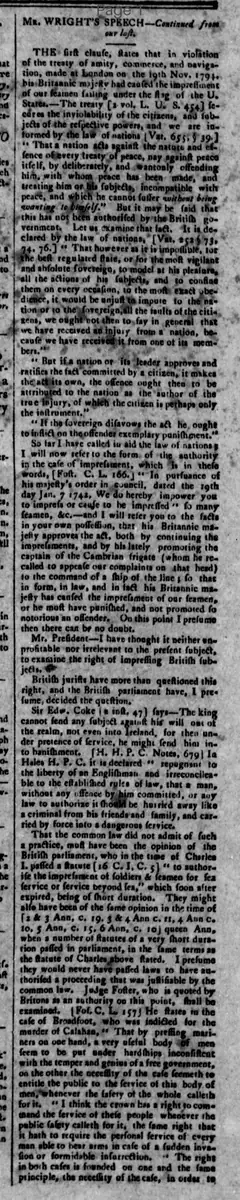
THE first clause, states that in violation of the treaty of amity, commerce, and navigation, made at London on the 19th Nov. 1794, his Britannic majesty had caused the impressment of our seamen sailing under the flag of the U. States.--The treaty [2 vol. L. U. S. 454] secures the inviolability of the citizens, and objects of the respective powers, and we are informed by the law of nations [Vat. 65, s. 39.] "That a nation acts against the nature and essence of every treaty of peace, nay against peace itself, by deliberately, and wantonly offending him, with whom peace has been made, and treating him or his objects, incompatible with peace, and which he cannot suffer without being wanting to himself." But it may be said that this has not been authorized by the British government. Let us examine that fact. It is declared by the law of nations, [Vat. 252 § 73, 74, 76.] "That however as it is impossible, for the best regulated state, or for the most vigilant and absolute sovereign, to model at his pleasure, all the actions of his Subjects, and to confine them on every occasion, to the most exact obedience, it would be unjust to impute to the nation or to the sovereign, all the faults of the citizens, we ought not then to say in general that we have received an injury from a nation, because we have received it from one of its members."
"But if a nation or its leader approves and ratifies the fact committed by a citizen, it makes the act its own, the offence ought then to be attributed to the nation as the author of the true injury, of which the citizen is perhaps only the instrument."
"If the sovereign disavows the act he, ought to inflict on the offender exemplary punishment."
So far I have called in aid the law of nations I will now refer to the form of the authority in the case of impressment, which is in these words, [Fost. C. L. 166.] "--In pursuance of his majesty's order in council, dated the 19th day Jan. 1774, We do hereby empower you to impress or cause to be impressed " so many Seamen, &c.--and I will refer you to the facts in your own petition, that his Britannic majesty approves the act, both by continuing the impressments, and by his lately promoting the captain of the Cambrian frigate (whom he recalled to appease our complaints on that head) to the command of a ship of the line; so that in form, in law, and in act his Britannic majesty has caused the impressment of our seamen or he must have punished, and not promoted so notorious an offender.. On this point I presume then there can be no doubt.
Mr. President--I have thought it neither unprofitable nor irrelevant to the present subject, to examine the right of impressing British subjects.
British jurists have more than questioned this right, and the British parliament have, I presume, decided the question.
Sir Edw. Coke [2 Inst. 47] says--The king cannot send any subject against his will out of the realm, not even into Ireland, for then under pretence of service, he might send him into banishment. [H. H. P. C. Notes, 679] In Hale's H. P. C. it is declared "repugnant to the liberty of an Englishman-- and irreconcilable to the established rules of law, that a man, without any offence by him committed, or any law to authorize it should be hurried away like a criminal from his friends and family, and carried by force into a dangerous service."
That the common law did not admit of such a practice, must have been the opinion of the British parliament, who in the time of Charles I. passed a statute [16 C. I. c. 5] "to authorize the impressment of soldiers & Seamen for Sea service or service beyond sea," which soon after expired, being of short duration. They might also have been of the same opinion in the time of [2 & 3 Ann, C. 19, 3 & 4 Ann C. 11, 4 Ann C. 10. 5 Ann, C. 15. 6 Ann, C. 10] queen Ann, when a number of statutes of a very short duration passed in parliament, in the same terms as the Statute of Charles above stated. I presume they would never have passed laws to have authorized a proceeding that was justifiable by the common law. Judge Foster, who is quoted by Britons as an authority on this point, shall be examined. (Fost. C. L. 157j He states in the case of Broadfoot, who was indicted for the murder of Calahan, "That by pressing mariners on one hand, a very useful body of men seem to be put under hardships inconsistent with the temper and genius of a free government, On the other the necessity of the case seemeth to entitle the public to the service of this body of men, whenever the safety of the whole calleth for it. " I think the crown has a right to command the service of these people whenever the public safety calleth for it, the same right that it hath to require the personal service of every man able to bear arms in case of a sudden invasion or formidable insurrection. " The right in both cases is founded on one and the same principle, the necessity of the case, in order to...
the preservation of the whole. But he adds, [Fort. C. L. 154] If it be asked where are the adjudged cases, on which he groundeth his opinion? He freely confesses that he hath not met with one in which the legality of pressing for the sea service hath directly come in question. He states that according to his best apprehension, (having thought much upon the subject) the right of impressing mariners for the public service is a prerogative, inherent in the crown, grounded upon the common law, and recognized by many acts of parliament. With great deference to his honor, I would ask if anything can be evidence of the common law, but judicial decisions on the point which he admits are not to be found? I will also examine the statutes on which he relies as recognizing this right. I would here observe that he holds the soldier and seaman alike bound by the same law, and it would [Fort. C. L. 166] seem by Adm. Seymour's commission, that his power extended to seize ships, captains, masters, pilots and seamen, as well as all other persons fit for the purpose. This was for the sea and foreign service, and did not extend to land soldiers, as till the 24th year of Charles II, all the lands were held by military tenures, whereby the tenants were obliged to furnish soldiers and everything necessary for them in war; but by 24 C. II. [24 C. II. c. i] these tenures were abolished, and I question much whether the stat. Charles I. extended to the feudal tenants, who were bound to serve only in England. By a statute of Henry VII, (7 H. 7, C. 1) it is enacted, that if any soldier being no captain immediately retained with the king which shall be in wages, and retained, or take any prest to serve the king upon the sea or upon the land beyond sea, depart out of the king's service without licence from the captain, it shall be adjudged felony. The stat. of Henry VI. [18 H. 6, C. 19] against desertion was construed to extend to soldiers bound by tenure or covenant to serve on land --and a question was made whether soldiers who had taken prest to serve against the rebels in Ireland, were liable to the penalties of that law, which was cleared up in parliament in these words, That the said stat. Hen. VI. in all pains, forfeitures and penalties did, doth, and hereafter shall extend as well to every mariner and gunner having taken, or who hereafter shall take prest of wages, to serve her queen's majesty, as it did, or doth, to soldiers, any opinion to the contrary notwithstanding. These are the statutes from whence the right is pretended to be inferred; which, I presume, go to show that the mariner and soldier must be enlisted before they are liable to the penalties of desertion, and that it is by contract and not by force, the soldier becomes bound to serve, and that this right is founded in the prostitution of the sound of the word prest. [Fort. C. L. Inst. J. L. D.] prest for the ensign, which word means money paid to a soldier or sailor to enlist-- nor is it at all to be wondered at, that a right founded in necessity, the tyrant's plea, should rest on a prerogative of Henry, or that the barriers of etymology should not be able to withstand, as necessity has no law, the physical force of a press gang. And although this right of the seaman to be exempt from service but on their enlistment, has been under the claim of prerogative, substantially violated, yet the form of the commission to impress remains the evidence of this violation. it is in these words: [Fort. C. L. 15 c.] We do hereby empower and direct you to impress or cause to be impressed so many seamen, &c. giving unto each man one shilling for prest money. &c. Thus I have shown, that British subjects are not legally bound unless they receive prest, or bounty to enlist. And to avoid imposition it is provided by statute 5 & 6 W. & M. c. 15) that no person shall be enlisted for the land service, who did not in presence of a magistrate, high constable, &c. declare his free consent to be enlisted as a soldier.
What sub-type of article is it?
What themes does it cover?
What keywords are associated?
What entities or persons were involved?
Where did it happen?
Story Details
Key Persons
Location
London
Event Date
19th Nov. 1794
Story Details
Mr. Wright argues that British impressment of American seamen violates the 1794 treaty and international law, as the British government approves the acts; he challenges the legality of impressment under British common law and statutes, asserting it requires voluntary enlistment with prest money.