Thank you for visiting SNEWPapers!
Sign up free
The Virginia Gazette
Richmond, Williamsburg, Richmond County, Virginia
What is this article about?
Satirical essay continuing remarks on the 'Virginia Pindar,' mocking his bathetic poetic descriptions of God, ideas, mind, voyages, madness, devil's triumph, and more, contrasting with sublime works by Pope and Milton through quoted excerpts and commentary.
Merged-components note: Continuation of the literary piece 'Remarks on the Virginia Pindar continued,' split across pages with direct textual continuation.
Clippings
1 of 2
OCR Quality
Full Text
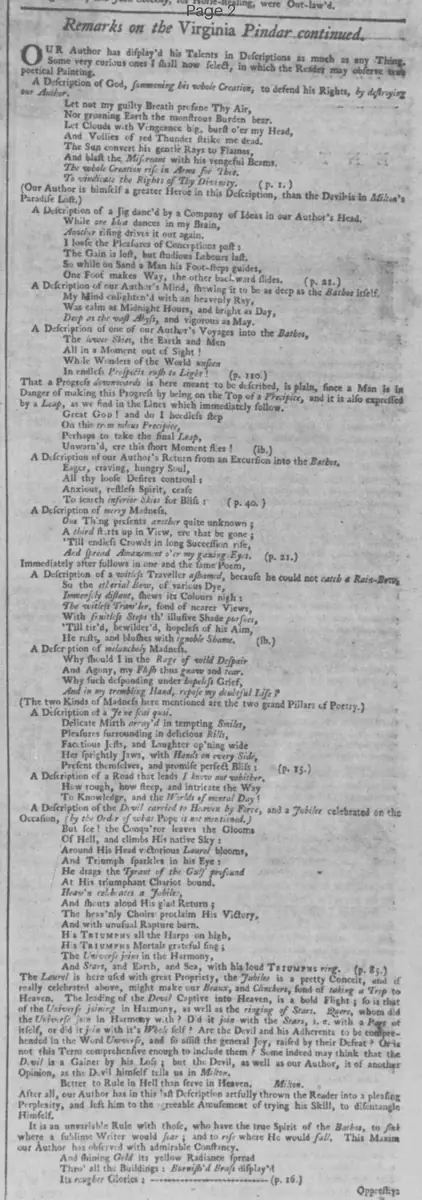
Our Author has display'd his Talents in Descriptions as much as any Thing poetical Painting. Some very curious ones I now select, in which the Reader may observe
A Description of God, Summoning his whole Creation, to defend his Rights, by destroying
Let not my guilty Breath profane Thy Air,
Nor groaning Earth the monstrous Burden bear.
Let Clouds with Vengeance big, burst o'er my Head,
And Volleys of red Thunder strike me dead.
The Sun convert his gentle Rays to Flames.
And blast the Miscreant with his vengeful Beams.
The whole Creation rise in Arms for Thee.
To vindicate the Rights of Thy Divinity.
(p. 1.)
(Our Author is himself a greater Heroe in this Description, than the Devil is in Aiken's Paradise Lost.)
A Description of a Jig danc'd by a Company of Ideas in our Author's Head.
While one Idea dances in my Brain,
Another rising drives it out again.
I loose the Pleasures of Conceptions past:
The Gain is lost, but studious Labours last.
So while on Sand a Man his Foot-steps guides,
One Foot makes Way, the other backward slides.
(p.21.)
A Description of our Author's Mind, shewing it to be as deep as the Bathos itself
My Mind enlight'n'd with an heav'nly Ray,
Was calm as Midnight Hours, and bright as Day,
Deep as the vast Abyss, and vigorous as May.
A Description of one of our Author's Voyages into the Bathos,
The lower Skies, the Earth and Men
All in a Moment out of Sight!
While Wonders of the World unseen
In endless Prospects rush to Light!
(p. 110.)
That a Progress downwards is here meant to be described,
is plain, since a Man is in Danger of making this Progress by being on the Top of a Precipice,
and it is also expressed by a Leap, as we find in the Lines which immediately follow.
Great world! and do I heedless step
On this tremendus Precipice,
Perhaps to take the fatal Leap,
Unwarn'd, ere this short Moment flies!
(ib.)
A Description of our Author's Return from an Excursion into the Bathos,
Eager, craving, hungry Soul,
All thy loose Desires controul:
Anxious, restless Spirit, cease
To search inferior Skies for Bliss: .'(p. 4a.)
A Description of merry Madness,
One Thing presents another quite unknown
A third starts up in View, ere that be gone
'Till endless Crowds in long Succession rise
And tremendous Amazement o'er my gazing Eyes, : (p. 21.)
Immediately after follows in one add the Same Poem,
A Description of a witless Traveller ashamed, because he could not catch the Rain-Bow
So the ethereal Bow, of various Dye,
Immensely distant, Shews its Colours nigh:
The witless Trav'ler, fond of nearer Views,
With timidness Steps th' illusive Shade pursues,
'Till tir'd, bewilder'd, hopeless of his Aim,
: He rusts, aird blushes with ignoble Shame,
(ib.)
A Description of melancholy Madness,
Why should I in the Rage of wild Despair
And Agony, my Flesh thus gnaw and tear.
- Why Such desponding under hopeless Grief,
And in my trembling Hand, repose my desulful Life? :
(The two Kinds of Madness here mentioned are the two grand Pillars of Poetry.)
A Description of a Je ne sais quoi.
Delicate Mirth array'd in tempting Smiles,
Pleasures surrounding in delicious Rills,
Facetious Jests, and Laughter op'ning wide
Her prightly Jaws, with Hands on every Side,
Present themselves, and promise perfect Bliss:
(p. 15.)
A Description of a Road that leads I know not whither.
How rough, how steep, and intricate the Way
To Knowledge, and the Worlds of mental Day
A Description of the Devil carried to Heaven by Farce, and a Jubilee celebrated on the Occasion, (by the Order wherof Pope is not mentioned.)
But see! the Conqu'ror leaves the Glooms
Of Hell, and climbs His native Sky:
Around His Head victorious Laurel blooms,
And Triumph sparkles in his Eye:
He drags the Tyrant of the Gulf profound
At His triumphant Chariot bound.
Heav'n celebrates a Jubilee
And Shouts aloud His glad Return;
The heav'nly Choirs proclaim His Victory,
And with unusual Rapture burn.
His Taramus all the Harps on high,
His Triumphs Mortals grateful sing;
The Universe joins in the Harmony,
And Stars, and Earth, and Sea, with his loud Tarumrus ring.
(p. 85.)
The Laurel is here us'd with great Propriety, the Jubilee is a pretty Conceit, and if really celebrated above, might make our Beaux, and Clinchers, fond of taking a Trip to Heaven. The leading of the Devil Captive into Heaven, is a bold Flight; so is that of the Universe joining in Harmony, as well as the ringing of Stars.
Quere, whom did the Universe join in Harmony with? Did it join with the Stars, i. e. with a Part of itself, or did it join with it's Whole self? Are the Devil and his Adherents to be comprehended In the Word Universe, and so assist the general Joy, rais'd by their Defeat? Or is not this Term comprehensive enough to include them? Some indeed may think that the Devil is a Gainer by his Loss; but the Devil, as well as our Author, is of another Opinion, as the Devil himself tells us in Milton.
Better to Rule in Hell than serve in Heaven.
Milton.
After all, our Author has in this last Description artfully thrown the Reader into a pleasing Perplexity, and left him to the agreeable Amusement of trying his Skill, to disentangle Himself.
It is an unvariable Rule with those, who have the true Spirit of the Bathos, to sink where a sublime Writer would soar; and to rise where He would fall.
This Maxim our Author has observed with admirable Constancy.
And shining Gold its yellow Radiance Spread
Thro' all the Buildings: Burnish'd Brass display'd
Its rougher Glories: --o.........
..........-(p. 16.)
Oppressions, Sorrows and Vexations grow
In ev'ry State, in ev'ry Clime below,
(p. 18.)
Anxieties in all Things earthly dwell,
Which All can feel, but none can tell,
In dull Successions daily Pleasures run
In the same tedious Circle ever round. (p. 18.)
There is a great Beauty in these two Lines; they running themselves as idly in a dull
Succession, to agree the better with the Thing described, according to that of Mr. Pope.
("'Tis not enough no Harshness give Offence,
The Sound should be an Echo to the Sense.)
The ever-moving Wheels of Nature run
In the Same Tract; in the same Tract the Sun
Rolls on his tiresome, everlasting Round.
And still we tread the same Old-fashion'd Ground. (p. 18.)
(He must be a great Admirer of new Fashions surely, and more so than the nicest Lady,
who complains for want of a New-fashion'd Earth to walk upon.)
And thou immense, majestic Main,
Let not thy Billows roll in vain;
But swell each Billow to a Tear:
(p. 38.)
This Swelling of Billows into so many Tears is the same as Enlarging Mountains into
Mole-hills, and gives a Surprize to the Mind, so like the Effect produced on it by a
witty Turn, that one may Safely pronounce this Passage to approach the nearest in its Na-
ture to a witty Turn of any Thing that has dropp'd from our Author's Pen.
Jehovah hears, and with a Smile
Lays the Dread Thunder by a-while. (p. 50.)
Then, if my Non-existence Should but raise,
Thy Glory, I'm content thy Hand should
Me from the Rank of Being, and conclude my Days. (p. 22.)
That thou should'st condescend so low to us,
And with peculiar Favours crown us thus! (p.60.)
Struck with the Terror of Jehovah's Look,
Aspiring Worms all creep into the Rock; (p. 73.)
It tends much to discover the Size of a Writer's Genius, to observe what Words he is
particularly fond of. Our Author is remarkably delighted with, and makes most fre-
quent Use of the Words Worm for Man, and Writhing as an Epithet to all Sorts of Pain
and Anguish, which evidently demonstrates how nice he is in the Choice of his Fa-
vourites.)
The wrathful Heaven's vindictive frown,
And Thunders murmur to be let loose,
To blast a Worm, &c. (p. 98.)
If you should wonder at there being so much ado about killing a Worm: You must re-
member, that this Worm is a Man, and this Man perhaps a Giant, eight or ten Feet
high.
Some, whose dear Memories now dissolve my Mind,
Once to my Heart in close Friendship join'd,
Have gone before, and (swear I will not) LEFT ME HERE BEHIND. (p.78.)
(It is really a bad Case, but at the Same Time a very common Practice, for those who
go before any Person to leave the said Person behind.)
Who in dread Majesty serenely rides
On wild unruly Hurricanes and Storms;
While all their most outrageous Forms
Tamely obey his mighty Call,
To purge the Air, or shake this guilty Ball.
To Scathe the sturdy Oak, or blast audacious Worms. (p. 147.)
(Qu. Whether Worms here mean Men, or are to be taken literally for the Inhabitants of
the Oak? I must not omit here what I had like to have entirely forgot, to the great and
irreparable Loss of the Reader, that Worms, as a good Rhyme on all Occasions to Storms,
is another of the Words for which our Author seems to have an uncommon Degree of
Friendship; and with good Reason, for when this Friend happens not to be at Hand, his
Absence generally proves a Damage to the final Consonance.)
Snow, Rain and Frost commixt, and Savage Storms
Ravage and bluster in a thousand Forms; (p. 8.)
Tempests, and Hurricanes, and Storms,
Bewail in all your dreadful Forms. (p. 37.)
I might be very prolix under this Head, of our Author's managing the Rise and Fall
in a Way directly contrary to that which sublime Writers use: But it would lead me
into the Repetition of many Passages already mentioned. For our Author does not
only adorn every Sentence almost with some one Beauty or other of the Bathos; but often
crowds a Number and Variety of them into one single Sentence. For this Reason I
shall not set down the Places where our Author is too poetical to write English, or, in-
indeed, any other Language, according to that of Butler.
"For He could coin, or counterfeit
"New Words, with little or no Wit:
"Words so debased and hard, no Stone
"Was hard enough to touch them on:
"And when with hasty Noise He spoke 'em,
"The Ignorant for Current took'em."
BUTLER.
For Instances of the Talent here alluded to, I refer the intelligent Reader to the Ex-
tracts already drawn from our Author, or to any Page of our Author's Book, where he
may plentifully pick them out at his Leisure. I shall only here tell some People, whom
I have heard discourse upon our Author's Performances, that it is a Mistake to imagine,
when our Author fixes his Eyes intense, or stares intense, as he often does in his Poems,
that he gives them to understand, He has a fierce or angry Look. He intended no such
Matter, but only Some Delineation of that Amazement, which must discover itself in
the Eyes of all Poets, who are blessed with any Thing of that noble Madness, and
divine Enthusiasm, so necessary to Persons of their Character.
I know not whether the cloathing ordinary Thoughts with pompous Diction, or grand
Sentiments with mean Language, ought to have the Preference: For it is equally di-
verting to see a Beggar dress'd like a King, or a King like a Beggar. Our Author is
incomparably excellent in both. Particular Instances of which I shall here omit, for the
Reason above-mentioned, only referring to Christ's Agony in the Garden (p. 105.) for
our Author's Skill in the one, and to his Description of a Storm (p. 127.) for his Art
in the other.
[To be continued.]
What sub-type of article is it?
What keywords are associated?
Literary Details
Title
Remarks On The Virginia Pindar Continued.
Subject
Satirical Critique Of The Virginia Pindar's Poetic Descriptions And Bathos
Form / Style
Satirical Prose Essay With Quoted Poetic Excerpts
Key Lines