Thank you for visiting SNEWPapers!
Sign up free
Literary
November 9, 1810
Virginia Argus
Richmond, Virginia
What is this article about?
Excerpt from Bishop Perieus's lectures affirming Christ's divinity through the centurion's eyewitness testimony at the crucifixion, emphasizing natural phenomena and Jesus's demeanor. Compares to Rousseau's eloquent contrast of Socrates's and Jesus's deaths, concluding Jesus's as divine.
Clipping
OCR Quality
95%
Excellent
Full Text
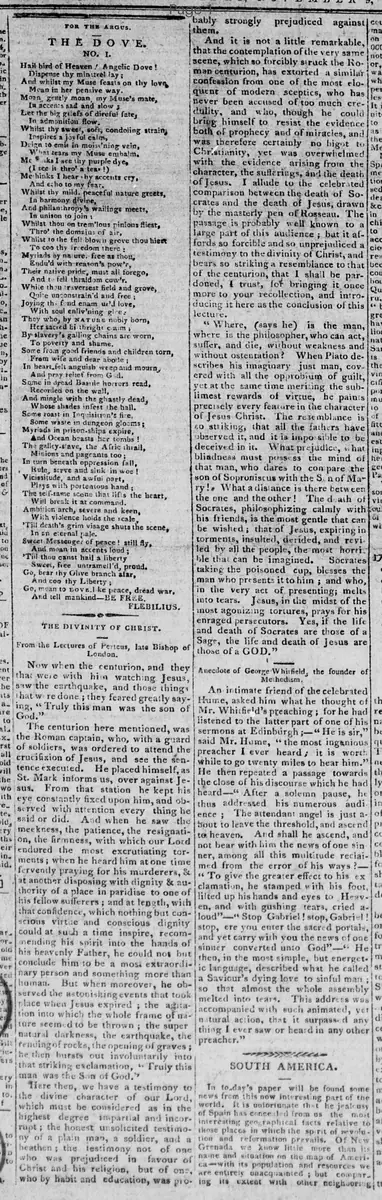
THE DIVINITY OF CHRIST.
From the Lectures of Perieus, late Bishop of London.
Now when the centurion, and they that were with him watching Jesus, saw the earthquake, and those things that were done; they feared greatly saying, "Truly this man was the son of God."
The centurion here mentioned, was the Roman captain, who, with a guard of soldiers, was ordered to attend the crucifixion of Jesus, and see the sentence executed. He placed himself, as St. Mark informs us, over against Jesus. From that station he kept his eye constantly fixed upon him, and observed with attention every thing he said or did. And when he saw the meekness, the patience, the resignation, the firmness, with which our Lord endured the most excruciating torments; when he heard him at one time fervently praying for his murderers, & at another disposing with dignity & authority of a place in paradise to one of his fellow sufferers; and at length, with that confidence, which nothing but conscious virtue and conscious dignity could at such a time inspire, recommending his spirit into the hands of his heavenly Father, he could not but conclude him to be a most extraordinary person and something more than human. But when moreover, he observed the astonishing events that took place when Jesus expired; the agitation into which the whole frame of nature seemed to be thrown; the supernatural darkness, the earthquake, the rending of rocks, the opening of graves; he then bursts out involuntarily into that striking exclamation, "Truly this man was the Son of God."
Here then, we have a testimony to the divine character of our Lord, which must be considered as in the highest degree impartial and incorrupt; the honest unsolicited testimony of a plain man, a soldier, and a heathen; the testimony not of one who was prejudiced in favour of Christ and his religion, but of one, who by habit and education, was probably strongly prejudiced against them.
And it is not a little remarkable, that the contemplation of the very same scene, which so forcibly struck the Roman centurion, has extorted a similar confession from one of the most eloquent of modern sceptics, who has never been accused of too much credulity, and who, though he could bring himself to resist the evidence both of prophecy and of miracles, and was therefore certainly no bigot to Christianity, yet was overwhelmed with the evidence arising from the character, the sufferings, and the death of Jesus. I allude to the celebrated comparison between the death of Socrates and the death of Jesus, drawn by the masterly pen of Rousseau. The passage is probably well known to a large part of this audience; but it affords so forcible and so unprejudiced a testimony to the divinity of Christ, and bears so striking a resemblance to that of the centurion, that I shall be pardoned, I trust, for bringing it once more to your recollection, and introducing it here as the conclusion of this lecture.
"Where, (says he) is the man, where is the philosopher, who can act, suffer. and die, without weakness and without ostentation? When Plato describes his imaginary just man, covered with all the opprobrium of guilt, yet at the same time meriting the sublimest rewards of virtue, he paints precisely every feature in the character of Jesus Christ. The resemblance is so striking, that all the fathers have observed it, and it is impossible to be deceived in it. What prejudice, what blindness must possess the mind of that man, who dares to compare the son of Sophroniscus with the Son of Mary! What a distance is there between the one and the other! The death of Socrates, philosophizing calmly with his friends, is the most gentle that can be wished; that of Jesus, expiring in torments, insulted, derided, and reviled by all the people, the most horrible that can be imagined. Socrates taking the poisoned cup, blesses the man who presents it to him; and who, in the very act of presenting; melts into tears. Jesus, in the midst of the most agonizing tortures, prays for his enraged persecutors. Yes, if the life and death of Socrates are those of a sage, the life and death of Jesus are those of a GOD."
From the Lectures of Perieus, late Bishop of London.
Now when the centurion, and they that were with him watching Jesus, saw the earthquake, and those things that were done; they feared greatly saying, "Truly this man was the son of God."
The centurion here mentioned, was the Roman captain, who, with a guard of soldiers, was ordered to attend the crucifixion of Jesus, and see the sentence executed. He placed himself, as St. Mark informs us, over against Jesus. From that station he kept his eye constantly fixed upon him, and observed with attention every thing he said or did. And when he saw the meekness, the patience, the resignation, the firmness, with which our Lord endured the most excruciating torments; when he heard him at one time fervently praying for his murderers, & at another disposing with dignity & authority of a place in paradise to one of his fellow sufferers; and at length, with that confidence, which nothing but conscious virtue and conscious dignity could at such a time inspire, recommending his spirit into the hands of his heavenly Father, he could not but conclude him to be a most extraordinary person and something more than human. But when moreover, he observed the astonishing events that took place when Jesus expired; the agitation into which the whole frame of nature seemed to be thrown; the supernatural darkness, the earthquake, the rending of rocks, the opening of graves; he then bursts out involuntarily into that striking exclamation, "Truly this man was the Son of God."
Here then, we have a testimony to the divine character of our Lord, which must be considered as in the highest degree impartial and incorrupt; the honest unsolicited testimony of a plain man, a soldier, and a heathen; the testimony not of one who was prejudiced in favour of Christ and his religion, but of one, who by habit and education, was probably strongly prejudiced against them.
And it is not a little remarkable, that the contemplation of the very same scene, which so forcibly struck the Roman centurion, has extorted a similar confession from one of the most eloquent of modern sceptics, who has never been accused of too much credulity, and who, though he could bring himself to resist the evidence both of prophecy and of miracles, and was therefore certainly no bigot to Christianity, yet was overwhelmed with the evidence arising from the character, the sufferings, and the death of Jesus. I allude to the celebrated comparison between the death of Socrates and the death of Jesus, drawn by the masterly pen of Rousseau. The passage is probably well known to a large part of this audience; but it affords so forcible and so unprejudiced a testimony to the divinity of Christ, and bears so striking a resemblance to that of the centurion, that I shall be pardoned, I trust, for bringing it once more to your recollection, and introducing it here as the conclusion of this lecture.
"Where, (says he) is the man, where is the philosopher, who can act, suffer. and die, without weakness and without ostentation? When Plato describes his imaginary just man, covered with all the opprobrium of guilt, yet at the same time meriting the sublimest rewards of virtue, he paints precisely every feature in the character of Jesus Christ. The resemblance is so striking, that all the fathers have observed it, and it is impossible to be deceived in it. What prejudice, what blindness must possess the mind of that man, who dares to compare the son of Sophroniscus with the Son of Mary! What a distance is there between the one and the other! The death of Socrates, philosophizing calmly with his friends, is the most gentle that can be wished; that of Jesus, expiring in torments, insulted, derided, and reviled by all the people, the most horrible that can be imagined. Socrates taking the poisoned cup, blesses the man who presents it to him; and who, in the very act of presenting; melts into tears. Jesus, in the midst of the most agonizing tortures, prays for his enraged persecutors. Yes, if the life and death of Socrates are those of a sage, the life and death of Jesus are those of a GOD."
What sub-type of article is it?
Essay
What themes does it cover?
Religious
Death Mortality
What keywords are associated?
Divinity Of Christ
Crucifixion
Centurion Testimony
Rousseau Comparison
Socrates Vs Jesus
Religious Lecture
What entities or persons were involved?
From The Lectures Of Perieus, Late Bishop Of London.
Literary Details
Title
The Divinity Of Christ.
Author
From The Lectures Of Perieus, Late Bishop Of London.
Key Lines
Now When The Centurion, And They That Were With Him Watching Jesus, Saw The Earthquake, And Those Things That Were Done; They Feared Greatly Saying, "Truly This Man Was The Son Of God."
"Truly This Man Was The Son Of God."
"Where, (Says He) Is The Man, Where Is The Philosopher, Who Can Act, Suffer. And Die, Without Weakness And Without Ostentation?"
What Prejudice, What Blindness Must Possess The Mind Of That Man, Who Dares To Compare The Son Of Sophroniscus With The Son Of Mary!
Yes, If The Life And Death Of Socrates Are Those Of A Sage, The Life And Death Of Jesus Are Those Of A God."