Thank you for visiting SNEWPapers!
Sign up free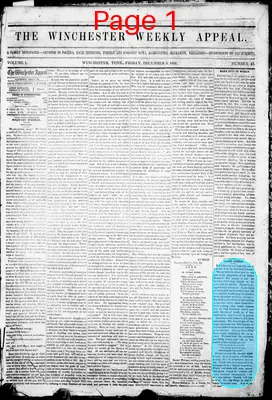
Literary
December 5, 1856
The Winchester Weekly Appeal
Winchester, Franklin County, Tennessee
What is this article about?
Reflective prose from the Hartford Courant on the beauty and sadness of Indian Summer, portraying nature's fading as a melancholy yet lovely death, contrasted with human mortality, including a short poetic stanza on absent forest birds.
Clipping
OCR Quality
98%
Excellent
Full Text
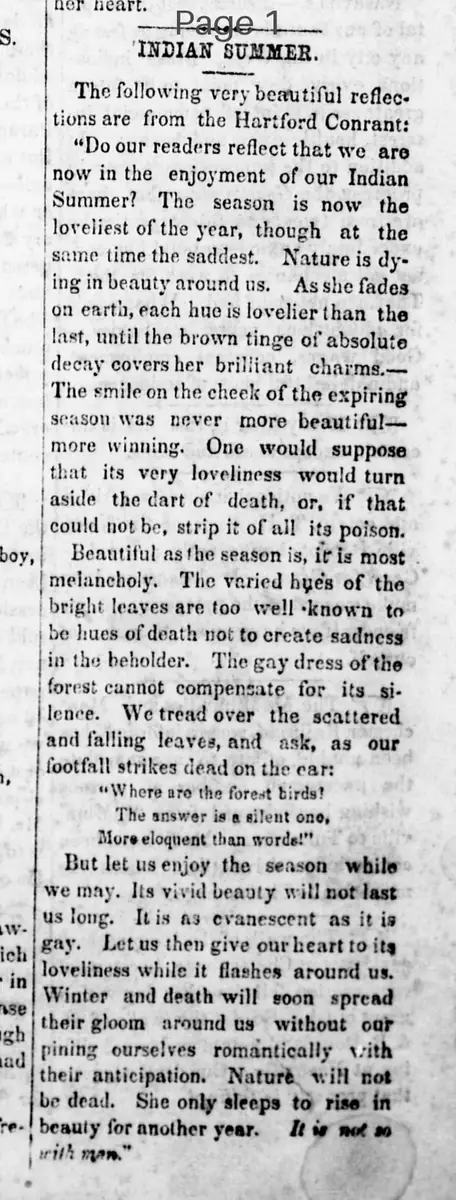
INDIAN SUMMER.
The following very beautiful reflections are from the Hartford Courant:
"Do our readers reflect that we are now in the enjoyment of our Indian Summer? The season is now the loveliest of the year, though at the same time the saddest. Nature is dying in beauty around us. As she fades on earth, each hue is lovelier than the last, until the brown tinge of absolute decay covers her brilliant charms. The smile on the cheek of the expiring season was never more beautiful--more winning. One would suppose that its very loveliness would turn aside the dart of death, or, if that could not be, strip it of all its poison. Beautiful as the season is, it is most melancholy. The varied hues of the bright leaves are too well known to be hues of death not to create sadness in the beholder. The gay dress of the forest cannot compensate for its silence. We tread over the scattered and falling leaves, and ask, as our footfall strikes dead on the ear:
"Where are the forest birds?
The answer is a silent one.
More eloquent than words!"
But let us enjoy the season while we may. Its vivid beauty will not last us long. It is as evanescent as it is gay. Let us then give our heart to its loveliness while it flashes around us. Winter and death will soon spread their gloom around us without our pining ourselves romantically with their anticipation. Nature will not be dead. She only sleeps to rise in beauty for another year. It is not so with man."
The following very beautiful reflections are from the Hartford Courant:
"Do our readers reflect that we are now in the enjoyment of our Indian Summer? The season is now the loveliest of the year, though at the same time the saddest. Nature is dying in beauty around us. As she fades on earth, each hue is lovelier than the last, until the brown tinge of absolute decay covers her brilliant charms. The smile on the cheek of the expiring season was never more beautiful--more winning. One would suppose that its very loveliness would turn aside the dart of death, or, if that could not be, strip it of all its poison. Beautiful as the season is, it is most melancholy. The varied hues of the bright leaves are too well known to be hues of death not to create sadness in the beholder. The gay dress of the forest cannot compensate for its silence. We tread over the scattered and falling leaves, and ask, as our footfall strikes dead on the ear:
"Where are the forest birds?
The answer is a silent one.
More eloquent than words!"
But let us enjoy the season while we may. Its vivid beauty will not last us long. It is as evanescent as it is gay. Let us then give our heart to its loveliness while it flashes around us. Winter and death will soon spread their gloom around us without our pining ourselves romantically with their anticipation. Nature will not be dead. She only sleeps to rise in beauty for another year. It is not so with man."
What sub-type of article is it?
Essay
Poem
What themes does it cover?
Nature
Seasonal Cycle
Death Mortality
What keywords are associated?
Indian Summer
Nature Beauty
Seasonal Melancholy
Death Analogy
Forest Silence
What entities or persons were involved?
Hartford Courant
Literary Details
Title
Indian Summer.
Author
Hartford Courant
Subject
Reflections On Indian Summer
Form / Style
Prose Reflection With Poetic Excerpt
Key Lines
Where Are The Forest Birds?
The Answer Is A Silent One.
More Eloquent Than Words!