Thank you for visiting SNEWPapers!
Sign up free
The New Hampshire Gazette And General Advertiser
Portsmouth, Exeter, Rockingham County, New Hampshire
What is this article about?
Account of the naval engagement on September 5 between British and French fleets off Cape Henry, as reported in Rivington's Royal Gazette. British fleet, damaged and unable to pursue, retreated to New York after burning the ship Terrible. British casualties: 1 lieutenant and 90 men killed, 280 wounded, one captain lost a leg. Sarcastic commentary criticizes the British performance.
Clipping
OCR Quality
Full Text
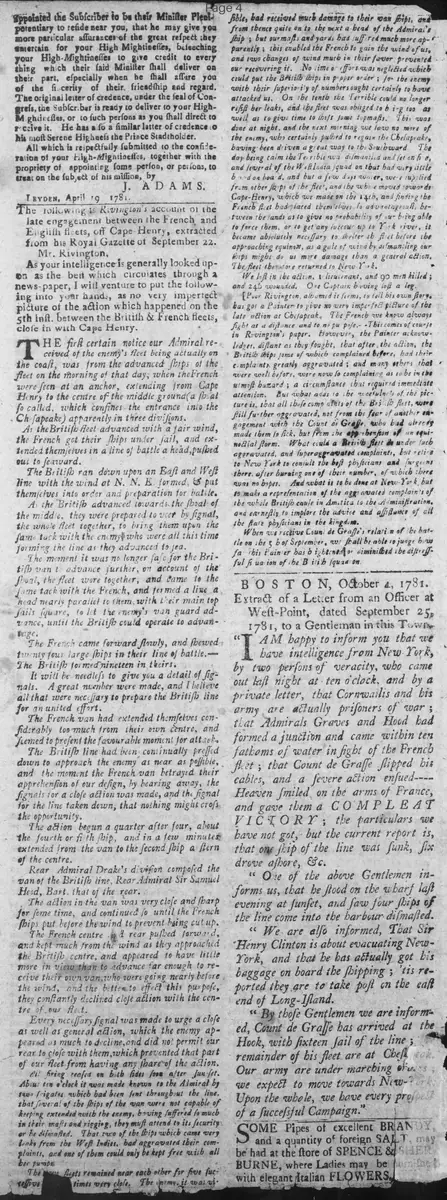
Mr. Rivington,
As your intelligence is generally looked upon as the best which circulates through a news-paper, I will venture to put the following into your hands, as no very imperfect picture of the action which happened on the 5th inst. between the British & French fleets, close in with Cape Henry.
The first certain notice our Admiral received of the enemy's fleet being actually on the coast, was from the advanced ships of the fleet on the morning of that day, when the French were seen at an anchor, extending from Cape Henry to the centre of the middle ground (a shoal so called, which confines the entrance into the Chesapeake) apparently in three divisions.
As the British fleet advanced with a fair wind, the French got their ships under sail, and extended themselves in a line of battle a head, pushed out to seaward.
The British ran down upon an East and West line with the wind at N. N. E. formed, put themselves into order and preparation for battle.
As the British advanced towards the shoal of the middle, they were prepared to veer by signal, the whole fleet together, to bring them upon the same tack with the enemy who were all this time forming the line as they advanced to sea.
The moment it was no longer safe for the British van to advance further, on account of the shoal, the fleet wore together, and came to the same tack with the French, and formed a line a head nearly parallel to them, with their main top sails square, to let the enemy's van guard advance, until the British could operate to advantage.
The French came forward slowly, and showed twenty four large ships in their line of battle. The British formed nineteen in theirs.
It will be needless to give you a detail of signals. A great number were made, and I believe all that were necessary to prepare the British line for an united effort.
The French van had extended themselves considerably too much from their own centre, and seemed to present the favourable moment for attack.
The British line had been continually pressed down to approach the enemy as near as possible, and the moment the French van betrayed their apprehension of our design, by bearing away, the signals for a close action was made, and this signal for the line taken down, that nothing might cross the opportunity.
The action begun a quarter after four, about the fourth or fifth ship, and in a few minutes extended from the van to the second ship a stern of the centre.
Rear Admiral Drake's division composed the van of the British line. Rear Admiral Sir Samuel Hood, Bart. that of the rear.
The action in the van was very close and sharp for some time, and continued so until the French ships put before the wind to prevent being cut up.
The French centre and rear pushed forward, and kept much from the wind as they approached the British centre, and appeared to have little more in view than to advance far enough to receive their own van, who were going nearly before the wind, and the better to effect this purpose, they constantly declined close action with the centre of our fleet.
Every necessary signal was made to urge a close as well as general action, which the enemy appeared as much to decline, and did not permit our rear to close with them, which prevented that part of our fleet from having any share of the action.
After firing ceased on both sides soon after sun-set.
About ten o'clock it was made known to the Admiral by two frigates, which had been sent throughout the line, that several of the ships of the van were not capable of keeping company with the enemy, having suffered so much in their masts and rigging, they must attend to its security or be dismasted. That two of the ships which came very leaky from the West Indies, had aggravated their complaints, and one of them could only be kept free with all her pumps.
The two fleets remained near each other for five successive times very close. The enemy, it was visible, had received much damage to their van ships, and from thence quite on to the next a-head of the Admiral's ship; but our masts and yards had suffered much more apparently; this enabled the French to gain the wind of us, and two changes of wind much in their favor prevented our recovering it. No time or effort was neglected which could put the British ships in proper order; for the enemy with their superiority of numbers ought certainly to have attacked us. On the tenth the Terrible could no longer resist her leaks, and the fleet was obliged to burn her as well as to give time to shift some topmasts. This was done at night, and the next morning we saw no more of the enemy, who certainly pushed to regain the Chesapeake having been driven a great way to the Southward. The day being calm the Terrible was dismantled and set on fire, and several of the West-India squadron that had very little bread on board, and but a few days water, were supplied from other ships of the fleet, and the whole moved towards Cape-Henry, which we made on the 12th, and finding the French fleet had placed themselves so advantageously between the sands as to give no probability of our being able to force them, or to get any succour up to York river, it became absolutely necessary to shelter the fleet before the approaching equinox, as a gale of wind by dismantling our ships might do us more damage than a general action.
The fleet therefore returned to New York.
We lost in the action, a lieutenant, and 90 men killed; and 280 wounded. One Captain having lost a leg.
Poor Rivington, ashamed it seems, to tell his own story, has got a Painter to give so very imperfect picture of the late action at Chesapeake. The French we know always fight at a distance and to no purpose. This comes of course in Rivington's paper. However, the Painter acknowledges, distant as they fought, that after the action, the British ships some of which complained before, had their complaints greatly aggravated; and many others that were well before, were now so complaining as to be in the utmost hazard; a circumstance that required immediate attention. But what adds to the woefulness of the picture is, that all those complaints of the British fleet, were still further aggravated, not from the fear of another engagement with the Count de Grasse, who had already made them so sick, but from the apprehension of an equinoctial storm. What could a British fleet under such aggravated, and superaggravated complaints, but retire to New York to consult the best physicians and surgeons there, after burning one of their number, of which there was no hope. And what is to be done at New-York but to make a representation of the aggravated complaints of the whole British cause in America to the Administration, and earnestly to implore the advice and assistance of all the State physicians in the kingdom.
When we receive Count de Grasse's relation of the battle on the 5th of September, we shall be able to judge how far this Painter has heightened or diminished the distressful situation of the British squadron on
What sub-type of article is it?
What keywords are associated?
What entities or persons were involved?
Where did it happen?
Domestic News Details
Primary Location
Off Cape Henry
Event Date
5th Inst.
Key Persons
Outcome
british lost a lieutenant and 90 men killed; 280 wounded. one captain lost a leg. fleet burned the terrible and returned to new york.
Event Details
British fleet of 19 ships engaged French fleet of 24 ships off Cape Henry. Action began at quarter after four, focused on van. French avoided close action in center and rear. British ships damaged in masts, rigging, and leaks; unable to pursue after sunset.