Thank you for visiting SNEWPapers!
Sign up free
Richmond Enquirer
Richmond, Richmond County, Virginia
What is this article about?
An editorial from the N.Y. Evening Post argues that Harrison's 1840 election victory over Van Buren decided nothing substantive on policy issues like the National Bank, Internal Improvements, Tariff, or Independent Treasury, attributing the win to economic discontent, Whig deception, and corrupt practices rather than ideological endorsement.
Clipping
OCR Quality
Full Text
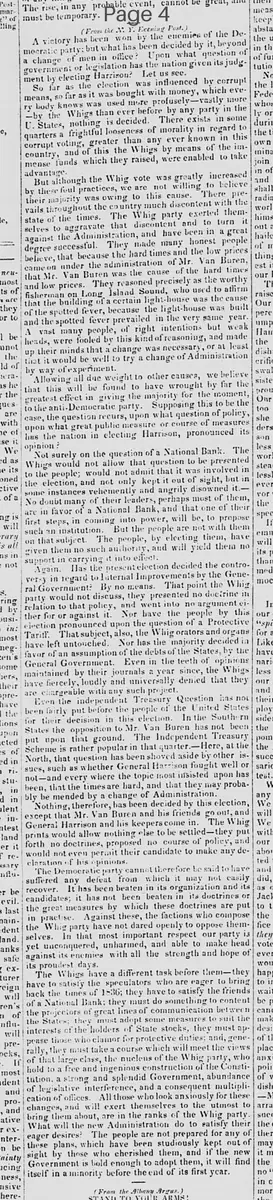
A victory has been won by the enemies of the Democratic party; but what has been decided by it, beyond a change of men in office? Upon what question of government or legislation has the nation given its judgment by electing Harrison? Let us see.
So far as the election was influenced by corrupt means, so far as it was bought with money, which everybody knows was used more profusely by the Whigs than ever before by any party in the U. States, nothing is decided. There exists in some quarters a frightful looseness of morality in regard to corrupt voting, greater than any ever known in this country, and of this the Whigs by means of the immense funds which they raised, were enabled to take advantage.
But although the Whig vote was greatly increased by these foul practices, we are not willing to believe their majority was owing to this cause. There prevails throughout the country much discontent with the state of the times. The Whig party exerted themselves to aggravate that discontent and to turn it against the Administration, and have been in a great degree successful. They made many honest people believe, that because the hard times and the low prices came on under the administration of Mr. Van Buren, that Mr. Van Buren was the cause of the hard times and low prices. They reasoned precisely as the worthy fisherman on Long Island Sound, who used to affirm that the building of a certain light-house was the cause of the spotted fever, because the light-house was built and the spotted fever prevailed in the very same year.
A vast many people, of right intentions but weak heads, were fooled by this kind of reasoning, and made up their minds that a change was necessary, or at least that it would be well to try a change of Administration by way of experiment.
Allowing all due weight to other causes, we believe that this will be found to have wrought by far the greatest effect in giving the majority for the moment, to the anti-Democratic party. Supposing this to be the case, the question recurs, upon what question of policy, upon what great public measure or course of measures has the nation in electing Harrison, pronounced its opinion?
Not surely on the question of a National Bank. The Whigs would not allow that question to be presented to the people; would not admit that it was involved in the election, and not only kept it out of sight, but in some instances vehemently and angrily disowned it. No doubt many of their leaders, perhaps most of them, are in favor of a National Bank, and that one of their first steps, in coming into power, will be, to propose such an institution. But the people are not with them on that subject. The people, by electing them, have given them no such authority, and will yield them no support in carrying it into effect.
Again. Has the present election decided the controversy in regard to Internal Improvements by the General Government? By no means. That point the Whig party would not discuss, they presented no doctrine in relation to that policy, and went into no argument either for or against it. Nor have the people by this election pronounced upon the question of a Protective Tariff. That subject, also, the Whig orators and organs have left untouched. Nor has the majority decided in favor of an assumption of the debts of the States, by the General Government. Even in the teeth of opinions maintained by their journals a year since, the Whigs have fiercely, loudly and universally denied that they are chargeable with any such project.
Even the Independent Treasury Question has not been fairly put before the people of the United States for their decision in this election. In the Southern States the opposition to Mr. Van Buren has not been put upon that ground. The Independent Treasury Scheme is rather popular in that quarter. Here, at the North, that question has been shoved aside by other issues, such as whether General Harrison fought well or not—and every where the topic most insisted upon has been, that the times are hard, and that they may probably be mended by a change of Administration.
Nothing, therefore, has been decided by this election, except that Mr. Van Buren and his friends go out, and General Harrison and his keepers come in. The Whig prints would allow nothing else to be settled—they put forth no doctrines, proposed no course of policy, and would not even permit their candidate to make any declaration of his opinions.
The Democratic party cannot therefore be said to have suffered any defeat from which it may not easily recover. It has been beaten in its organization and its candidates; it has not been beaten in its doctrines or the great measures by which these doctrines are put in practice. Against these, the factions who compose the Whig party have not dared openly to oppose themselves. In that most important respect our party is yet unconquered, unharmed, and able to make head against its enemies with all the strength and hope of its proudest days.
The Whigs have a different task before them—they have to satisfy the speculators who are eager to bring back the times of 1836; they have to satisfy the friends of a National Bank; they must do something to content the projectors of great lines of communication between the States; they must adopt some measures to suit the interests of the holders of State stocks, they must appease those who clamor for protective duties: and, generally, they must take a course which will meet the views of that large class, the nucleus of the Whig party, who hold to a free and ingenious construction of the Constitution, a strong and splendid Government, abundance of legislative interference, and a consequent multiplication of offices. All those who look anxiously for these changes, and will exert themselves to the utmost to bring them about, are in the ranks of the Whig party.
What will the new Administration do to satisfy their eager desires? The people are not prepared for any of these plans, which have been studiously kept out of sight by those who cherished them, and if the new Government is bold enough to adopt them, it will find itself in a minority before the end of its first year.
What sub-type of article is it?
What themes does it cover?
What keywords are associated?
What entities or persons were involved?
Where did it happen?
Story Details
Key Persons
Location
United States
Event Date
1840 Election
Story Details
The article analyzes Harrison's election victory as resulting from economic discontent and Whig misleading tactics rather than policy endorsements, arguing no major issues like the National Bank or Tariff were decided, and predicting challenges for the new administration.