Thank you for visiting SNEWPapers!
Sign up free
The North Carolina Standard
Raleigh, Wake County, North Carolina
What is this article about?
A letter to the editor of the N.C. Standard encloses the speech of Hon. Mr. Hamer of Ohio from March 2, 1837, defending the Jackson administration against opposition charges of corruption in the Treasury Department and public money handling. The writer provides context on congressional investigations that found no evidence of wrongdoing, emphasizing the speech's role in clarifying the matter.
Merged-components note: This is a continuation of the letter to the editor across pages, including the full speech of Mr. Hamer on the investigating committee; the second component was incorrectly labeled as 'story' but belongs to the letter.
Clippings
1 of 2
OCR Quality
Full Text
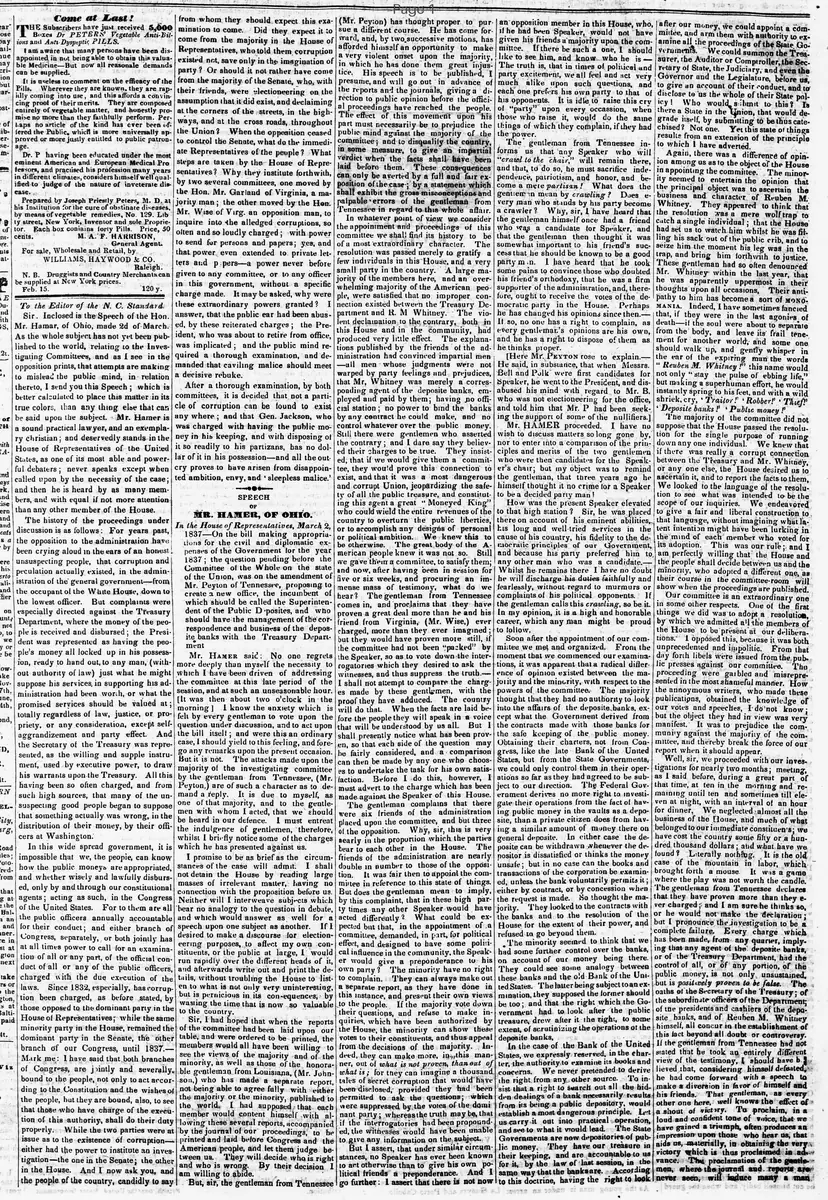
Sir. Inclosed is the Speech of the Hon. Mr. Hamer, of Ohio, made 2d of March.
As the whole subject has not yet been published to the world, relating to the Investigating Committees, and as I see in the opposition prints, that attempts are making to mislead the public mind, in relation thereto, I send you this Speech; which is better calculated to place this matter in its true colors, than any thing else that can be said upon the subject. Mr. Hamer is a sound practical lawyer, and an exemplary christian; and deservedly stands in the House of Representatives of the United States, as one of its most able and powerful debaters; never speaks except when called upon by the necessity of the case; and then he is heard by as many members, and with equal if not more attention than any other member of the House.
The history of the proceedings under discussion is as follows: For years past, the opposition to the administration have been crying aloud in the ears of an honest unsuspecting people, that corruption and peculation actually existed, in the administration of the general government—from the occupant of the White House, down to the lowest officer. But complaints were especially directed against the Treasury Department, where the money of the people is received and disbursed; the President was represented as having the people's money all locked up in his possession, ready to hand out, to any man, (without authority of law) just what he might suppose his services, in supporting his administration had been worth, or what the promised services should be valued at: totally regardless of law, justice, or propriety, or any consideration, except self-aggrandizement and party effect. And the Secretary of the Treasury was represented, as the willing and supple instrument, used by executive power, to draw his warrants upon the Treasury. All this having been so often charged, and from such high sources, that many of the unsuspecting good people began to suppose that something actually was wrong, in the distribution of their money, by their officers at Washington.
In this wide spread government, it is impossible that we, the people, can know how the public moneys are appropriated, and whether wisely and lawfully disbursed, only by and through our constitutional agents; acting as such, in the Congress of the United States. For to them are all the public officers annually accountable for their conduct; and either branch of Congress, separately, or both jointly has at all times power to call for an examination of all or any part, of the official conduct of all or any of the public officers, charged with the due execution of the laws. Since 1832, especially, has corruption been charged, as before stated, by those opposed to the dominant party in the House of Representatives; while the same minority party in the House, remained the dominant party in the Senate, the other branch of our Congress, until 1837.—
Mark me: I have said that both branches of Congress, are jointly and severally, bound to the people, not only to act according to the Constitution and the wishes of the people, but they are bound, also, to see that those who have charge of the execution of this authority, shall do their duty properly. While the two parties were at issue as to the existence of corruption—either had the power to institute an investigation—the one in the Senate; the other in the House. And I now ask you, and the people of the country, candidly to say from whom they should expect this examination to come. Did they expect it to come from the majority in the House of Representatives, who told them corruption existed not, save only in the imagination of party? Or should it not rather have come from the majority of the Senate, who, with their friends, were electioneering on the assumption that it did exist, and declaiming at the corners of the streets, in the high-ways, and at the cross roads, throughout the Union? When the opposition ceased to control the Senate, what do the immediate Representatives of the people? What steps are taken by the House of Representatives? Why they institute forthwith, by two several committees, one moved by the Hon. Mr. Garland of Virginia, a majority man; the other moved by the Hon. Mr. Wise of Va. an opposition man, to inquire into the alleged corruptions, so often and so loudly charged; with power to send for persons and papers; yes, and that power, even extended to private letters and papers—a power never before given to any committee, or to any officer in this government, without a specific charge made. It may be asked, why were these extraordinary powers granted? I answer, that the public ear had been abused, by these reiterated charges; the President, who was about to retire from office, was implicated; and the public mind required a thorough examination, and demanded that caviling malice should meet a decisive rebuke.
After a thorough examination, by both committees, it is decided that not a particle of corruption can be found to exist any where; and that Gen. Jackson, who was charged with having the public money in his keeping, and with disposing of it so readily to his partizans, has not a dollar of it in his possession—and all the outcry proves to have arisen from disappointed ambition, envy, and sleepless malice.
SPEECH
OF
MR. HAMER, OF OHIO.
In the House of Representatives, March 2, 1837—On the bill making appropriations for the civil and diplomatic expenses of the Government for the year 1837; the question pending before the Committee of the Whole on the state of the Union, was on the amendment of Mr. Peyton of Tennessee, proposing to create a new office, the incumbent of which should be called the Superintendent of the Public Deposites, and who should have the management of the correspondence and business of the deposite banks with the Treasury Department
Mr. Hamer said: No one regrets more deeply than myself the necessity to which I have been driven of addressing the committee at this late period of the session, and at such an unseasonable hour. [It was then about two o'clock in the morning] I know the anxiety which is felt by every gentleman to vote upon the question under discussion, and to act upon the bill itself; and were this an ordinary case, I should yield to this feeling, and forego any remarks upon the present occasion. But it is not. The attacks made upon the majority of the investigating committee by the gentleman from Tennessee, (Mr. Peyton,) are of such a character as to demand a reply. It is due to myself, as one of that majority, and to the gentlemen with whom I acted, that we should be heard in our defence. I must entreat the indulgence of gentlemen, therefore, whilst I briefly notice some of the charges which he has presented against us.
I promise to be as brief as the circumstances of the case will admit. I shall not detain the House by reading large masses of irrelevant matter, having no connection with the proposition before us. Neither will I interweave subjects which bear no analogy to the question in debate, and which would answer as well for a speech upon one subject as another. If I desired to make a discourse for electioneering purposes, to affect my own constituents, or the public at large, I would run rapidly over the different heads of it and afterwards write out and print the details, without troubling the House to listen to what is not only very uninteresting, but is pernicious in its consequences, by wasting the time that is now so valuable to the country.
Sir, I had hoped that when the reports of the committee had been laid upon our table, and were ordered to be printed, the members would all have been willing to see the views of the majority and of the minority, as well as those of the honorable gentleman from Louisiana, (Mr. Johnson,) who has made a separate report, not being able to agree fully with either the majority or the minority, published to the world. I had supposed that each member would content himself with allowing these several reports, accompanied by the journal of our proceedings, to be printed and laid before Congress and the American people, and let them judge between us. They will decide what is right and who is wrong. By their decision I am willing to abide.
But, sir, the gentleman from (Mr. Peyton) has thought proper, to pursue a different course. He has come forward, and, by two successive motions, has afforded himself an opportunity to make a very violent onset upon the majority, in which he has done them great injustice. His speech is to be published, I presume, and will go out in advance of the reports and the journals, giving a direction to public opinion before the official proceedings have reached the people. The effect of this movement upon his part must necessarily be to prejudice the public mind against the majority of the committee; and to disqualify the country, in some measure, to give an impartial verdict when the acts shall have been laid before them. These consequences can only be averted by a full and fair exposition of the case; by a statement which shall exhibit the gross misconceptions and palpable errors of the gentleman from Tennessee in regard to this whole affair.
In whatever point of view we consider the appointment and proceedings of this committee we shall find its history to be of a most extraordinary character. The resolution was passed merely to gratify a few individuals in this House, and a very small party in the country. A large majority of the members here, and an overwhelming majority of the American people, were satisfied that no improper connection existed between the Treasury Department and R. M. Whitney.—The violent declamation to the contrary, both in this House and in the community, had produced very little effect. The explanations published by the friends of the administration had convinced impartial men—all men whose judgments were not warped by party feelings and prejudices, that Mr. Whitney was merely a corresponding agent of the deposite banks, employed and paid by them; having no official station; no power to bind the banks by any contract he could make, and no control whatever over the public money.
Still there were gentlemen who asserted the contrary; and I dare say they believed their charges to be true. They insisted that if we would give them a committee, they would prove this connection to exist, and that it was a most dangerous and corrupt Union, jeopardizing the safety of all the public treasure, and constituting this agent a great "Moneyed King" who could wield the entire revenues of the country to overturn the public liberties, or to accomplish any designs of personal or political ambition. We knew this to be otherwise. The great body of the American people knew it was not so. Still we gave them a committee, to satisfy them; and now, after having been in session for five or six weeks, and procuring an immense mass of testimony, what do we hear? The gentleman from Tennessee comes in, and proclaims that they have proven a great deal more than he and his friend from Virginia, (Mr. Wise,) ever charged, more than they ever imagined; but they would have proven more still, if the committee had not been "packed" by the Speaker, so as to vote down the interrogatories which they desired to ask the witnesses, and thus suppress the truth.—
I shall not attempt to compare the charges made by these gentlemen, with the proof they have adduced. The country will do that. When the facts are laid before the people they will speak in a voice that will be understood by us all. But I shall presently notice what has been proven, so that each side of the question may be fairly considered, and a comparison can then be made by any one who chooses to undertake the task for his own satisfaction. Before I do this, however, I must advert to the charge which has been made against the Speaker of this House.
The gentleman complains that there were six friends of the administration placed upon the committee, and but three of the opposition. Why, sir, this is very nearly in the proportion which the parties bear to each other in the House. The friends of the administration are nearly double in number to those of the opposition. It was fair then to appoint the committee in reference to this state of things. But does the gentleman mean to imply by this complaint, that in these high party times any other Speaker would have acted differently? What could be expected but that, in the appointment of a committee, demanded, in part, for political effect, and designed to have some political influence in the community, the Speaker would give a preponderance to his own party? The minority have no right to complain. They can always make out a separate report, as they have done in this instance, and present their own views to the people. If the majority vote down their questions, and refuse to make inquiries, which have been authorized by the House, the minority can show these votes to their constituents, and thus appeal from the decisions of the majority. Indeed, they can make more out of what is not proven, than out of what is; for they can imagine a thousand tales of secret corruption that would have been disclosed, provided they had been permitted to ask the questions; which were suppressed by the votes of the dominant party; whereas the truth may be, that if the interrogatories had been propounded, the witnesses would have been unable to give any information on the subject.
But I assert, that under similar circumstances, no Speaker has ever been known to act otherwise than to give his own political friends a preponderance. And I go further: I assert that there is not now an opposition member in this House, who, if he had been Speaker, would not have given his friends a majority upon the committee. If there be such a one, I should like to see him, and know who he is—
The truth is, that in times of political and party excitement, we all feel and act very much alike upon such questions, and each one prefers his own party to that of his opponents. It is idle to raise this cry of "party" upon every occasion, when those who raise it, would do the same things of which they complain, if they had the power.
The gentleman from Tennessee informs us that any Speaker who will "crawl to the chair," will remain there, and that, to do so, he must sacrifice independence, patriotism, and honor, and become a mere partisan! What does the gentleman mean by crawling? Does every man who stands by his party become a crawler? Why, sir, I have heard that the gentleman himself once had a friend who was a candidate for Speaker, and that the gentleman then thought it was somewhat important to his friend's success that he should be known to be a good party man. I have heard that he took some pains to convince those who doubted his friend's orthodoxy, that he was a firm supporter of the administration, and, therefore, ought to receive the votes of the democratic party in the House. Perhaps he has changed his opinions since then. If so, no one has a right to complain, as every gentleman's opinions are his own, and he has a right to dispose of them as he thinks proper.
[Here Mr. PEYTON rose to explain.—He said, in substance, that when Messrs. Bell and Polk were first candidates for Speaker, he went to the President, and disabused his mind with regard to Mr. B. who was not electioneering for the office, and told him that Mr. P had been seeking the support of some of the nullifiers.]
Mr. HAMER proceeded. I have no wish to discuss matters so long gone by, nor to enter into a comparison of the principles and merits of the two gentlemen who were then candidates for the Speaker's chair; but my object was to remind the gentleman, that three years ago he himself thought it no crime for a Speaker to be a decided party man!
How was the present Speaker elevated to that high station? Sir, he was placed there on account of his eminent abilities, his long and well-tried services in the cause of his country, his fidelity to the democratic principles of our Government, and because his party preferred him to any other man who was a candidate.—Whilst he remains there I have no doubt he will discharge his duties faithfully and fearlessly, without regard to murmurs or complaints of his political opponents. If the gentleman calls this crawling, so be it. In my opinion, it is a high and honorable career, which any man might be proud to follow.
Soon after the appointment of our committee we met and organized. From the moment that we commenced our examinations, it was apparent that a radical difference of opinion existed between the majority and the minority, with respect to the powers of the committee. The majority thought that they had no authority to look into the affairs of the deposite banks, except what the Government derived from the contracts made with those banks for the safe keeping of the public money. Obtaining their charters, not from Congress, like the late Bank of the United States, but from the State Governments, we could only control them in their operations so far as they had agreed to be subject to our direction. The Federal Government derives no more right to investigate their operations from the fact of having public money in the vaults as a deposit, than a private citizen does from having a similar amount of money there on general deposite. In either case the deposit can be withdrawn whenever the depositor is dissatisfied or thinks the money unsafe; but in no case can the books and transactions of the corporation be examined, unless the bank voluntarily permits it; either by contract, or by concession when the request is made. So thought the majority. They looked to the contracts with the banks and to the resolution of the House for the extent of their power, and refused to go beyond them.
The minority seemed to think that we had some further control over the banks, on account of our money being there. They could see some analogy between these banks and the old Bank of the United States. The latter being subject to an examination, they supposed the former should be too; and that the right which the Government had to look after the public treasure, drew after it the right, to some extent, of scrutinizing the operations of the deposite banks.
In the case of the Bank of the United States, we expressly reserved, in the charter, the authority to examine its books and concerns. We never pretended to derive the right from any other source. To insist that a right to search out all the hidden dealings of a bank necessarily results from its being a public depository, would establish a most dangerous principle. Let us carry it out into practical operation, and see to what it would lead. The State Governments are now depositories of public money. They have our treasure in their keeping, and are accountable to us for it, by the law of last session, in the same way that the banks are. According to this doctrine, having the right to look after our money, we could appoint a committee, and arm them with authority to examine all the proceedings of the State Governments. We could summon the Treasurer, the Auditor or Comptroller, the Secretary of State, the Judiciary, and even the Governor and the Legislature, before us, to give an account of their conduct, and to disclose to us the whole of their State policy! Who would submit to this? Is there a State in the Union, that would degrade itself, by submitting to be thus catechised? Not one. Yet this state of things results from an extension of the principle to which I have adverted.
Again, there was a difference of opinion among us as to the object of the House in appointing the committee. The minority seemed to entertain the opinion that the principal object was to ascertain the business and character of Reuben M. Whitney. They appeared to think that the resolution was a mere wolf-trap to catch a single individual; that the House had set us to watch him whilst he was filling his sack out of the public crib, and to seize him the moment his leg was in the trap, and bring him forthwith to justice. These gentlemen had so often denounced Mr. Whitney within the last year, that he was apparently uppermost in their thoughts upon all occasions. Their antipathy to him has become a sort of monomania. Indeed, I have sometimes fancied that, if they were in the last agonies of death—if the soul were about to separate from the body, and leave its frail tenement for another world; and some one should walk up, and gently whisper in the ear of the expiring man the words "Reuben M. Whitney!" this name would not only "stay the pulse of ebbing life," but making a superhuman effort, he would instantly spring to his feet, and with a wild shriek, cry, Traitor! Robber! Thief! Deposite banks! Public money!
The majority of the committee did not suppose that the House passed the resolution for the single purpose of running down any one individual. We knew that if there was really a corrupt connection between the Treasury and Mr. Whitney, or any one else, the House desired us to ascertain it, and to report the facts to them. We looked to the language of the resolution to see what was intended to be the scope of our inquiries. We endeavored to give a fair and liberal construction to that language, without imagining what latent intention might have been lurking in the mind of each member who voted for its adoption. This was our rule; and I am perfectly willing that the House and the people shall decide between us and the minority, who adopted a different one, as their course in the committee-room will show when the proceedings are published.
Our committee is an extraordinary one in some other respects. One of the first things we did was to adopt a resolution by which we admitted all the members of the House to be present at our deliberations. I opposed this, because it was both unprecedented and impolitic. From that day forth libels were issued from the public presses against our committee. The proceedings were garbled and misrepresented in the most shameful manner. How the anonymous writers, who made these publications, obtained the knowledge of our votes and speeches, I do not know; but the object they had in view was very manifest. It was to prejudice the community against the majority of the committee, and thereby break the force of our report when it should appear.
Well, sir, we proceeded with our investigations for nearly two months; meeting, as I said before, during a great part of that time, at ten in the morning and remaining until ten and sometimes till eleven at night, with an interval of an hour for dinner. We neglected almost all the business of the House, and much of what belonged to our immediate constituents; we have cost the country some fifty or a hundred thousand dollars; and what have we found? Literally nothing. It is the old case of the mountain in labor, which brought forth a mouse. It was a game where the play was not worth the candle.
The gentleman from Tennessee declares that they have proven more than they ever charged; and I am sure he thinks so, or he would not make the declaration: but I pronounce the investigation to be a complete failure. Every charge which has been made, from any quarter, implying that any agent of the deposite banks, or of the Treasury Department, had the control of all, or of any portion, of the public money, is not only unsustained, but is positively proven to be false. The oaths of the Secretary of the Treasury; of the subordinate officers of the Department; of the presidents and cashiers of the deposite banks, and of Reuben M. Whitney himself, all concur in the establishment of this fact beyond all doubt or controversy.
If the gentleman from Tennessee had not stated that he took an entirely different view of the testimony, I should have believed that, considering himself defeated, he had come forward with a speech to make a diversion in favor of himself and his friends. That gentleman, as every other one here, well knows the effect of a shout of victory. To proclaim, in a loud and confident tone of voice, that we have gained a triumph, often produces an impression upon those who hear us, that aids us, materially, in obtaining the very victory which is thus proclaimed in advance. This proclamation of the gentleman, where the journal and reports are never seen, will induce many a man
to believe that he and his friends have been completely successful in this investigation; but those who read and think for themselves will come to a very different conclusion.
If the minority have fully sustained all their charges, and gone even beyond them, it is remarkable that such loud complaints are made of the illiberal and rigid construction given to our resolution by the majority of the committee! Yet the greater part of the gentleman's long speech was made up of these complaints? What did the resolution require of us?
1st. To ascertain "whether the several banks employed for the deposit of the public money have all or any of them, by joint or several contract, employed an agent to transact their business with the Treasury Department."
2d. "What is the character of the business which he is so employed to transact."
3d. "What compensation he receives."
4th. "Whether such agent, if there be one, has been employed at the request, or through the procurement, of the Treasury Department."
5th. "Whether the business of the Treasury Department with said banks is conducted through the said agent."
6th. "And whether said agent receives any compensation from the Treasury Department."
These are the points submitted to us by the House for our investigation. We examined them thoroughly; and, notwithstanding all the intimations to the contrary, I now defy the gentleman from Tennessee to show a single instance in which the majority of the committee voted to suppress any inquiry or interrogatory, which was authorized by a fair construction of the resolution of the House. Give me a jury of twelve honest, sensible men of any party, and I will debate the point with him till doomsday, if we live so long, without the slightest apprehension of even partial defeat. So far were we from curtailing the inquiry, that if I have anything to reproach myself with, it is that I sometimes voted in favor of interrogatories which, strictly speaking, did not come within the scope of the resolution.
But we were so anxious to give the minority no cause of complaint, that in doubtful cases we leaned to their side, and voted for the freedom of investigation. Such was my own feeling; and I believe it was the rule that guided the other members who voted with me.
In the course of our investigation, indeed almost at the threshold, we ascertained, distinctly, that there was no connection whatever between the Treasury Department and Mr. Whitney, or any other agent of the Deposit banks. The statements of the Secretary of the Treasury will be found on the pages of our printed journal. Speaking of the compensation paid to the agent, he says, (page 14th.) "no request has ever been made to me for any such compensation, and no idea was ever entertained by me of acceding to it, if made; the agent being appointed by and for the banks, and not by or for the Department." In regard to Mr. Whitney's authority and business, he says, (page 11,) that the Department never found it necessary to call for the agent's authority, as it has never been necessary for him to execute any written official document, binding the banks, and the contracts on file are all signed by the officers of the banks themselves.
On page 28th of the journal, we have Mr. Whitney's testimony in regard to himself. He swears, that he holds "no office or agency whatever under the Government of the United States, or any department thereof; nor has he the control of any money or property whatever of the said Government, or any department: nor has he any agency whatever, which relates to the public money, beyond acting as corresponding agent of some of the deposit banks."
Upon pages 32 and 33 will be found Mr. Woodbury's statement in regard to any influence of the Department in procuring the appointment of Mr. Whitney. He declares that no agent has been appointed at the request or through the procurement of the Treasury Department.
By reference to pages 63 and 54, the following question and answer will be found. "Has the Treasury Department any use whatever for such an agency as that of Reuben M. Whitney?" Answer by Mr. Woodbury. "I am not aware that the Department has any use for such an agent."
The following is the resolution of the House: Resolved, That a committee of nine members be appointed, whose duty it shall be to inquire whether the several banks employed for the deposit of the public money have all, or any of them, by joint or several contract, employed an agent to reside at the seat of Government, to transact their business with the Treasury Department; what is the character of the business which he is so employed to transact, and what compensation he receives; whether such agent, if there be one, has been employed at the request, or through the procurement, of the Treasury Department; whether the business of the Treasury Department with said banks is conducted through the said agent; and whether, in the transactions of any business confided to said agent, he receives any compensation from the Treasury Department; and that said committee have power to send for persons and papers.
Mr. Garland of Virginia; Mr. Pierce of New Hampshire; Mr. Fairfield of Maine; Mr. Wise of Virginia; Mr. Gillet of New York; Mr. Johnson of Louisiana; Mr. Hamer of Ohio; Mr. Martin of Alabama; Mr. Peyton of Tennessee; were appointed the said committee.
What sub-type of article is it?
What themes does it cover?
What keywords are associated?
What entities or persons were involved?
Letter to Editor Details
Recipient
To The Editor Of The N. C. Standard
Main Argument
the letter defends the jackson administration against baseless opposition charges of corruption in the treasury department and public money handling, enclosing mr. hamer's speech to demonstrate that congressional investigations found no evidence of wrongdoing, attributing accusations to partisan malice.
Notable Details