Thank you for visiting SNEWPapers!
Sign up free
Story
July 25, 1930
The Mahnomen Pioneer
Mahnomen, Mahnomen County, Minnesota
What is this article about?
Prof. S. H. Langdon returns from seven-year Mesopotamian expedition, announcing discovery of biblical flood evidence in Kish: a 1.5-foot sediment stratum. Also unearths early Sumerian city details and Semitic skulls suggesting Semites as oldest race.
Clipping
OCR Quality
98%
Excellent
Full Text
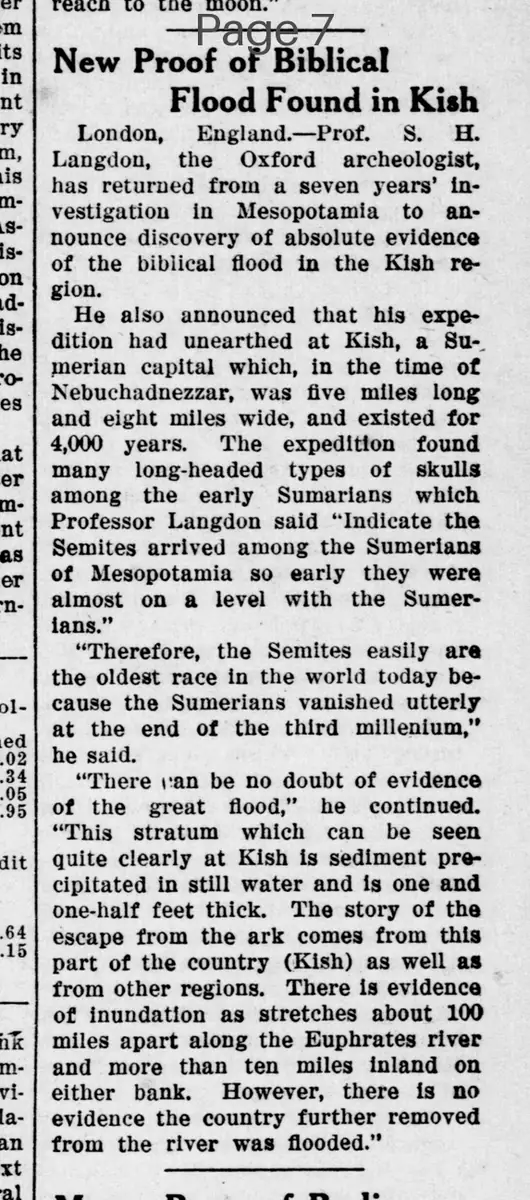
New Proof of Biblical Flood Found in Kish
London, England.—Prof. S. H. Langdon, the Oxford archeologist, has returned from a seven years' investigation in Mesopotamia to announce discovery of absolute evidence of the biblical flood in the Kish region.
He also announced that his expedition had unearthed at Kish, a Sumerian capital which, in the time of Nebuchadnezzar, was five miles long and eight miles wide, and existed for 4,000 years.
The expedition found many long-headed types of skulls among the early Sumarians which Professor Langdon said "Indicate the Semites arrived among the Sumerians of Mesopotamia so early they were almost on a level with the Sumerians."
"Therefore, the Semites easily are the oldest race in the world today because the Sumerians vanished utterly at the end of the third millennium," he said.
"There can be no doubt of evidence of the great flood," he continued. "This stratum which can be seen quite clearly at Kish is sediment precipitated in still water and is one and one-half feet thick. The story of the escape from the ark comes from this part of the country (Kish) as well as from other regions. There is evidence of inundation as stretches about 100 miles apart along the Euphrates river and more than ten miles inland on either bank. However, there is no evidence the country further removed from the river was flooded."
London, England.—Prof. S. H. Langdon, the Oxford archeologist, has returned from a seven years' investigation in Mesopotamia to announce discovery of absolute evidence of the biblical flood in the Kish region.
He also announced that his expedition had unearthed at Kish, a Sumerian capital which, in the time of Nebuchadnezzar, was five miles long and eight miles wide, and existed for 4,000 years.
The expedition found many long-headed types of skulls among the early Sumarians which Professor Langdon said "Indicate the Semites arrived among the Sumerians of Mesopotamia so early they were almost on a level with the Sumerians."
"Therefore, the Semites easily are the oldest race in the world today because the Sumerians vanished utterly at the end of the third millennium," he said.
"There can be no doubt of evidence of the great flood," he continued. "This stratum which can be seen quite clearly at Kish is sediment precipitated in still water and is one and one-half feet thick. The story of the escape from the ark comes from this part of the country (Kish) as well as from other regions. There is evidence of inundation as stretches about 100 miles apart along the Euphrates river and more than ten miles inland on either bank. However, there is no evidence the country further removed from the river was flooded."
What sub-type of article is it?
Historical Event
Extraordinary Event
Curiosity
What themes does it cover?
Exploration
Providence Divine
Triumph
What keywords are associated?
Biblical Flood
Kish Excavation
Sumerian History
Semitic Origins
Mesopotamia Archaeology
Flood Evidence
What entities or persons were involved?
Prof. S. H. Langdon
Where did it happen?
Kish Region, Mesopotamia
Story Details
Key Persons
Prof. S. H. Langdon
Location
Kish Region, Mesopotamia
Story Details
Prof. Langdon's expedition uncovers evidence of biblical flood via sediment layer in Kish, details on ancient Sumerian city, and early Semitic skulls indicating Semites as oldest race.