Thank you for visiting SNEWPapers!
Sign up free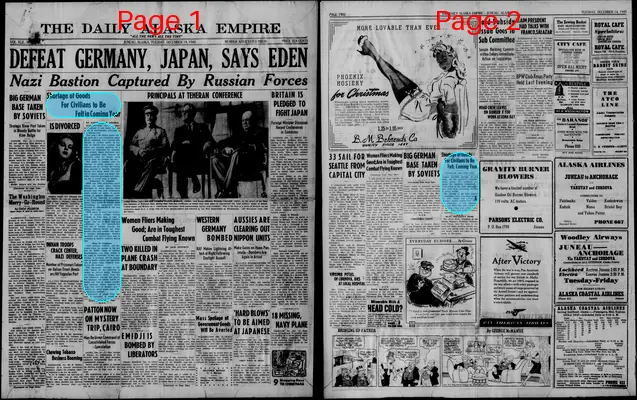
The Daily Alaska Empire
Juneau, Juneau County, Alaska
What is this article about?
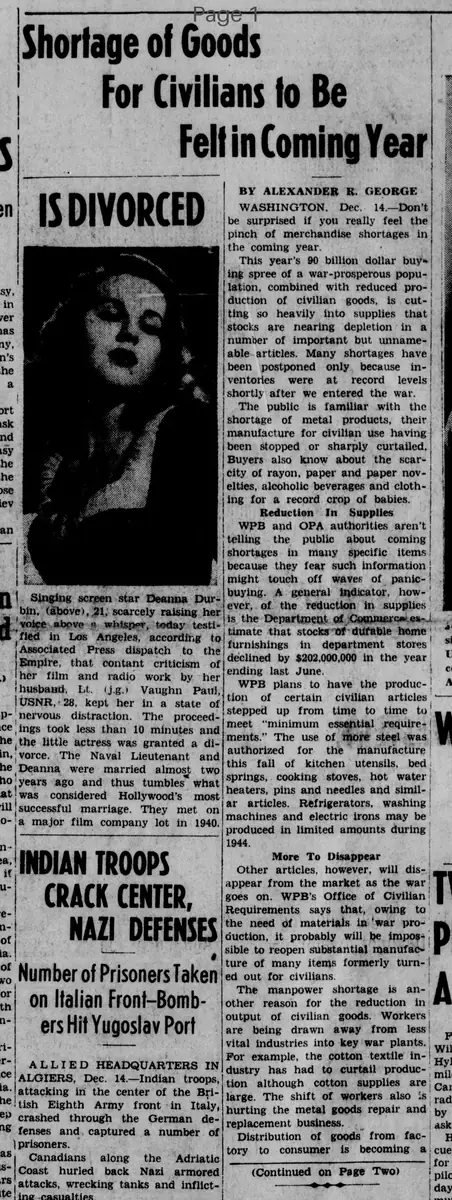
Washington report by Alexander R. George warns of impending civilian merchandise shortages in 1944 due to war priorities reducing production, depleting stocks, manpower shifts, and transportation strains, despite some planned increases for essentials.
Merged-components note: Continuation of the same domestic news article; relabeled from 'commercial' to 'domestic_news' as it matches the topic of civilian shortages in the US.
Clippings
1 of 2
OCR Quality
Full Text
BY ALEXANDER R. GEORGE
WASHINGTON, Dec. 14.-Don't be surprised if you really feel the pinch of merchandise shortages in the coming year.
This year's 90 billion dollar buying spree of a war-prosperous population, combined with reduced production of civilian goods, is cutting so heavily into supplies that stocks are nearing depletion in a number of important but unnameable articles. Many shortages have been postponed only, because inventories were at record levels shortly after we entered the war.
The public is familiar with the shortage of metal products, their manufacture for civilian use having been stopped or sharply curtailed. Buyers also know about the scarcity of rayon, paper and paper novelties, alcoholic beverages and clothing for a record crop of babies.
Reduction In Supplies
WPB and OPA authorities aren't telling the public about coming shortages in many specific items because they fear such information might touch off waves of panic-buying. A general indicator, however, of the reduction in supplies is the Department of Commerce estimate that stocks of durable home furnishings in department stores declined by $202,000,000 in the year ending last June.
WPB plans to have the production of certain civilian articles stepped up from time to time to meet "minimum essential requirements." The use of more steel was authorized for the manufacture this fall of kitchen utensils, bed springs, cooking stoves, hot water heaters, pins and needles and similar articles. Refrigerators, washing machines and electric irons may be produced in limited amounts during 1944.
More To Disappear
Other articles, however, will disappear from the market as the war goes on. WPB's Office of Civilian Requirements says that, owing to the need of materials in 'war production, it probably will be impossible to reopen substantial manufacture of many items formerly turned out for civilians.
The manpower shortage is another reason for the reduction in output of civilian goods. Workers are being drawn away from less vital industries into key war plants. For example, the cotton textile industry has had to curtail production although cotton supplies are large. The shift of workers also is hurting the metal goods repair and replacement business.
Distribution of goods from factory to consumer is becoming a
(Continued on Page Two)
Shortage of Goods For Civilians to Be Felt, Coming Year
(Continued from Page One)
tougher problem because of the strain on the country's transportation system. The railroads' capacity for handling shipments is being taxed to the limit. Car-shortages have been mounting steadily in recent weeks.
The outlook so far with respect to providing John and Mary Civilian with "goods and services to maintain health, morale and working efficiency" is not alarming.
John and Mary can count, however, on finding fewer and fewer goods to buy unless-and until-Germany is knocked out.
What sub-type of article is it?
What keywords are associated?
Where did it happen?
Domestic News Details
Primary Location
Washington
Event Date
Dec. 14
Outcome
stocks of durable home furnishings declined by $202,000,000 in the year ending last june; shortages in metal products, rayon, paper, alcoholic beverages, baby clothing; limited production of refrigerators, washing machines, electric irons in 1944; some articles to disappear; manpower and transportation strains reducing output.
Event Details
Wartime buying spree and reduced civilian production leading to merchandise shortages in coming year; WPB and OPA withholding specifics to avoid panic-buying; plans to step up production of essentials like kitchen utensils; cotton textile curtailment despite ample supplies; transportation system strained by railroad capacity limits.