Thank you for visiting SNEWPapers!
Sign up free
Staunton Spectator, And General Advertiser
Staunton, Virginia
What is this article about?
Dramatic courtroom scene in New Orleans during Mrs. Gen. Gaines' inheritance suit against parties including Richard Relf and Beverly Chew, where her counsel withdraws, she attempts self-representation, leading to heated exchanges with Judge Buchanan over evidence admissibility and alleged bias.
Clipping
OCR Quality
Full Text
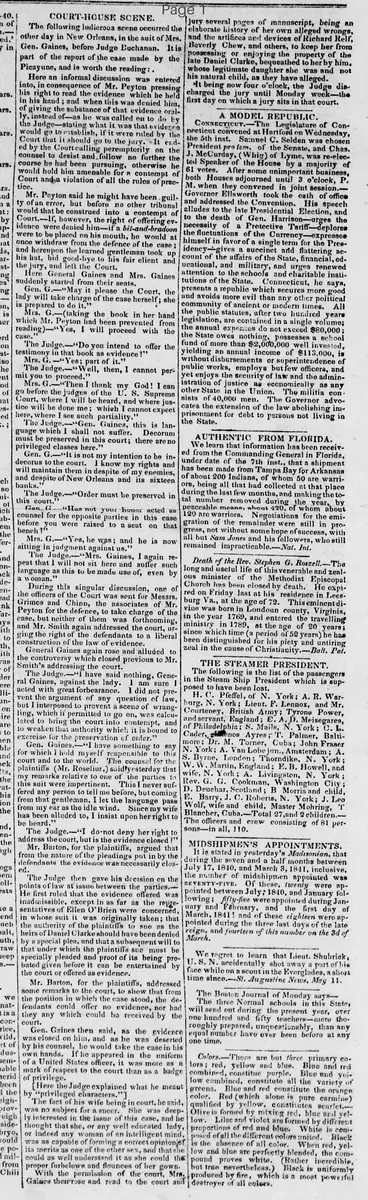
The following ludicrous scene occurred the other day in New Orleans, in the suit of Mrs. Gen. Gaines, before Judge Buchanan. It is part of the report of the case made by the Picayune, and is worth the reading.
Here an informal discussion was entered into, in consequence of Mr. Peyton pressing his right to read the evidence which he held in his hand; and when this was denied him, of giving the substance of that evidence orally, instead of—as he was called on to do by the Judge—stating what it was that evidence would go to establish, if it were ruled by the Court that it should go to the jury. It ended by the Court calling peremptorily on the counsel to desist and follow no further the course he had been pursuing, otherwise he would hold him amenable for a contempt of Court and a violation of all the rules of practice.
Mr. Peyton said he might have been guilty of an error, but before no other tribunal would that be construed into a contempt of Court.—If, however, the right of offering evidence were denied him—if a bit-and-bridle were to be placed on his mouth, he would at once withdraw from the defence of the case; and hereupon the learned gentleman took up his hat, bid good-bye to his fair client and the jury, and left the Court.
Here General Gaines and Mrs. Gaines suddenly started from their seats.
Gen. G.—"May it please the Court. the lady will take charge of the case herself; she is prepared to do it."
Mrs. G. (taking the book in her hand which Mr. Peyton had been prevented from reading)—"Yes, I will proceed with the case."
The Judge.—"Do you intend to offer the testimony in that book as evidence?"
Mrs. G. —"Yes; part of it."
The Judge.—"Well, then, I cannot permit you to proceed."
Mrs. G.—"Then I thank my God! I can go before the judges of the U. S. Supreme Court, where I will be heard, and where justice will be done me; which I cannot expect here, where I see such partiality."
The Judge.—"Gen. Gaines, this is language which I shall not suffer. Decorum must be preserved in this court; there are no privileged classes here."
Gen. G.—"It is not my intention to be indecorous to the court. I know my rights and will maintain them in despite of my enemies, and despite of New Orleans and its sixteen banks."
The Judge.—"Order must be preserved in this court."
Gen. G.—"Has not your honor acted as counsel for the opposite parties in this case before you were raised to a seat on that bench?"
Mrs. G.—"Yes, he was; and he is now sitting in judgment against us."
The Judge.—"Mrs. Gaines, I again repeat that I will not sit here and suffer such language as this to be made use of, even by a woman."
During this singular discussion, one of the officers of the Court was sent for Messrs. Grimes and Chinn, the associates of Mr. Peyton for the defence, to take charge of the case, but neither of them was forthcoming, and Mr. Smith again addressed the court, urging the right of the defendants to a liberal construction of the law of evidence.
General Gaines again rose and alluded to the controversy which closed previous to Mr. Smith's addressing the court.
The Judge.—"I have said nothing, General Gaines, against the lady. I am sure I acted with great forbearance. I did not prevent the argument of any question of law, but I interposed to prevent a scene of wrangling, which if permitted to go on, was calculated to bring the court into contempt, and to weaken that authority which it is bound to exercise for the preservation of order."
Gen. Gaines.—"I have something to say for which I hold myself responsible to this court and to the world. The counsel for the plaintiffs (Mr. Roselius,) said yesterday that my remarks relative to one of the parties to this suit were impertinent. This I never suffered any person to tell me before, but coming from that gentleman, I let the language pass from my ear as the idle wind. Since my wife has been alluded to, I insist upon her right to be heard."
The Judge.—"I do not deny her right to address the court, but is the evidence closed ?"
Mr. Barton, for the plaintiffs, argued that from the nature of the pleadings put in by the defendants the evidence was necessarily closed.
The Judge then gave his decision on the points of law at issue between the parties,— He first ruled that the evidence offered was inadmissible, except in as far as the representatives of Ellen O'Brien were concerned, in whose suit it was originally taken; that the authority of the plaintiffs to sue as the heirs of Daniel Clarke should have been denied by a special plea, and that a subsequent will to that under which the plaintiffs sue must be specially pleaded and proof of its being probated given before it can be entertained by the court or offered as evidence.
Mr. Barton, for the plaintiffs, addressed some remarks to the court, to show that from the position in which the case stood, the defendants could offer no evidence, nor had they any which could be received by the court.
Gen. Gaines then said, as the evidence was closed on him, and as he was deserted by his counsel, he would take the case in his own hands. If he appeared in the uniform of a United States officer, it was more as a mark of respect to the court than as a badge of privilege.
[Here the Judge explained what he meant by "privileged characters."]
The fact of his wife being in court, he said, was no subject for a sneer. She was deeply interested in the issue of this case, and he thought that she, or any well educated lady, or indeed any woman of an intelligent mind, was as capable of forming a correct opinion of its merits as one of the other sex, and that she could as well understand it as she could the proper flounces and furbelows of her gown.
With the permission of the court, Mrs. Gaines then rose and read to the court and jury several pages of manuscript, being an elaborate history of her own alleged wrongs, and the artifices and devices of Richard Relf. Beverly Chew, and others, to keep her from possessing or enjoying the property of the late Daniel Clarke, bequeathed to her by him, whose legitimate daughter she was and not his natural child, as they have alleged.
It being now four o'clock, the Judge discharged the jury until Monday week—the first day on which a jury sits in that court.
What sub-type of article is it?
What themes does it cover?
What keywords are associated?
What entities or persons were involved?
Where did it happen?
Story Details
Key Persons
Location
New Orleans Court House
Event Date
The Other Day
Story Details
In Mrs. Gaines' inheritance suit before Judge Buchanan, counsel Mr. Peyton withdraws after dispute over evidence; Mrs. Gaines attempts to represent herself but is denied; exchanges accuse judge of bias due to prior counsel role; judge rules evidence inadmissible except for Ellen O'Brien's suit; Mrs. Gaines reads her history of wrongs by Relf, Chew, and others denying her as Daniel Clarke's legitimate daughter.