Thank you for visiting SNEWPapers!
Sign up free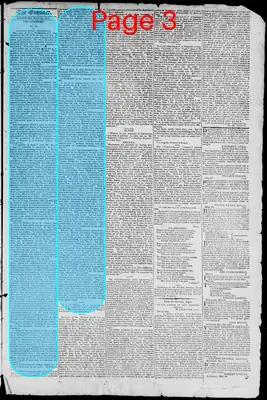
Editorial
May 18, 1810
The Enquirer
Richmond, Henrico County, Virginia
What is this article about?
Editorial in The Enquirer criticizes the U.S. House of Representatives for printing an ex-parte committee report accusing General James Wilkinson of misconduct without allowing him to respond, arguing it violates procedural fairness and differs from impeachment or trial processes.
Clipping
OCR Quality
95%
Excellent
Full Text
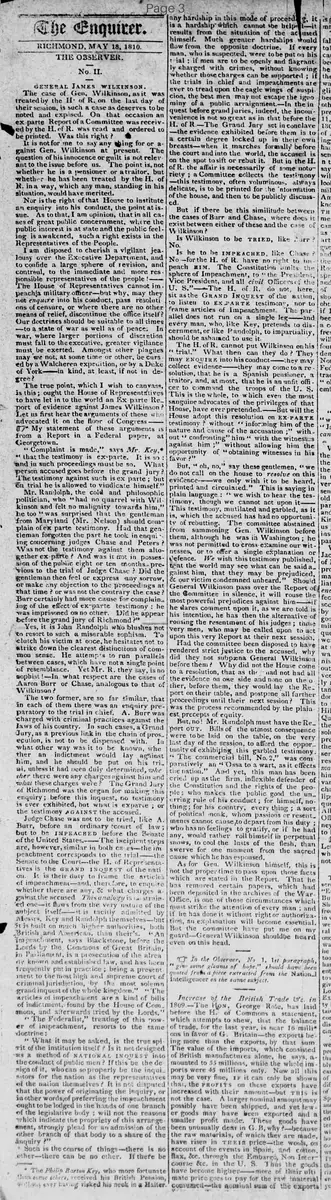
The Enquirer.
RICHMOND, MAY 18, 1810.
THE OBSERVER.
No. II.
GENERAL JAMES WILKINSON.
The case of Gen. Wilkinson, as it was treated by the House of Representatives on the last day of their session, is such a case as deserves to be noted and exposed. On that occasion an ex-parte Report of a Committee was received by the House of Representatives, was read and ordered to be printed. Was this right?
It is not for me to say anything for or against Gen. Wilkinson at present. The question of his innocence or guilt is not relevant to the issue before us. The point is, not whether he is a pensioner or a traitor, but whether he has been treated by the House of Representatives in a way which any man standing in his situation would have merited.
Nor is the right of that House to institute an enquiry into his conduct, the point at issue. As to that, I am of opinion, that in all cases of great public concernment, where the public interest is at stake and the public feeling is awakened, such a right exists in the Representatives of the People.
I am disposed to cherish a vigilant jealousy over the Executive Department, and to confide a large sphere of revision, and control, to the immediate and more responsible representatives of the people!
The House of Representatives cannot impeach a military officer—but why, may they not enquire into his conduct, pass resolutions of censure, or where there are no other means of relief, discontinue the office itself?
Our doctrines should be suitable to all times—to a state of war as well as of peace: In war, where larger portions of discretion must fall to the executive, greater vigilance must be exerted. Amongst other plagues may we not, at some time or other, be cursed by a Walcheren expedition, or by a Duke of York—in kind, at least, if not in degree?
The true point, which I wish to canvass, is this; ought the House of Representatives to have let in to the world an Ex-parte Report of evidence against James Wilkinson?
Let us first hear the arguments of those who advocated it on the floor of Congress—
My statement of these arguments is from a Report in a Federal paper, at Georgetown.
"Complaint is made," says Mr. Key, "that the testimony is ex-parte. It is so: and in such proceedings must be so. What person accused goes before the grand jury? The testimony against such is ex-parte; but on trial he is allowed to vindicate himself."
Mr. Randolph, the cold and philosophic politician, who "had no quarrel with Wilkinson and felt no malignity towards him," he too "was surprised that the gentleman from Maryland (Mr. Nelson) should complain of ex parte testimony. Had that gentleman forgotten the part he took in enquiring concerning judges Chase and Peters? Was not the testimony against them altogether ex-parte? And was it not in possession of the public eight or ten months—previous to the trial of Judge Chase? Did the gentleman then feel or express any sorrow, or make any objection to the proceedings at that time? or was not the contrary the case?"
Burr certainly had more cause for complaining of the effect of ex-parte testimony: he was imprisoned on no other. Did he appear before the grand jury of Richmond?
Yes, it is John Randolph who blushes not to resort to such a miserable sophism. To clutch his victim at once, he hesitates not to strike down the clearest distinctions of common sense. He attempts to run parallels between cases, which have not a single point of resemblance. Yet Mr. R. they say, is no sophist!—In what respect are the cases of Aaron Burr or Chase, analogous to that of Wilkinson?
The two former, are so far similar, that in each of them there was an enquiry preparatory to the trial in chief. A. Burr was charged with criminal practices against the laws of his country. In such cases, a Grand Jury, as a previous link in the chain of prosecution, is not to be dispensed with. In what other way was it to be known, whether an indictment would lay against him, and he should be put on his trial, unless it had been duly determined, whether there were any charges against him and what these charges were? The Grand Jury of Richmond was the organ for making this enquiry; before this inquest, no testimony is ever exhibited, but what is ex-parte; or the testimony AGAINST the accused.
Judge Chase was not to be tried, like A. Burr, before an ordinary court of law; but to be IMPEACHED before the Senate of the United States.—The incipient steps are, however, similar in both cases—the impeachment corresponds to the trial—the Senate to the Court—the House of Representatives is the GRAND INQUEST of the nation. It is their duty to frame the articles of impeachment—and, therefore, to enquire whether there are any, & what charges against the accused. This analogy is strained once—it flows from the very nature of the subject itself—it is tacitly admitted by Messrs. Key and Randolph themselves—but it is built on much higher authorities, both British and American, than theirs. "An impeachment, says Blackstone, before the Lords by the Commons of Great Britain, in Parliament, is a prosecution of the already known and established law, and has been frequently put in practice; being a presentment to the most high and supreme court of criminal jurisdiction, by the most solemn grand inquest of the whole kingdom." "The articles of impeachment are a kind of bills of indictment, found by the House of Commons, and afterwards tried by the Lords."
"The Federalist," treating of this power of impeachment, resorts to the same doctrine:
"What it may be asked, is the true spirit of the institution itself? Is it not designed as a method of NATIONAL INQUEST into the conduct of public men? If this be the design of it, who can so properly be the inquisitors for the nation as the representatives of the nation themselves? It is not disputed that the power of originating the inquiry, or in other words, of preferring the impeachment ought to be lodged in the hands of one branch of the legislative body: will not the reasons which indicate the propriety of this arrangement, strongly plead for an admission of the other branch of that body to a share of the inquiry?"
Such is the course of things—there is no other—there can be no other. If there be any hardship in this mode of proceeding, it is a hardship which cannot be helped—it results from the situation of the accused himself. Much greater hardships would flow from the opposite doctrine. If every man who is suspected, were to be put on his trial: if men are to be openly and flagrantly charged with crimes, without knowing whether those charges can be supported; if the trials in chief and impeachments are ever to tread upon the eagle wings of suspicion, the best men may not escape the ignominy of a public arraignment.—In the inquest before grand juries, indeed, the inconvenience is not so great as in that before the House of Representatives. The Grand Jury sit in conclave—the evidence exhibited before them is to a certain degree locked up in their own breasts—when it marches formally before the court and into the world, the accused is on the spot to sift or rebut it. But in the House of Representatives the affair is necessarily of some notoriety; a Committee collects the testimony—this testimony, often voluminous, always delicate, is to be printed for the information of the house, and then to be publicly discussed.
But if there be this similitude between the cases of Burr and Chase, where does it exist between either of these and the case of Wilkinson?
Is Wilkinson to be TRIED, like Burr?
No.
Is he to be IMPEACHED, like Chase?
No—for the House of Representatives have no right to impeach him. The Constitution limits the sphere of Impeachment, to "the President, Vice President, and all civil Officers of the U. S."—The House of Representatives do not, here, sit as the Grand Inquest of the nation, to listen to Ex-PARTE testimony, nor to frame articles of Impeachment. The parallel does not run on a single leg—and every man, who, like Key, pretends to discernment, or like Randolph, to impartiality, should be ashamed to use it.
The House of Representatives cannot put Wilkinson on his "trial." What then can they do? They may ENQUIRE into his conduct—they may collect evidence—they may come to a resolution, that he is a Spanish pensioner, a traitor, and, at most, that he is an unfit officer to command the troops of the U. S.
This is the whole, to which even the most sanguine advocates of the privileges of that House, have ever pretended.—But will the House adopt this resolution on Ex-PARTE testimony? without "informing him of the nature and cause of the accusation;" without "confronting him with the witnesses against him;" without allowing him the opportunity of "obtaining witnesses in his favor?"
But, "oh, no," say these gentlemen, "we do not call on the house to resolve on this evidence—we only wish it to be heard, printed and circulated." This is saying in plain language: "we wish to hear the testimony, though we cannot act upon it.—This testimony, mutilated and garbled, as it is, which the accused has had no opportunity of rebutting. The committee abstained from summoning Gen. Wilkinson before them, although he was in Washington; he was not permitted to cross-examine our witnesses, or to offer a single explanation or defence. We wish this testimony published, that the world may see what can be said against him, that they may be prejudiced, & our victim condemned unheard." Should General Wilkinson pass over the Report of the Committee in silence, it will rouse the most powerful prejudices against him—if he dares comment upon it, as we are told is his intention, he has then the alternative of rousing the resentment of his judges; those very men, who may be called upon to act upon this very Report at their next session.
Had the committee been disposed to have rendered strict justice to the accused, why did they not subpoena General Wilkinson before them? Why did not the House come to a resolution, that as they had not had all the evidence on one side and none on the other, before them, they would lay the Report on their table, and postpone all further proceedings until their next session? This was the process recommended by the plainest precepts of equity.
But, no! Mr. Randolph must have the Report out. Bills of the utmost consequence were to be laid on the table, on the very last day of the session, to afford the opportunity of exhibiting this garbled testimony. "The commercial bill, No. 2," was comparatively an "Ossa to a wart, as it affects the nation." And yet, this man has been cried up as the firm, inflexible defender of the Constitution and the rights of the people; who makes the public good the unerring rule of his conduct; for himself, nothing; for his country, every thing; a sort of political monk, whom passions or resentments cannot cause to depart from his duty; who has no feelings to gratify, or if he had any, would rather roll himself in perpetual snows, to cool the lusts of the flesh, than swerve for one moment from the sacred cause which he has espoused.
As for Gen. Wilkinson himself, this is not the proper time to pass upon those facts which are stated in the Report. That he has removed certain papers, which had been deposited in the archives of the War-Office, is one of those circumstances which must strike the attention of every man; and if he has done it without right or authorization, an explanation will become essential.
But the committee have put me on my guard—General Wilkinson should be heard even on this head.
In the Observer, No. 1, 1st paragraph, "give some glimpse of hope," should have been quoted from a piece extracted from the National Intelligencer on the same subject.
RICHMOND, MAY 18, 1810.
THE OBSERVER.
No. II.
GENERAL JAMES WILKINSON.
The case of Gen. Wilkinson, as it was treated by the House of Representatives on the last day of their session, is such a case as deserves to be noted and exposed. On that occasion an ex-parte Report of a Committee was received by the House of Representatives, was read and ordered to be printed. Was this right?
It is not for me to say anything for or against Gen. Wilkinson at present. The question of his innocence or guilt is not relevant to the issue before us. The point is, not whether he is a pensioner or a traitor, but whether he has been treated by the House of Representatives in a way which any man standing in his situation would have merited.
Nor is the right of that House to institute an enquiry into his conduct, the point at issue. As to that, I am of opinion, that in all cases of great public concernment, where the public interest is at stake and the public feeling is awakened, such a right exists in the Representatives of the People.
I am disposed to cherish a vigilant jealousy over the Executive Department, and to confide a large sphere of revision, and control, to the immediate and more responsible representatives of the people!
The House of Representatives cannot impeach a military officer—but why, may they not enquire into his conduct, pass resolutions of censure, or where there are no other means of relief, discontinue the office itself?
Our doctrines should be suitable to all times—to a state of war as well as of peace: In war, where larger portions of discretion must fall to the executive, greater vigilance must be exerted. Amongst other plagues may we not, at some time or other, be cursed by a Walcheren expedition, or by a Duke of York—in kind, at least, if not in degree?
The true point, which I wish to canvass, is this; ought the House of Representatives to have let in to the world an Ex-parte Report of evidence against James Wilkinson?
Let us first hear the arguments of those who advocated it on the floor of Congress—
My statement of these arguments is from a Report in a Federal paper, at Georgetown.
"Complaint is made," says Mr. Key, "that the testimony is ex-parte. It is so: and in such proceedings must be so. What person accused goes before the grand jury? The testimony against such is ex-parte; but on trial he is allowed to vindicate himself."
Mr. Randolph, the cold and philosophic politician, who "had no quarrel with Wilkinson and felt no malignity towards him," he too "was surprised that the gentleman from Maryland (Mr. Nelson) should complain of ex parte testimony. Had that gentleman forgotten the part he took in enquiring concerning judges Chase and Peters? Was not the testimony against them altogether ex-parte? And was it not in possession of the public eight or ten months—previous to the trial of Judge Chase? Did the gentleman then feel or express any sorrow, or make any objection to the proceedings at that time? or was not the contrary the case?"
Burr certainly had more cause for complaining of the effect of ex-parte testimony: he was imprisoned on no other. Did he appear before the grand jury of Richmond?
Yes, it is John Randolph who blushes not to resort to such a miserable sophism. To clutch his victim at once, he hesitates not to strike down the clearest distinctions of common sense. He attempts to run parallels between cases, which have not a single point of resemblance. Yet Mr. R. they say, is no sophist!—In what respect are the cases of Aaron Burr or Chase, analogous to that of Wilkinson?
The two former, are so far similar, that in each of them there was an enquiry preparatory to the trial in chief. A. Burr was charged with criminal practices against the laws of his country. In such cases, a Grand Jury, as a previous link in the chain of prosecution, is not to be dispensed with. In what other way was it to be known, whether an indictment would lay against him, and he should be put on his trial, unless it had been duly determined, whether there were any charges against him and what these charges were? The Grand Jury of Richmond was the organ for making this enquiry; before this inquest, no testimony is ever exhibited, but what is ex-parte; or the testimony AGAINST the accused.
Judge Chase was not to be tried, like A. Burr, before an ordinary court of law; but to be IMPEACHED before the Senate of the United States.—The incipient steps are, however, similar in both cases—the impeachment corresponds to the trial—the Senate to the Court—the House of Representatives is the GRAND INQUEST of the nation. It is their duty to frame the articles of impeachment—and, therefore, to enquire whether there are any, & what charges against the accused. This analogy is strained once—it flows from the very nature of the subject itself—it is tacitly admitted by Messrs. Key and Randolph themselves—but it is built on much higher authorities, both British and American, than theirs. "An impeachment, says Blackstone, before the Lords by the Commons of Great Britain, in Parliament, is a prosecution of the already known and established law, and has been frequently put in practice; being a presentment to the most high and supreme court of criminal jurisdiction, by the most solemn grand inquest of the whole kingdom." "The articles of impeachment are a kind of bills of indictment, found by the House of Commons, and afterwards tried by the Lords."
"The Federalist," treating of this power of impeachment, resorts to the same doctrine:
"What it may be asked, is the true spirit of the institution itself? Is it not designed as a method of NATIONAL INQUEST into the conduct of public men? If this be the design of it, who can so properly be the inquisitors for the nation as the representatives of the nation themselves? It is not disputed that the power of originating the inquiry, or in other words, of preferring the impeachment ought to be lodged in the hands of one branch of the legislative body: will not the reasons which indicate the propriety of this arrangement, strongly plead for an admission of the other branch of that body to a share of the inquiry?"
Such is the course of things—there is no other—there can be no other. If there be any hardship in this mode of proceeding, it is a hardship which cannot be helped—it results from the situation of the accused himself. Much greater hardships would flow from the opposite doctrine. If every man who is suspected, were to be put on his trial: if men are to be openly and flagrantly charged with crimes, without knowing whether those charges can be supported; if the trials in chief and impeachments are ever to tread upon the eagle wings of suspicion, the best men may not escape the ignominy of a public arraignment.—In the inquest before grand juries, indeed, the inconvenience is not so great as in that before the House of Representatives. The Grand Jury sit in conclave—the evidence exhibited before them is to a certain degree locked up in their own breasts—when it marches formally before the court and into the world, the accused is on the spot to sift or rebut it. But in the House of Representatives the affair is necessarily of some notoriety; a Committee collects the testimony—this testimony, often voluminous, always delicate, is to be printed for the information of the house, and then to be publicly discussed.
But if there be this similitude between the cases of Burr and Chase, where does it exist between either of these and the case of Wilkinson?
Is Wilkinson to be TRIED, like Burr?
No.
Is he to be IMPEACHED, like Chase?
No—for the House of Representatives have no right to impeach him. The Constitution limits the sphere of Impeachment, to "the President, Vice President, and all civil Officers of the U. S."—The House of Representatives do not, here, sit as the Grand Inquest of the nation, to listen to Ex-PARTE testimony, nor to frame articles of Impeachment. The parallel does not run on a single leg—and every man, who, like Key, pretends to discernment, or like Randolph, to impartiality, should be ashamed to use it.
The House of Representatives cannot put Wilkinson on his "trial." What then can they do? They may ENQUIRE into his conduct—they may collect evidence—they may come to a resolution, that he is a Spanish pensioner, a traitor, and, at most, that he is an unfit officer to command the troops of the U. S.
This is the whole, to which even the most sanguine advocates of the privileges of that House, have ever pretended.—But will the House adopt this resolution on Ex-PARTE testimony? without "informing him of the nature and cause of the accusation;" without "confronting him with the witnesses against him;" without allowing him the opportunity of "obtaining witnesses in his favor?"
But, "oh, no," say these gentlemen, "we do not call on the house to resolve on this evidence—we only wish it to be heard, printed and circulated." This is saying in plain language: "we wish to hear the testimony, though we cannot act upon it.—This testimony, mutilated and garbled, as it is, which the accused has had no opportunity of rebutting. The committee abstained from summoning Gen. Wilkinson before them, although he was in Washington; he was not permitted to cross-examine our witnesses, or to offer a single explanation or defence. We wish this testimony published, that the world may see what can be said against him, that they may be prejudiced, & our victim condemned unheard." Should General Wilkinson pass over the Report of the Committee in silence, it will rouse the most powerful prejudices against him—if he dares comment upon it, as we are told is his intention, he has then the alternative of rousing the resentment of his judges; those very men, who may be called upon to act upon this very Report at their next session.
Had the committee been disposed to have rendered strict justice to the accused, why did they not subpoena General Wilkinson before them? Why did not the House come to a resolution, that as they had not had all the evidence on one side and none on the other, before them, they would lay the Report on their table, and postpone all further proceedings until their next session? This was the process recommended by the plainest precepts of equity.
But, no! Mr. Randolph must have the Report out. Bills of the utmost consequence were to be laid on the table, on the very last day of the session, to afford the opportunity of exhibiting this garbled testimony. "The commercial bill, No. 2," was comparatively an "Ossa to a wart, as it affects the nation." And yet, this man has been cried up as the firm, inflexible defender of the Constitution and the rights of the people; who makes the public good the unerring rule of his conduct; for himself, nothing; for his country, every thing; a sort of political monk, whom passions or resentments cannot cause to depart from his duty; who has no feelings to gratify, or if he had any, would rather roll himself in perpetual snows, to cool the lusts of the flesh, than swerve for one moment from the sacred cause which he has espoused.
As for Gen. Wilkinson himself, this is not the proper time to pass upon those facts which are stated in the Report. That he has removed certain papers, which had been deposited in the archives of the War-Office, is one of those circumstances which must strike the attention of every man; and if he has done it without right or authorization, an explanation will become essential.
But the committee have put me on my guard—General Wilkinson should be heard even on this head.
In the Observer, No. 1, 1st paragraph, "give some glimpse of hope," should have been quoted from a piece extracted from the National Intelligencer on the same subject.
What sub-type of article is it?
Constitutional
Partisan Politics
Military Affairs
What keywords are associated?
General Wilkinson
Ex Parte Testimony
House Of Representatives
Congressional Inquiry
Due Process
Military Officer Conduct
Partisan Debate
What entities or persons were involved?
General James Wilkinson
House Of Representatives
Mr. Key
Mr. Randolph
Aaron Burr
Judge Chase
Editorial Details
Primary Topic
Critique Of Ex Parte Report On General Wilkinson
Stance / Tone
Critical Of House Procedures, Advocating Fairness
Key Figures
General James Wilkinson
House Of Representatives
Mr. Key
Mr. Randolph
Aaron Burr
Judge Chase
Key Arguments
House Should Not Publish Ex Parte Report Without Hearing The Accused
Analogy To Grand Jury Inquests Does Not Apply To Wilkinson's Case
Wilkinson Cannot Be Impeached Or Tried By House
Printing Report Prejudices Public Without Defense Opportunity
Committee Failed To Subpoena Wilkinson For Testimony