Thank you for visiting SNEWPapers!
Sign up free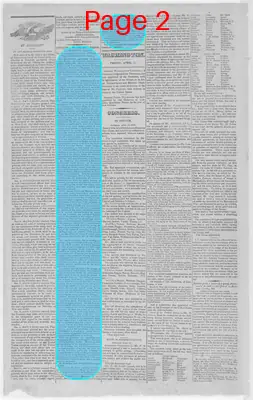
Daily National Intelligencer
Washington, District Of Columbia
What is this article about?
In a Senate speech on March 24, Mr. Dickerson advocates for a congressional resolution thanking Major General William Henry Harrison and former Kentucky Governor Isaac Shelby for their bravery in defeating British and Indian forces at the Battle of the Thames on October 5, 1813. He addresses past objections, vindicates Harrison based on a 1817 inquiry, and quotes Shelby praising Harrison. The resolution, including gold medals, is unanimously adopted.
Clipping
OCR Quality
Full Text
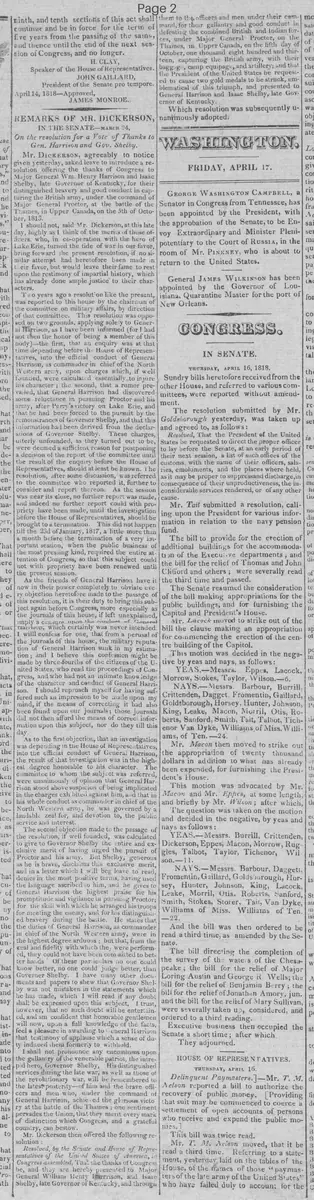
On the resolution for a Vote of Thanks to Gen. Harrison and Gov. Shelby.
Mr. Dickerson, agreeably to notice given yesterday, asked leave to introduce a resolution offering the thanks of Congress to Major General Wm. Henry Harrison and Isaac Shelby, late Governor of Kentucky, for their distinguished bravery and good conduct in capturing the British army, under the command of Major General Proctor, at the battle of the Thames, in Upper Canada, on the 5th of October, 1813.
I should not, said Mr. Dickerson, at this late day, highly as I think of the merits of those officers, who, in co-operation with the hero of Lake Erie, turned the tide of war in our favor, bring forward the present resolution, if no similar attempt had heretofore been made in their favor, but would leave their fame to rest upon the testimony of impartial history, which has already done ample justice to their characters.
Two years ago a resolution like the present, was reported to this house by the chairman of the committee on military affairs, by direction of that committee. This resolution was opposed on two grounds, applying solely to General Harrison, as I have been informed (for I had not then the honor of being a member of this body)—the first, that an enquiry was at that time depending before the House of Representatives, into the official conduct of General Harrison, as commander in chief of the North Western army, upon charges which, if well founded, were calculated essentially to injure his character; the second, that a rumor prevailed, that General Harrison had discovered some reluctance in pursuing Proctor and his army, after Perry's victory on Lake Erie, and that he had been forced to the pursuit by the remonstrances of Governor Shelby, and that this information had been derived from the declarations of Governor Shelby. These charges, utterly unfounded, as they turned out to be, were deemed a sufficient reason for postponing a decision of the report of the committee until the result of the enquiry before the House of Representatives, should at least be known. The resolution, after some discussion, was referred to the committee who reported it, further to consider and report thereon. As the session was near its close, no further report was made, and indeed no further report could with propriety have been made, until the investigation before the House of Representatives, should be brought to a termination. This did not happen till the 23d of January, 1817, a little more than a month before the termination of a very important session, when the public business of the most pressing kind, required the entire attention of Congress, so that this subject could not with propriety have been renewed until the present session.
As the friends of General Harrison have it now in their power completely to obviate every objection heretofore made to the passage of this resolution, it is their duty to bring this subject again before Congress, more especially as the journals of this house, if left unexplained, imply a censure upon the conduct of General Harrison, which certainly was never intended. I will confess for one, that from a perusal of the journals of this house, the military reputation of General Harrison sunk in my estimation; and I believe this confession might be made by three-fourths of the citizens of the United States, who read the proceedings of Congress, and who had not an intimate knowledge of the character and conduct of General Harrison. I should reproach myself for having suffered such an impression to be made upon my mind, if the means of correcting it had also been found upon our journals; those journals did not then afford the means of correct information upon this subject, nor do they till this day.
As to the first objection, that an investigation was depending in the House of Representatives, into the official conduct of General Harrison, the result of that investigation was in the highest degree honorable to his character. The committee to whom the subject was referred, were unanimously of opinion that General Harrison stood above suspicion of being implicated in the charges exhibited against him, and that in his whole conduct as commander in chief of the North Western army, he was governed by a laudable zeal for, and devotion to, the public service and interest.
The second objection made to the passage of the resolution, if well founded, was calculated to give to Governor Shelby the entire and exclusive merit of having urged the pursuit of Proctor and his army. But Shelby, generous as he is brave, disclaims this exclusive merit and in a letter which I will beg leave to read, denies in the most positive terms, having used the language ascribed to him, and he gives to General Harrison the highest praise for his promptitude and vigilance in pursuing Proctor; for the skill with which he arranged his troops for meeting the enemy, and for his distinguished bravery during the battle. He states that the duties of General Harrison, as commander in chief of the North Western army, were in the highest degree arduous; but that, from the zeal and fidelity with which they were performed, they could not have been committed to better hands. Of these particulars no one could know better, no one could judge better, than Governor Shelby. I have many other documents and papers to shew that Governor Shelby was not mistaken in the statements which he has made, which I will read if any doubt shall be expressed upon this subject, I trust, however, that no such doubt will be entertained, and am confident that honorable gentlemen will now, upon a full knowledge of the facts, feel a pleasure in awarding to General Harrison that testimony of applause which a sense of duty induced them formerly to withhold.
I shall not pronounce any encomiums upon the gallantry of the venerable patriot, the intrepid hero, Governor Shelby. His distinguished services during the late war, as well as those of the revolutionary war, will be remembered to the latest posterity—of him and the brave officers and men who, under the command of General Harrison, achieved the glorious victory at the battle of the Thames; one sentiment pervades the Union, that they merit every mark of distinction which Congress, and a grateful country, can bestow.
Mr. Dickerson then offered the following resolution:
Resolved, by the Senate and House of Representatives of the United States of America, in Congress assembled, That the thanks of Congress be, and they are hereby presented to Major General William Henry Harrison, and Isaac Shelby, late Governor of Kentucky, and through them to the officers and men under their command, for their gallantry and good conduct in defeating the combined British and Indian forces, under Major General Proctor, on the Thames, in Upper Canada, on the fifth day of October, one thousand eight hundred and thirteen, capturing the British army, with their baggage, camp equipage, and artillery; and that the President of the United States be requested to cause two gold medals to be struck, emblematical of this triumph, and presented to General Harrison and Isaac Shelby, late Governor of Kentucky.
Which resolution was subsequently unanimously adopted.
What sub-type of article is it?
What themes does it cover?
What keywords are associated?
What entities or persons were involved?
Where did it happen?
Story Details
Key Persons
Location
Senate; Battle Of The Thames, Upper Canada
Event Date
March 24; 5th Of October, 1813
Story Details
Mr. Dickerson introduces and defends a resolution thanking General Harrison and Governor Shelby for their victory at the Battle of the Thames, addressing past unfounded objections and vindicating Harrison's conduct based on a prior inquiry and Shelby's testimony; the resolution is unanimously adopted.