Thank you for visiting SNEWPapers!
Sign up free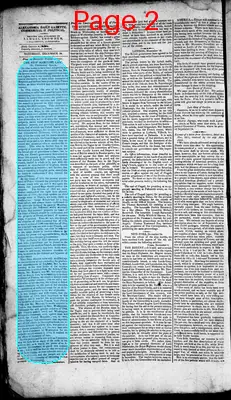
Alexandria Daily Gazette, Commercial & Political
Alexandria, Virginia
What is this article about?
Opinion piece from Baltimore Federal Gazette critiquing French maritime decrees from 1704 to 1806, including the Berlin Decree and Continental System, as violations of neutral shipping rights, contrasting with U.S. principles under Washington and urging reversal of current policy.
Clipping

OCR Quality
Full Text
THE NEW MARITIME LAW,
Or, Continental System.
An idea seems to have been adopted by many, even among those who consider the Berlin decree as an intolerable aggression on neutral rights, that it was entirely founded on the partial blockades, or some other measures of England, and had not been practised by France before, an error which it may be important to correct.
In 1704, during the war of the Spanish succession, an edict was passed by Louis XIV. authorising his cruisers to capture ships which should be loaded with goods, the produce or manufacture of his enemies, and permitting the vessels to proceed on their voyage after landing the illicit cargoes. This continued to be the rule of prizes in France, until the American war, when, by the treaty of 1778, neutral ships were allowed to protect the cargoes, not only when the growth or manufacture of enemies, but even when the enemies' property, terms which were favorable to the northern powers, and generally adopted by them, but of which the United States never derived any advantage, for as soon as the late war commenced, (February, 1793) in violation of the treaty and the newly established right of neutrals, the French began to seize neutral ships and in ten weeks after they declared war, passed an edict to sanction the violation. This went no further than to the property of enemies on board such ships, and the forced sale of provisions to them; but in 1798, the French government determined to drive this country to extremities, surpassed the edicts of Louis XIV. and declared, that vessels loaded in whole or in part with the produce or manufacture of England, should be considered as enemies; and further, that vessels touching at English ports, should also be liable to confiscation if they entered the ports of France.
By the treaty of 1800, the present government of France restored the principles of the former treaty with us, and it was again declared, that neutral flags should protect the cargoes.
The decrees of 1806 are more violent outrages of the right here allowed, than that of 1793; for ships spoken on their passage even to France, are made liable to confiscation. Great Britain had for a long time before, and always since, conformed to the principle declared by general Washington, through Mr. Jefferson, whilst secretary of state, that enemies' property on board of the ships of friends should be confiscated, and the property of friends on board of enemies ships, respected. Thus we see, that though the violation of 1806 exceeded that of 1798, as much as that of 1798 exceeded that of 1704, the principle was not new to the French, and their return to it lately, can only be referred to the same desire to involve others in the contest for power and aggrandisement, which signalized their former governments:
The vacillation of their measures proves promises of the modern French, and that whatever advances society may have made there, France is still ready, whenever occasion offers, to return to the violence and injustice of darker times.
That those decrees were only modified upon the condition of our excluding the produce and manufactures of England, that is, conforming to the very letter of the decrees themselves, is evident from the letters of Mr. Smith, Mr. Russell, and Mr. Serrurier himself, so that, in fact, by submitting to become colonists of France, we obtain a limited trade with our mother country; this we call a modification of her decrees, the refusal to follow which example, on the part of her enemies, is considered as sufficient cause for us to become active partners in the war of plunder.
It was thought and with reason, that the principles of 1778 were important to this country, and it was for his acquiescence in the violation of them by France, from 1793 to 1796, that Mr. Monroe, formerly minister to France, was dismissed by Gen. Washington.
To oppose the still greater violation of 1798, this country armed itself, and Washington accepted a command, even against what was called the French Republic; but, in 1806, after a despot had overthrown that republic, and all the others in his neighborhood, the violation of these rights by him, was passed over almost unnoticed, and the very man who had been dismissed by Washington for his culpable acquiescence in 1796, is exalted to the office of secretary of state.
In this policy, and in this only, as I conceive, may we look for as many of the evils of the present day, as it was in the power of an American government to guard this country from; it may well be feared, that we shall not again have happy, or even tolerable times, until it is reversed, and the people are made sensible of the necessity of returning to that pursued by Washington.
The Old Baltimorean.
What sub-type of article is it?
What keywords are associated?
What entities or persons were involved?
Where did it happen?
Foreign News Details
Primary Location
France
Event Date
1806
Key Persons
Outcome
french decrees violate neutral rights by confiscating ships with enemy goods or touching english ports; u.s. urged to return to washington's principles.
Event Details
Historical analysis of French maritime edicts from 1704, 1778 treaty, 1793 and 1798 violations, 1800 restoration, and 1806 decrees exceeding prior aggressions, critiquing French policy as aggressive towards neutrals and calling for U.S. resistance.