Thank you for visiting SNEWPapers!
Sign up free
Editorial
October 19, 1833
The Liberator
Boston, Suffolk County, Massachusetts
What is this article about?
An 1833 Boston editorial criticizes the American Colonization Society for supplying arguments to British slavery defenders, like the Duke of Wellington and Sir Robert Peel, by depicting free blacks as degraded, thereby obstructing global emancipation efforts. It quotes society materials and echoes Wilberforce's view that the society hinders worldwide abolition.
Clipping
OCR Quality
98%
Excellent
Full Text
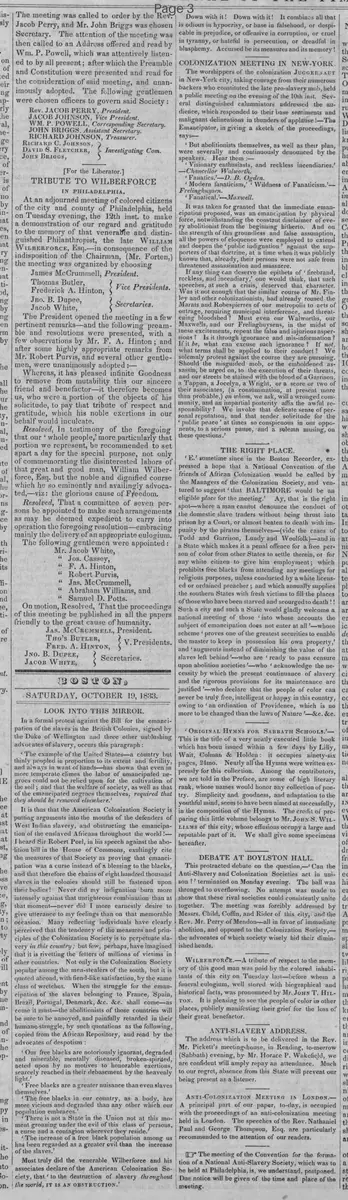
BOSTON,
SATURDAY, OCTOBER 19, 1833.
LOOK INTO THIS MIRROR.
In a formal protest against the Bill for the emancipation of the slaves in the British Colonies, signed by the Duke of Wellington and three other unblushing advocates of slavery, occurs this paragraph:
The example of the United States—a country but thinly peopled in proportion to its extent and fertility, and always in want of hands—has shown that even in more temperate climes the labor of emancipated negroes could not be relied upon for the cultivation of the soil; and that the welfare of society, as well as that of the emancipated negroes themselves, required that they should be removed elsewhere.'
It is thus that the American Colonization Society is putting arguments into the mouths of the defenders of West Indian slavery, and obstructing the emancipation of the enslaved Africans throughout the world!— I heard Sir Robert Peel, in his speech against the abolition bill in the House of Commons, exultingly cite the measures of that Society as proving that emancipation was a curse instead of a blessing to the blacks, and that therefore the chains of eight hundred thousand slaves in the colonies should still be fastened upon their bodies! Never did my indignation burn more intensely against that unrighteous combination than at that moment-never did I more earnestly desire to give utterance to my feelings than on that memorable occasion. Many reflecting individuals have clearly perceived that the tendency of the measures and principles of the Colonization Society is to perpetuate slavery in this country; but few, perhaps, have imagined that it is rivetting the fetters of millions of victims in other countries. Not only is the Colonization Society popular among the men-stealers of the south, but it is quoted abroad, with fiend-like satisfaction, by the same class of wretches. When the struggle for the emancipation of the slaves belonging to France, Spain, Brazil, Portugal, Denmark, &c. &c. shall come--as come it must-the abolitionists of those countries will be sure to be annoyed, and painfully retarded in their humane struggle, by such quotations as the following. copied from the African Repository, and read by the advocates of despotism :
' Our free blacks are notoriously ignorant, degraded and miserable, mentally diseased, broken-spirited, acted upon by no motives to honorable exertions, scarcely reached in their debasement by the heavenly light.'
'Free blacks are a greater nuisance than even slaves themselves.'
The free blacks in our country, as a body, are more vicious and degraded than any other which our population embraces.
There is not a State in the Union not at this moment groaning under the evil of this class of persons, a curse and a contagion wherever they reside.
The increase of a free black population among us has been regarded as a greater evil than the increase of the slaves.'
Most truly did the venerable Wilberforce and his associates declare of the American Colonization Society, that 'to the destruction of slavery throughout the world, IT IS AN OBSTRUCTION.'
Down with it! Down with it! It combines all that is odious in hypocrisy, or base in falsehood, or despicable in prejudice, or offensive in corruption, or cruel in tyranny, or hateful in persecution, or dreadful in blasphemy. Accursed be its measures and its memory!
SATURDAY, OCTOBER 19, 1833.
LOOK INTO THIS MIRROR.
In a formal protest against the Bill for the emancipation of the slaves in the British Colonies, signed by the Duke of Wellington and three other unblushing advocates of slavery, occurs this paragraph:
The example of the United States—a country but thinly peopled in proportion to its extent and fertility, and always in want of hands—has shown that even in more temperate climes the labor of emancipated negroes could not be relied upon for the cultivation of the soil; and that the welfare of society, as well as that of the emancipated negroes themselves, required that they should be removed elsewhere.'
It is thus that the American Colonization Society is putting arguments into the mouths of the defenders of West Indian slavery, and obstructing the emancipation of the enslaved Africans throughout the world!— I heard Sir Robert Peel, in his speech against the abolition bill in the House of Commons, exultingly cite the measures of that Society as proving that emancipation was a curse instead of a blessing to the blacks, and that therefore the chains of eight hundred thousand slaves in the colonies should still be fastened upon their bodies! Never did my indignation burn more intensely against that unrighteous combination than at that moment-never did I more earnestly desire to give utterance to my feelings than on that memorable occasion. Many reflecting individuals have clearly perceived that the tendency of the measures and principles of the Colonization Society is to perpetuate slavery in this country; but few, perhaps, have imagined that it is rivetting the fetters of millions of victims in other countries. Not only is the Colonization Society popular among the men-stealers of the south, but it is quoted abroad, with fiend-like satisfaction, by the same class of wretches. When the struggle for the emancipation of the slaves belonging to France, Spain, Brazil, Portugal, Denmark, &c. &c. shall come--as come it must-the abolitionists of those countries will be sure to be annoyed, and painfully retarded in their humane struggle, by such quotations as the following. copied from the African Repository, and read by the advocates of despotism :
' Our free blacks are notoriously ignorant, degraded and miserable, mentally diseased, broken-spirited, acted upon by no motives to honorable exertions, scarcely reached in their debasement by the heavenly light.'
'Free blacks are a greater nuisance than even slaves themselves.'
The free blacks in our country, as a body, are more vicious and degraded than any other which our population embraces.
There is not a State in the Union not at this moment groaning under the evil of this class of persons, a curse and a contagion wherever they reside.
The increase of a free black population among us has been regarded as a greater evil than the increase of the slaves.'
Most truly did the venerable Wilberforce and his associates declare of the American Colonization Society, that 'to the destruction of slavery throughout the world, IT IS AN OBSTRUCTION.'
Down with it! Down with it! It combines all that is odious in hypocrisy, or base in falsehood, or despicable in prejudice, or offensive in corruption, or cruel in tyranny, or hateful in persecution, or dreadful in blasphemy. Accursed be its measures and its memory!
What sub-type of article is it?
Slavery Abolition
What keywords are associated?
American Colonization Society
Slavery Emancipation
Free Blacks
West Indian Slavery
Wilberforce
African Repository
British Abolition
What entities or persons were involved?
American Colonization Society
Duke Of Wellington
Sir Robert Peel
Wilberforce
British Colonies
West Indian Slavery
African Repository
Editorial Details
Primary Topic
Criticism Of The American Colonization Society For Obstructing Global Emancipation
Stance / Tone
Strongly Anti Colonization Society And Pro Emancipation
Key Figures
American Colonization Society
Duke Of Wellington
Sir Robert Peel
Wilberforce
British Colonies
West Indian Slavery
African Repository
Key Arguments
The American Colonization Society Provides Arguments To Defenders Of Slavery By Portraying Emancipated Negroes As Unreliable For Labor.
Sir Robert Peel Cited The Society To Argue Against British Emancipation.
Society Materials Depict Free Blacks As Ignorant, Degraded, And A Nuisance, Used Abroad To Hinder Abolition.
The Society Perpetuates Slavery In The Us And Rivets Fetters On Millions Elsewhere.
Wilberforce Declared The Society An Obstruction To Worldwide Slavery Destruction.