Thank you for visiting SNEWPapers!
Sign up free
Daily Richmond Whig
Richmond, Virginia
What is this article about?
In the Virginia legislature, Mr. Smith of Greenbrier delivers a passionate speech opposing a bill for a constitutional convention, decrying unequal representation based on slave population that favors eastern Virginia over the west, advocating for extended suffrage to non-freeholders, and warning of potential unrest if western rights are denied.
Merged-components note: These components continue the debate on the convention from one column to the next on the same page, forming a single coherent story on Mr. Smith's speech.
Clipping
OCR Quality
Full Text
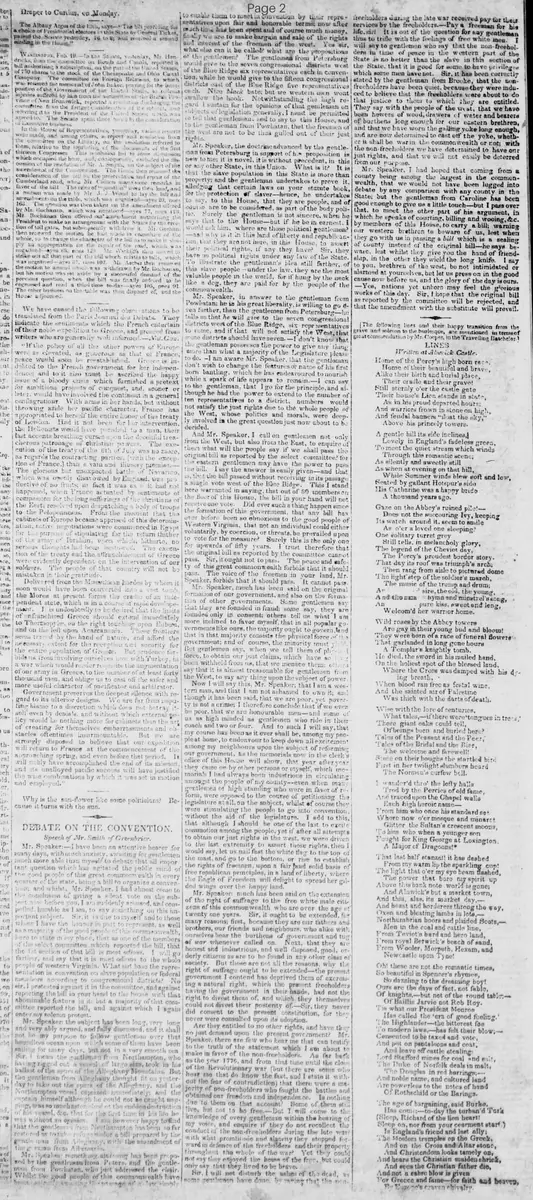
Speech of Mr. Smith of Greenbrier.
Mr. Speaker:—I have been an attentive hearer for many days, with much anxiety, awaiting for gentlemen much more able than myself to debate that all important question which has agitated the public mind of the good people of this great commonwealth in every quarter of the state, being a bill to organize a convention; and whilst, Mr. Speaker, I had almost come to the conclusion of giving a silent vote on the subject now before you, I am suddenly aroused, and compelled, humble as I am, to say something on this important subject. Sir, it is due to myself and to those whom I have the honour in part to represent, as well as a majority of the good people of this commonwealth, here to state in my place, that as one of the members of the select committee which reported the bill, that the 1st section of that bill is most odious. I will go farther, and say that it is most odious to the whole people of western Virginia. What sir! basing the representation in convention on slave population or federal members according to congressional districts? No sir, I protested against it in the committee, and against reporting the bill in your hand to the House with that abominable feature in it: but a majority of that committee reported the bill, and against which I again enter my solemn protest.
Mr. Speaker: the subject has been long, very long and very ably argued, and fully discussed, and it shall not be my purpose to follow gentlemen over that boundless ocean upon which some of them have been sailing for many days, but not in a very smooth sea Sir. I mean the gentleman from Northampton, who having rigged out a vessel of large size, took in his ballast of the spurs of the Alleghany Mountains. But the gentleman from Alleghany thought fit on yesterday to take out the spurs of the Alleghany, and the Northampton vessel capsized immediately; and the captain himself although he could not be caught napping, was so much astonished at the sudden destruction of his vessel, &c. that for the first time in his life he was without an opinion. I am however happy to find that the gentleman from Northampton has been so far restored as to take up a bill prepared by the gentleman from Alleghany, with the amendment of the gentleman from Albemarle.
Mr. Speaker something analogous has been proposed by the gentleman from Powhatan, and the gentleman from Powhatan, who just addressed the chair.
Whilst the good people of this commonwealth have been anxiously awaiting upon us to enable them to meet in convention by their representatives upon fair and honorable terms; now after much time has been spent and of course much money, finally we are to make bargain and sale of the rights and interest of the freemen of the west. Yes sir, what else can it be called? what are the propositions of the gentlemen? The gentleman from Petersburg would give to the seven congressional districts west of the Blue Ridge six representatives each in convention, while he would give to the fifteen congressional districts east of the Blue Ridge five representatives each. Nice black bait; but we western men won't swallow the hook. Notwithstanding the high regard I sustain for the opinions of that gentleman on subjects of legislation generally, I must be permitted to tell that gentleman, and to say to this House, and to the gentleman from Powhatan, that the freemen of the west are not to be thus gulled out of their just rights.
Mr. Speaker, the doctrine advanced by the gentleman from Petersburg in support of his proposition is new to me: it is novel, it is without precedent, in this or any other State, in this Union. What is it? It is that the slave population in this State is more than property; and the gentleman undertakes to prove it, alleging that certain laws on your statute book, for the protection of slaves—hence, he undertakes to say, to this House, that they are people, and of course are to be considered, as part of the body politic. Surely the gentleman is not sincere, when he says that to the House—but if he be in earnest, I would ask him, where are those political gentlemen?—and why is it in this land of liberty and republicanism, that they are not here, in this House, to assert their political rights, if any they have? Sir, they have no political rights under any law of the State.
To illustrate the gentleman's idea still farther, of this slave people—under the law, they are the most valuable people in the world, for if hung by the neck like a dog, they are paid for by the people of the commonwealth,
Mr. Speaker, in answer to the gentleman from Powhatan: he in his great liberality, is willing to go even further, than the gentlemen from Petersburg—he tells us that he will give to the seven congressional districts west of the Blue Ridge, six representatives to come, and if that will not satisfy the West, that some districts should have seven.—I don't know that the gentleman possesses the power to give any thing more than what a majority of the Legislature please to do.—I am aware Mr. Speaker, that the gentleman don't wish to change the features or name of his first born bantling, which he has endeavoured to nourish while a spark of life appears to remain.—I can say to the gentleman, that I go for the principle, and although he had the power to extend to the number of ten representatives to a district, numbers would not satisfy the just rights due to the whole people of the West, whose politics and morals, were deeply involved in the great question just now about to be decided.
And Mr. Speaker, I call on gentlemen not only from the West, but also from the East, to enquire of them what will the people say if we shall pass the original bill as reported by the select committee? for the eastern gentlemen may have the power to pass the bill. I say the answer is easily given—and that is, that the bill passed without receiving in its passage a single vote west of the Blue Ridge." This I stand here warranted in saying, that out of 80 members on the floor of this House, the bill in your hand will not receive one vote. Did ever such a thing happen since the formation of this government, that any bill has over before been so obnoxious to the good people of Western Virginia, that not an individual could either voluntarily, by coercion, or threats, be prevailed upon to vote for the measure? Surely this is the only one for upwards of fifty years. I trust therefore that the original bill as reported by the committee cannot pass. Sir, it ought not to pass. The peace and safety of this great commonwealth forbids that it should pass. The voice of the freemen in your land, Mr. Speaker, forbids that it should pass. It cannot pass.
Mr. Speaker, much has been said on the original formation of our government, and also on the formation of other governments. Some gentlemen say that they are founded in fraud; some say, they are founded only in consent; others tell us what I am more inclined to favor myself, that in all popular governments like ours, the majority ought to govern, and that in that majority consists the physical force of government; and of course, the minority must yield.
But gentlemen say, when we tell them of physical force, to obtain our just claims, which have so long been withheld from us, that we menace them: others say that it is almost treasonable for gentlemen from the West, to say any thing upon the subject of power.
Now I will say this, Mr. Speaker; that I am a western man, and that I am not ashamed to own it; and though it has been said, that we are poor, yet poverty is not a crime; I therefore conclude that if we even be poor, that we are honourable men—and some of us as high minded as gentlemen who ride in their coach and two or four. And to such I will say, that my course has been as it ever shall be, among my people at home, to endeavour to keep down all excitement among my neighbours upon the subject of reforming our government, as the memorials now in the clerk's office of this House will show, that year after year they came in by other persons or myself, which memorials I had always been industrious in circulating amongst the people of my county—even when many gentlemen of high standing who were in favor of reform, were opposed to the course of petitioning the legislature at all, on the subject, whilst of course they were stimulating the people to go into convention, without the aid of the legislature. I add to this, that although I should be one of the last to excite commotion among the people, yet if after all attempts to obtain our just rights in the west, we were driven to the last extremity to assert those rights, then I would say, let us nail fast the white flag to the top of the mast, and go to the bottom, or rise to establish the rights of freemen, upon a fair and solid basis of free republican principles, in a land of liberty, where the Eagle of Freedom will delight to spread her gilded wings over the happy land.
Mr. Speaker: much has been said on the extension of the right of suffrage to the free white male citizens of this commonwealth who are over the age of twenty one years. Sir, it ought to be extended, for many reasons; first, because they are our fathers and brothers, our friends and neighbours, who alike with ourselves bear the burthens of government and tug of war whenever called on. Next, that they are honest and industrious, and well disposed, good, orderly citizens as are to be found in any other class of society. But those are not all the reasons, why the right of suffrage ought to be extended—the present government I contend has deprived them of exercising a natural right, which the present freeholders having the government in their hands, had not the right to divest them of, and which they themselves could not divest their posterity of.—Sir, they never did consent to the present constitution, for they never were consulted upon its adoption.
Are they entitled to no other rights, and have they no just demand upon the present government? Mr. Speaker, there are few who hear me that can testify to the truth of the statement which I am about to make in favor of the non-freeholders. As far back as the year 1776, and from that time until the close of the Revolutionary war (but there are some who hear me that do know the fact, and I state it without the fear of contradiction) that there were a majority of non-freeholders who fought the battles and obtained our freedom and independence. Is nothing due to them on that account? Some of them still live, but not to be free.—But I will come to the knowledge of every gentleman within the hearing of my voice, and enquire if they do not recollect the conduct of the non-freeholders during the late war? with what promptitude and alacrity they stepped forward in defence of the freeholders and their property throughout the whole of the war? Yet they could not say they enjoyed the home of the free, but could only say that they lived to be brave.
Sir, I will not disturb the names of the dead, By some gentlemen have done, by giving that the non.
freeholders during the late war received pay for their services by the freeholders.—Pay a freeman for his life, sir! it is out of the question for any gentleman thus to trifle with the feelings of free white men. I will say to gentlemen who say that the non-freeholders in time of peace in this western part of the State is no better than the slave in this section of the State, that it is good for some to have privileges which some men have not. Sir, it has been correctly stated by the gentleman from Brooke, that the non-freeholders have been quiet, because they were induced to believe that the freeholders were about to do that justice to them to which they are entitled.
They say with the people of the west, that we have been hewers of wood, drawers of water and bearers of burthens long enough for our eastern brethren, and that we have worn the galling yoke long enough, and are now determined to cast off the yoke, whether it shall be war in the commonwealth or not; with the non-freeholders we have determined to have our just rights, and that we will not easily be deterred from our purpose.
Mr. Speaker, I had hoped that coming from a county being among the largest in the commonwealth, that we would not have been lugged into debate by any comparison with any county in the State: but the gentleman from Caroline has been good enough to give us a little touch—but I pass over that, to meet the other part of his argument, in which he speaks of courting, billing and wooing, &c. by members of this House, to carry a bill; warning our western brethren to beware of us, lest when they go with us in passing a bill which is a sealing of county instead of the original bill—he says beware, lest whilst they give you the hand of friendship, in the other they wield the long knife. I say to you, brethren of the west, be not intimidated or alarmed at yourselves, but let us press on in the good cause now before us, and the glory of the day is ours.
—Yes, nations yet unborn may feel the glorious works of this day. Sir, I hope that the original bill as reported by the committee will be rejected, and that the amendment with the substitute will prevail.
What sub-type of article is it?
What themes does it cover?
What keywords are associated?
What entities or persons were involved?
Where did it happen?
Story Details
Key Persons
Location
Virginia Legislature, Western Virginia, East Of The Blue Ridge
Story Details
Mr. Smith opposes a convention bill with unequal representation favoring eastern slave-based districts, protests basing seats on slaves, advocates fair representation for west, extends suffrage to non-freeholders citing their Revolutionary and War of 1812 service, warns of unrest if rights denied, urges rejection of original bill.