Thank you for visiting SNEWPapers!
Sign up free
Literary
May 14, 1907
Wausau Pilot
Wausau, Marathon County, Wisconsin
What is this article about?
Margaret, bored during a holiday with her uncongenial aunt in bleak countryside, meets Miles Leighton, a bicycle repairman who is an Oxford graduate. They bond over rides, discover shared backgrounds, and confess their love, overcoming professional class barriers.
Merged-components note: Continuation of the story 'Margaret's Adventure' across components.
Clipping
OCR Quality
98%
Excellent
Full Text
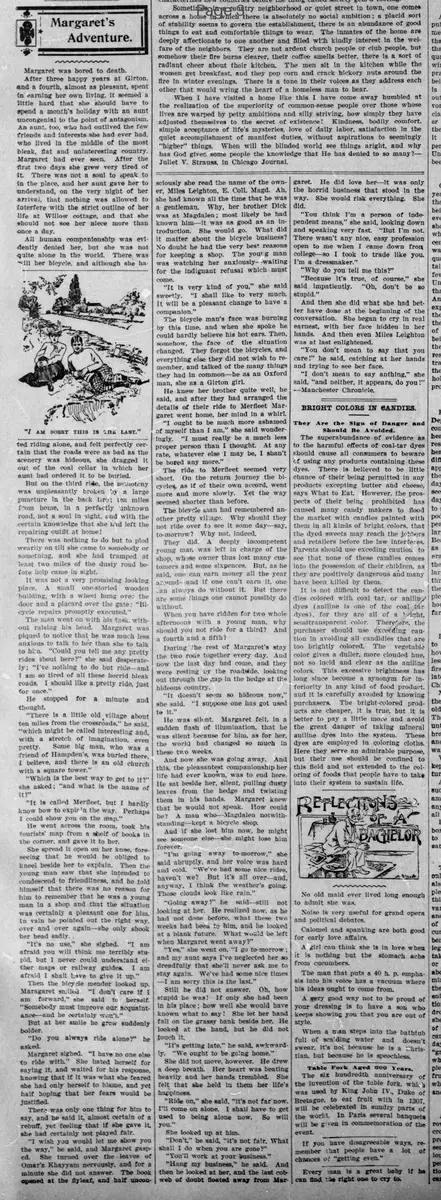
Margaret's Adventure.
Margaret was bored to death.
After three happy years at Girton,
and a fourth, almost as pleasant, spent
in earning her own living, it seemed a
little hard that she should have to
spend a month's holiday with an aunt
uncongenial to the point of antagonism.
An aunt, too, who had outlived the few
friends and interests she had ever had,
who lived in the middle of the most
bleak, flat and uninteresting country.
Margaret had ever seen. After the
first two days she grew very tired of
it. There was not a soul to speak to
in the place, and her aunt gave her to
understand, on the very night of her
arrival, that nothing was allowed to
interfere with the strict outline of her
life at Willow cottage, and that she
should not see her niece more than
once a day.
All human companionship was evidently denied her, but she was not
quite alone in the world. There was
still her bicycle, and although she hated riding alone, and felt perfectly certain that the roads were as bad as the
scenery was hideous, she dragged it
out of the coal cellar in which her
aunt had ordered it to be buried.
But on the third ride, the monotony
was unpleasantly broken
by
a large
puncture in the back tire; ten miles
from home, in a perfectly unknown
road, not a soul in sight, and with the
certain knowledge that she had left the
repairing outfit at home!
There was nothing to do but to plod
wearily on till she came to somebody or
something, and she had tramped at
least two miles of the dusty road before help came in sight.
It was not a very promising looking
place. A small one-storied wooden
building, with a wheel hung over the
door and a placard over the gate: "Bi-
bicycle repairs promptly executed."
The man went on with his task, without raising his head. Margaret was
piqued to notice that he was much less
anxious to talk to her than she to talk
to him. "Could you tell me any pretty
rides about here?" she said desperately: "I've nothing to do but ride-and
I am so tired of all these horrid bleak
roads. I should like a pretty ride, just
for once."
He stopped for a minute and
thought.
"There is a little old village about
ten miles from the crossroads," he said,
which might be called interesting and,
with a stretch of imagination, even
pretty.
Some big man, who was a
friend of Hampden's, was buried there.
I believe, and there is an old church
with a square tower."
"Which is the best way to get to it?"
she asked; "and what is the name of
it?"
"It is called Merfleet, but I hardly
know how to explain the way. Perhaps
I could show you on the map."
He went across the room, took his
tourists' map from a shelf of books in
the corner, and gave it to her.
She spread it open on her knee, fore-
seeing that he would be obliged to
kneel beside her to explain. Then the
young man saw that she intended to
condescend to friendliness, and he told
himself that there was no reason for
him to remember that he was a young
man in a shop and that the situation
was certainly a pleasant one for him.
In vain he pointed out the right way,
over and over again-she only shook
her head sadly.
"It's no use," she sighed. "I am
afraid you will think me terribly stupid, but I never could understand either maps or railway guides. I am
afraid I shall have to give it up."
Then the bicycle mender looked up.
Margaret smiled. "I don't care if I
am
forward," she said to herself.
"Somebody must improve our acquaintance and he certainly won't."
But at her smile he grew suddenly
bolder.
"Do you always ride alone?" he
asked.
Margaret sighed. "I have no one else
to ride with." She hated herself for
saying it, and waited for his response,
knowing that if it was what she feared
she had only herself to blame, and yet
half hoping that her fears would be
justified.
There was only one thing for him to
say, and he said it, almost certain of a
rebuff, yet feeling that if she gave it,
she had certainly not played fair.
"I wish you would let me show you
the way," he said, and Margaret gasped.
She turned over the leaves of
Omar's Rubaiyat nervously, and for a
minute she did not answer. The book
opened at the fly-leaf, and half uncon-
consciously she read the name of the owner, Miles Leighton, E. Coll. Magd. Ah,
she had known all the time that he was
a gentleman. Why, her brother Dick
was at Magdalen; most likely he had
known him-it was as good as an introduction. She would go. What did
it matter about the bicycle business?
No doubt he had the very best reasons
for keeping a shop. The young man
was watching her anxiously--waiting
for the indignant refusal which must
come.
"It is very kind of you," she said
sweetly. "I shall like to very much.
It will be a pleasant change to have a
companion."
The bicycle man's face was burning
by this time, and when she spoke he
could hardly believe his hot ears. Then,
somehow, the face of the situation
changed. They forgot the bicycles, and
everything else they did not wish to remember, and talked of the many things
they had in common-he as an Oxford
man, she as a Girton girl.
He knew her brother quite well, he
said, and after they had arranged the
details of their ride to Merfleet Margaret went home, her mind in a whirl.
"I ought to be much more ashamed
of myself than I am," she said wonder-
ingly. "I must really be a much less
proper person than I thought. At any
rate, whatever else I may be, I shan't
be bored any more."
The ride to Merfleet seemed very
short. On the return journey the bicycles, as if of their own accord, went
more and more slowly. Yet the way
seemed shorter than before.
The bicycle man had remembered another pretty village. Why should they
not ride over to see it some day-say,
to-morrow? Why not, indeed.
They did. A deeply incompetent
young man was left in charge of the
shop, whose owner thus lost many customers and some sixpences. But, as he
said, one can earn money all the year
around--and if one can't earn it, one
can always do without it. But there
are some things one cannot possibly do
without.
When you have ridden for two whole
afternoons with a young man, why
should you not ride for a third? And
a fourth and a fifth?
During the rest of Margaret's stay
the two rode together every day. And
now the last day had come, and they
were resting by the roadside, looking
out through the gap in the hedge at the
hideous country.
"It doesn't seem so hideous now,"
she said. "I suppose one has got used
to it."
He was silent. Margaret felt, in a
sudden flash of illumination, that he
was silent because for him, as for her,
the world had changed so much in
these two weeks.
And now she was going away. And
this, the pleasantest companionship her
life had ever known, was to end here.
He sat beside her, silent, pulling dusty leaves from the hedge and twisting
them in his hands. Margaret knew
that he would not speak. How could
he? A man who-Magdalen notwithstanding-kept a bicycle shop.
And if she lost him now, he might
see someone else-she might lose him
forever.
"I'm going away to-morrow," she
said abruptly, and her voice was hard
and cold. We've had some nice rides,
haven't we? But it's all over-and,
anyway, I think the weather's going.
Those clouds look like rain."
"Going away?" he said-still not
looking at her. He realized now, as he
had not done before, what these two
weeks had been to him, and he looked
at a blank future. What would be left
when Margaret went away?"
"Yes," she went on, "I go to-morrow;
and my aunt says I've neglected her so
dreadfully that she'll never ask me to
stay again. We've had some nice times
-I am sorry this is the last."
Still he did not answer. Oh, how
stupid he was! If only she had been
in his place: how well she would have
known what to say! She let her hand
fall on the grassy bank beside her. He
looked at the hand, but he did not
touch it.
"It's getting late," he said, awkwardly. "We ought to be going home."
She did not move, however. He drew
a deep breath. Her heart was beating
heavily and her hands trembled. She
felt that she held in them her life's
happiness.
"Ride on," she said, "it's not far now.
I'll come on alone. I shall have to get
used to being alone now. So will
you."
She looked up at him.
"Don't," he said. "It's not fair. What
shall I do when you are gone?"
"You'll work at your business."
"Hang my business," he said. And
then he looked at her, and the last cob-
web of doubt floated away from Margaret. He did love her-it was only
the horrid business that stood in the
way. She would risk everything. She
did.
"You think I'm a person of independent means," she said, looking down
and speaking very fast. "But I'm not.
There wasn't any nice, easy profession
open to me when I came down from
college so I took to trade like you.
I'm a dressmaker."
"Why do you tell me this?"
"Because it's true, of course," she
said impatiently.
"Oh, don't be so
stupid."
And then she did what she had better have done at the beginning of the
conversation. She began to cry in real
earnest, with her face hidden in her
hands. And then even Miles Leighton
was at last enlightened.
"You don't mean to say that you
care!" he said, catching at her hands
and trying to see her face.
"I don't mean to say anything," she
said, "and neither, it appears, do you!"
--Manchester Chronicle.
Margaret was bored to death.
After three happy years at Girton,
and a fourth, almost as pleasant, spent
in earning her own living, it seemed a
little hard that she should have to
spend a month's holiday with an aunt
uncongenial to the point of antagonism.
An aunt, too, who had outlived the few
friends and interests she had ever had,
who lived in the middle of the most
bleak, flat and uninteresting country.
Margaret had ever seen. After the
first two days she grew very tired of
it. There was not a soul to speak to
in the place, and her aunt gave her to
understand, on the very night of her
arrival, that nothing was allowed to
interfere with the strict outline of her
life at Willow cottage, and that she
should not see her niece more than
once a day.
All human companionship was evidently denied her, but she was not
quite alone in the world. There was
still her bicycle, and although she hated riding alone, and felt perfectly certain that the roads were as bad as the
scenery was hideous, she dragged it
out of the coal cellar in which her
aunt had ordered it to be buried.
But on the third ride, the monotony
was unpleasantly broken
by
a large
puncture in the back tire; ten miles
from home, in a perfectly unknown
road, not a soul in sight, and with the
certain knowledge that she had left the
repairing outfit at home!
There was nothing to do but to plod
wearily on till she came to somebody or
something, and she had tramped at
least two miles of the dusty road before help came in sight.
It was not a very promising looking
place. A small one-storied wooden
building, with a wheel hung over the
door and a placard over the gate: "Bi-
bicycle repairs promptly executed."
The man went on with his task, without raising his head. Margaret was
piqued to notice that he was much less
anxious to talk to her than she to talk
to him. "Could you tell me any pretty
rides about here?" she said desperately: "I've nothing to do but ride-and
I am so tired of all these horrid bleak
roads. I should like a pretty ride, just
for once."
He stopped for a minute and
thought.
"There is a little old village about
ten miles from the crossroads," he said,
which might be called interesting and,
with a stretch of imagination, even
pretty.
Some big man, who was a
friend of Hampden's, was buried there.
I believe, and there is an old church
with a square tower."
"Which is the best way to get to it?"
she asked; "and what is the name of
it?"
"It is called Merfleet, but I hardly
know how to explain the way. Perhaps
I could show you on the map."
He went across the room, took his
tourists' map from a shelf of books in
the corner, and gave it to her.
She spread it open on her knee, fore-
seeing that he would be obliged to
kneel beside her to explain. Then the
young man saw that she intended to
condescend to friendliness, and he told
himself that there was no reason for
him to remember that he was a young
man in a shop and that the situation
was certainly a pleasant one for him.
In vain he pointed out the right way,
over and over again-she only shook
her head sadly.
"It's no use," she sighed. "I am
afraid you will think me terribly stupid, but I never could understand either maps or railway guides. I am
afraid I shall have to give it up."
Then the bicycle mender looked up.
Margaret smiled. "I don't care if I
am
forward," she said to herself.
"Somebody must improve our acquaintance and he certainly won't."
But at her smile he grew suddenly
bolder.
"Do you always ride alone?" he
asked.
Margaret sighed. "I have no one else
to ride with." She hated herself for
saying it, and waited for his response,
knowing that if it was what she feared
she had only herself to blame, and yet
half hoping that her fears would be
justified.
There was only one thing for him to
say, and he said it, almost certain of a
rebuff, yet feeling that if she gave it,
she had certainly not played fair.
"I wish you would let me show you
the way," he said, and Margaret gasped.
She turned over the leaves of
Omar's Rubaiyat nervously, and for a
minute she did not answer. The book
opened at the fly-leaf, and half uncon-
consciously she read the name of the owner, Miles Leighton, E. Coll. Magd. Ah,
she had known all the time that he was
a gentleman. Why, her brother Dick
was at Magdalen; most likely he had
known him-it was as good as an introduction. She would go. What did
it matter about the bicycle business?
No doubt he had the very best reasons
for keeping a shop. The young man
was watching her anxiously--waiting
for the indignant refusal which must
come.
"It is very kind of you," she said
sweetly. "I shall like to very much.
It will be a pleasant change to have a
companion."
The bicycle man's face was burning
by this time, and when she spoke he
could hardly believe his hot ears. Then,
somehow, the face of the situation
changed. They forgot the bicycles, and
everything else they did not wish to remember, and talked of the many things
they had in common-he as an Oxford
man, she as a Girton girl.
He knew her brother quite well, he
said, and after they had arranged the
details of their ride to Merfleet Margaret went home, her mind in a whirl.
"I ought to be much more ashamed
of myself than I am," she said wonder-
ingly. "I must really be a much less
proper person than I thought. At any
rate, whatever else I may be, I shan't
be bored any more."
The ride to Merfleet seemed very
short. On the return journey the bicycles, as if of their own accord, went
more and more slowly. Yet the way
seemed shorter than before.
The bicycle man had remembered another pretty village. Why should they
not ride over to see it some day-say,
to-morrow? Why not, indeed.
They did. A deeply incompetent
young man was left in charge of the
shop, whose owner thus lost many customers and some sixpences. But, as he
said, one can earn money all the year
around--and if one can't earn it, one
can always do without it. But there
are some things one cannot possibly do
without.
When you have ridden for two whole
afternoons with a young man, why
should you not ride for a third? And
a fourth and a fifth?
During the rest of Margaret's stay
the two rode together every day. And
now the last day had come, and they
were resting by the roadside, looking
out through the gap in the hedge at the
hideous country.
"It doesn't seem so hideous now,"
she said. "I suppose one has got used
to it."
He was silent. Margaret felt, in a
sudden flash of illumination, that he
was silent because for him, as for her,
the world had changed so much in
these two weeks.
And now she was going away. And
this, the pleasantest companionship her
life had ever known, was to end here.
He sat beside her, silent, pulling dusty leaves from the hedge and twisting
them in his hands. Margaret knew
that he would not speak. How could
he? A man who-Magdalen notwithstanding-kept a bicycle shop.
And if she lost him now, he might
see someone else-she might lose him
forever.
"I'm going away to-morrow," she
said abruptly, and her voice was hard
and cold. We've had some nice rides,
haven't we? But it's all over-and,
anyway, I think the weather's going.
Those clouds look like rain."
"Going away?" he said-still not
looking at her. He realized now, as he
had not done before, what these two
weeks had been to him, and he looked
at a blank future. What would be left
when Margaret went away?"
"Yes," she went on, "I go to-morrow;
and my aunt says I've neglected her so
dreadfully that she'll never ask me to
stay again. We've had some nice times
-I am sorry this is the last."
Still he did not answer. Oh, how
stupid he was! If only she had been
in his place: how well she would have
known what to say! She let her hand
fall on the grassy bank beside her. He
looked at the hand, but he did not
touch it.
"It's getting late," he said, awkwardly. "We ought to be going home."
She did not move, however. He drew
a deep breath. Her heart was beating
heavily and her hands trembled. She
felt that she held in them her life's
happiness.
"Ride on," she said, "it's not far now.
I'll come on alone. I shall have to get
used to being alone now. So will
you."
She looked up at him.
"Don't," he said. "It's not fair. What
shall I do when you are gone?"
"You'll work at your business."
"Hang my business," he said. And
then he looked at her, and the last cob-
web of doubt floated away from Margaret. He did love her-it was only
the horrid business that stood in the
way. She would risk everything. She
did.
"You think I'm a person of independent means," she said, looking down
and speaking very fast. "But I'm not.
There wasn't any nice, easy profession
open to me when I came down from
college so I took to trade like you.
I'm a dressmaker."
"Why do you tell me this?"
"Because it's true, of course," she
said impatiently.
"Oh, don't be so
stupid."
And then she did what she had better have done at the beginning of the
conversation. She began to cry in real
earnest, with her face hidden in her
hands. And then even Miles Leighton
was at last enlightened.
"You don't mean to say that you
care!" he said, catching at her hands
and trying to see her face.
"I don't mean to say anything," she
said, "and neither, it appears, do you!"
--Manchester Chronicle.
What sub-type of article is it?
Prose Fiction
What themes does it cover?
Love Romance
Social Manners
What keywords are associated?
Romance
Bicycle Rides
Class Barriers
Oxford Graduate
Girton Girl
Holiday Boredom
Dressmaker
Bicycle Repair
Literary Details
Title
Margaret's Adventure.
Key Lines
"I Wish You Would Let Me Show You The Way," He Said, And Margaret Gasped.
"You Think I'm A Person Of Independent Means," She Said, Looking Down And Speaking Very Fast. "But I'm Not. There Wasn't Any Nice, Easy Profession Open To Me When I Came Down From College So I Took To Trade Like You. I'm A Dressmaker."
"You Don't Mean To Say That You Care!" He Said, Catching At Her Hands And Trying To See Her Face.
"I Don't Mean To Say Anything," She Said, "And Neither, It Appears, Do You!"
But, As He Said, One Can Earn Money All The Year Around And If One Can't Earn It, One Can Always Do Without It. But There Are Some Things One Cannot Possibly Do Without.