Thank you for visiting SNEWPapers!
Sign up free
Norfolk Gazette And Publick Ledger
Norfolk, Virginia
What is this article about?
In British Parliament, Lord Castlereagh defends his handling of negotiations with Murat amid opposition criticism. Debate escalates into accusations of sourcing information from foreign agents, leading to heated exchanges, retractions, and apologies. Papers on the matter to be presented for further discussion.
Clipping
OCR Quality
Full Text
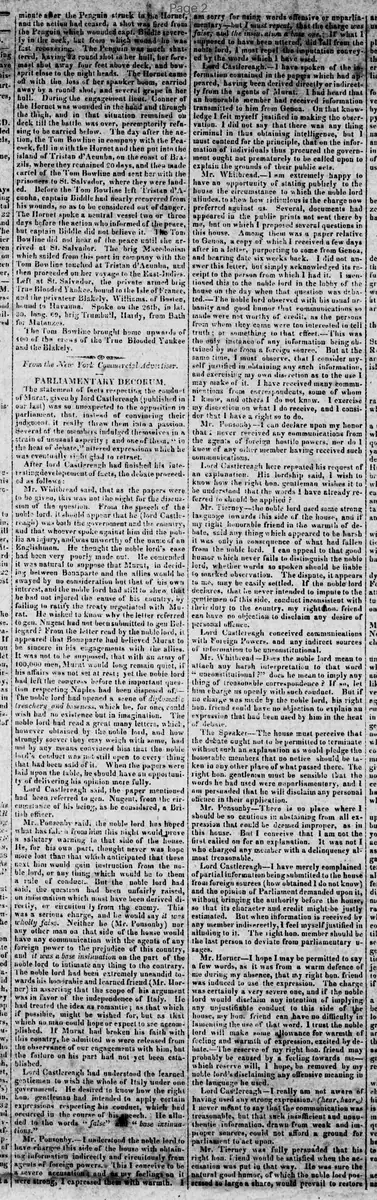
PARLIAMENTARY DECORUM.
The statement of facts respecting the conduct of Murat, given by lord Castlereagh (published in our last) was so unexpected to the opposition in parliament, that, instead of convincing their judgment, it really threw them into a passion. Several of the members indulged themselves in a strain of unusual asperity; and one of them, "in the heat of debate," uttered expressions which he was eventually right glad to retract.
After lord Castlereagh had finished his interesting development of facts, the debate proceeded as follows:
Mr. Whitbread said, that as the papers were to be given, this was not the night for the discussion of the question. From the speech of the noble lord, it should appear that he (lord Castlereagh) was both the government and the country, and that whoever spoke against him did the public an injury, and was unworthy of the name of an Englishman. He thought the noble lord's case had been very poorly made out. He contended it was natural to suppose that Murat, in deciding between Bonaparte and the allies would be swayed by no consideration but that of his own interest, and the noble lord had still to show that he had not injured the cause of his country, by failing to ratify the treaty negotiated with Murat. He wished to know why the letter referred to gen. Nugent had not been submitted to gen. Belgard? From the letter read by the noble lord, it appeared that Bonaparte had believed Murat to be sincere in his engagements with the allies. It was not to be supposed, that with an army of two,000 men, Murat would long remain quiet, if his affairs was not set at rest: yet the noble lord had left the congress before the important question respecting Naples had been disposed of.-- The noble lord had opened a scene of diplomatic treachery and baseness, which he, for one, could wish had no existence but in imagination. The noble lord had read a great many letters, which, however obtained by the noble lord, and how strongly soever they may weigh with some, had not by any means convinced him that the noble lord's conduct was not still open to every thing that had been said of it. When the papers were laid upon the table, he should have an opportunity of delivering his opinion more fully.
Lord Castlereagh said, the paper mentioned had been referred to gen. Nugent, from the circumstance of his being, as he considered, a British officer.
Mr. Ponsonby said, the noble lord has hoped what has fallen from him this night would prove a salutary warning to that side of the house. He, for his own part, thought never was hope more lost than that which anticipated that those next him would gain instruction from the noble lord, or any thing which would be to them a rule of conduct. But the noble lord had said, the question had been unfairly raised, on information which must have been derived directly, or circuitously from the enemy. This was a serious charge, and he would say it was wholly false. Neither he (Mr. Ponsonby) nor any other man on that side of the house would have any communication with the agents of any foreign power to the prejudice of this country, and it was a base insinuation on the part of the noble lord to intimate any thing to the contrary. The noble lord had been extremely uncandid towards his honorable and learned friend (Mr. Horner) in asserting that the scope of his argument was in favor of the independence of Italy. He had treated the idea as romantic; as that which if possible, might be wished for, but as that which no man could hope or expect to see accomplished. If Murat had broken his faith with this country, he admitted we were released from the observance of our engagements with him, but the failure on his part had not yet been established.
Lord Castlereagh had understood the learned gentleman to wish the whole of Italy under one government. He desired to know how the right hon. gentleman had intended to apply certain expressions respecting his conduct, which had occurred in the course of his speech. : He alluded to the words "false" and "base insinuations."
Mr. Ponsonby.-- I understood the noble lord to have charged this side of the house with obtaining information indirectly and circuitously from agents of foreign powers. . This I conceive to be a severe accusation and on my feelings on it am sorry for using words offensive or parliamentary but I must repeat that the charge was false and the insinuation a base one If what I supposed to have been uttered did fall from the noble lord, I must repel the imputation conveyed by the words which I have used.
Lord Castlereagh. I have spoken of the information contained in the papers which had appeared, having been derived directly or indirectly from the agents of Murat. I had heard that an honorable member had received information transmitted to him from Genoa. On that knowledge I felt myself justified in making the observation. I did not say that there was any thing criminal in thus obtaining intelligence, but I must contend for the principle, that on the information of individuals thus procured the government ought not prematurely to be called upon to explain the grounds of their public acts.
Mr. Whitbread.--I am extremely happy to have an opportunity of stating publicly to the house the circumstance to which the noble lord alluded. to shew how ridiculous is the charge now preferred against us. Several, documents had appeared in the public prints not sent there by me, but on which I proposed several questions in this house. Among them was a paper relative to Genoa, a copy of which I received a few days after in a letter, purporting to come from Genoa, and bearing date six weeks back. I did not answer this letter, but simply acknowledged its receipt to the person from which I had it. I mentioned this to the noble lord in the lobby of the house on the day when that question was debated.--The noble lord observed with his usual archary and good humor that communications so made were not worthy of credit, as the persons from whom they came were too interested to tell truth; or something to that effect.--This was the only instance of any information being obtained by me from a foreign source." But at the same time, I must observe, that I consider myself justified in obtaining any such information, and exercising my own discretion as to the use I may make of it. I have received many communications from correspondents, some of whom I know, and others I do not know. I exercise my discretion on what I do receive, and I consider that I have a right so to do.
Mr. Ponsonby-i can declare upon my honor that i never received any communications from the agents of foreign hostile powers, nor do I know of any other member having received such communications.
Lord Castlereagh here repeated his request of an explanation. His lordship said, I wish to know how the right hon. gentleman wishes it to be understood that the words I have already referred to should be applied ?
Mr. Tierney--the noble lord used some strong language towards this side of the house, and if my right honorable friend in the warmth of debate, said any thing which appeared to be harsh it was only in consequence of what had fallen from the noble lord. I can appeal to that good humor which never fails to distinguish the noble lord, whether words so spoken should be liable to marked observation. The dispute, it appears to me, may be easily settled. If the noble lord declares, that he never intended to impute to the gentlemen of this side. conduct inconsistent with their duty to the country, my right hon. friend can have no objection to disclaim any desire of personal offence.
Lord Castlereagh conceived communications with Foreign Powers, and any indirect sources of information to be unconstitutional.
Mr. Whitbread-But the noble lord mean to attach any harsh interpretation to that word " unconstitutional ?" does he mean to imply any thing of treasonable correspondence ? If so, let him charge us openly with such conduct. But if no charge was made by the noble lord, his right hon. friend could have no objection to explain an expression that had been used by him in the heat of debate.
The Speaker--The house must perceive that the debate ought not to be permitted to terminate without such an explanation as would pledge the honorable members that no notice should be taken in any other place of what passed there. The right hon. gentleman must be sensible that the words he had used were unparliamentary, and I am persuaded that he will disclaim any personal offence in their application.
Mr. Ponsonby--There is no place where I should be so cautious in abstaining from all expression that could be deemed improper, as in this house. But I conceive that I am not the first called on for an explanation. It was not I who charged any member with a delinquency almost treasonable.
Lord Castlereagh--I have merely complained of partial information being submitted to the house from foreign sources (how obtained I do not know) and the opinion of Parliament demanded upon it, without bringing the authority before the house, so that its character and credit might be justly estimated. But when information is received by any member indiscreetly, I feel myself justified in alluding to it. The right hon. member should be the last person to deviate from parliamentary usages.
Mr. Horner--I hope I may be permitted to say a few words, as it was from a warm defence of me during my absence, that my right hon. friend was induced to use the expression. The charge was certainly a very severe one, and if the noble lord would disclaim any intention of implying any unjustifiable conduct to this side of the house, my hon. friend can have no difficulty in lamenting the use of that word. I trust the noble lord will make some allowance for warmth of feeling and warmth of expression, excited by debate.--The reserve of my right hon. friend may probably be caused by a feeling towards me-- which reserve will, I hope, be removed by my noble lord's disclaiming any offensive meaning in the language he used.
Lord Castlereagh-I really am not aware of having used any strong expression. (hear, hear.) I never meant to say that the communication was treasonable, but that such insufficient and unauthentic information. drawn from weak and improper sources, could not afford a ground for parliament to act upon.
Mr. Tierney was fully persuaded that his right hon. friend would be satisfied when the accusation was put in that way. He was sure the natural good humor, of which the noble lord possessed so large a share, would prevail to restore amity. The noble lord had at first undoubtedly used very strong expressions.
Lord Castlereagh am not aware that, I employed any strong. language that could reasonably be made the subject of complaint. I apprehend that a motion made on information of such a description would not deserve the attention of parliament.
Mr. Ponsonby- I confess that I did not feel for my hon. friend when the, charge was made, very strongly.-I felt for myself, and for all those by whom I am usually surrounded, and I am happy to find that nothing was intended. I did assert that the accusation was of a most serious nature to every man who values his character, and with that impression I employed the words in the warmth of debate ; after the explanation of the noble lord, I may say that I am sorry I used them.
What sub-type of article is it?
What keywords are associated?
What entities or persons were involved?
Where did it happen?
Foreign News Details
Primary Location
London
Key Persons
Outcome
debate concludes with explanations, retractions of unparliamentary language, and apologies; papers on murat negotiations to be laid before parliament for future discussion.
Event Details
Opposition members react angrily to Lord Castlereagh's statement on Murat's conduct towards Bonaparte and the allies. Debate focuses on the failure to ratify a treaty with Murat, questions about Naples at the congress, and accusations of opposition obtaining information from foreign sources like Genoa. Exchanges involve charges of diplomatic treachery, unconstitutional communications, and base insinuations, leading to calls for retractions and eventual mutual apologies under the Speaker's guidance.