Thank you for visiting SNEWPapers!
Sign up free
Story
May 26, 1904
The Daily Morning Journal And Courier
New Haven, New Haven County, Connecticut
What is this article about?
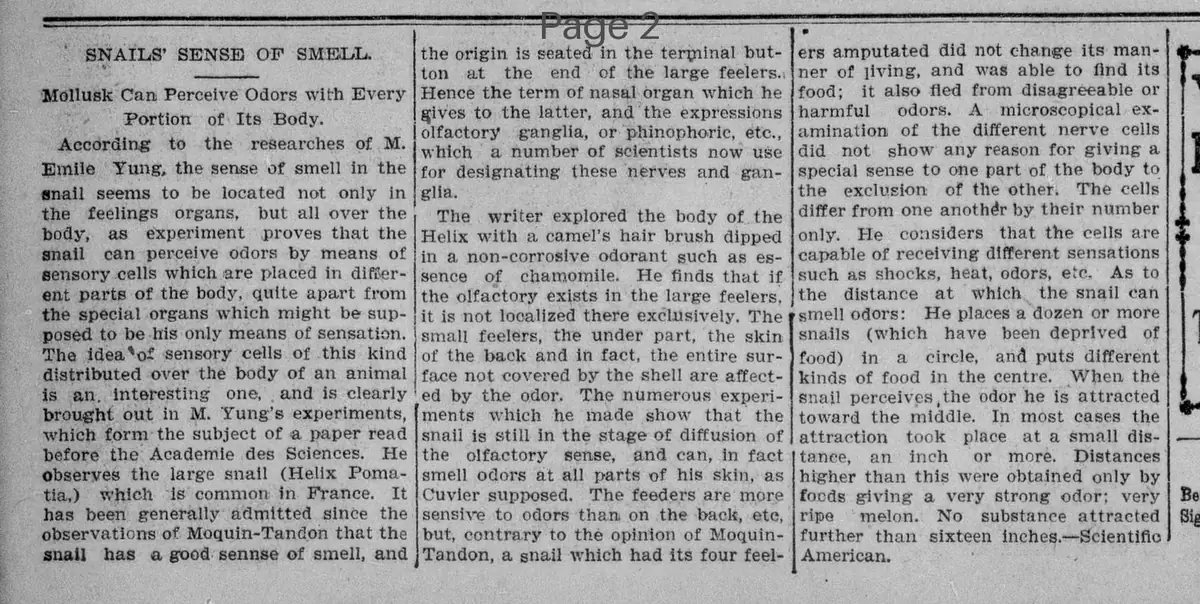
Research by M. Emile Yung reveals that snails perceive odors through sensory cells distributed across their entire body, not just feelers, as shown in experiments on Helix Pomatia in France.
Clipping
OCR Quality
98%
Excellent
Full Text
SNAILS' SENSE OF SMELL
Mollusk Can Perceive Odors with Every
Portion of Its Body.
According to the researches of M.
Emile Yung, the sense of smell in the
snail seems to be located not only in
the feelers organs, but all over the
body, as experiment proves that the
snail can perceive odors by means of
sensory cells which are placed in differ-
ent parts of the body, quite apart from
the special organs which might be sup-
posed to be his only means of sensation.
The idea of sensory cells of this kind
distributed over the body of an animal
is an interesting one, and is clearly
brought out in M. Yung's experiments,
which form the subject of a paper read
before the Academie des Sciences. He
observes the large snail (Helix Poma-
tia,) which is common in France. It
has been generally admitted since the
observations of Moquin-Tandon that the
snail has a good sense of smell, and
the origin is seated in the terminal but-
button at the end of the large feelers.
Hence the term of nasal organ which he
gives to the latter, and the expressions
olfactory ganglia, or rhinophoric, etc..
which a number of scientists now use
for designating these nerves and gan-
glia.
The writer explored the body of the
Helix with a camel's hair brush dipped
in a non-corrosive odorant such as es-
sence of chamomile. He finds that if
the olfactory exists in the large feelers,
it is not localized there exclusively. The
small feelers, the under part, the skin
of the back and in fact, the entire sur-
face not covered by the shell are affect-
ed by the odor. The numerous experi-
ments which he made show that the
snail is still in the stage of diffusion of
the olfactory sense, and can, in fact
smell odors at all parts of his skin, as
Cuvier supposed. The feelers are more
sensive to odors than on the back, etc.
but, contrary to the opinion of Moquin-
Tandon, a snail which had its four feel-
ers amputated did not change its man-
ner of living, and was able to find its
food; it also fled from disagreeable or
harmful odors. A microscopical ex-
amination of the different nerve cells
did not show any reason for giving a
special sense to one part of the body to
the exclusion of the other. The cells
differ from one another by their number
only. He considers that the cells are
capable of receiving different sensations
such as shocks, heat, odors, etc. As to
the distance at which the snail can
smell odors: He places a dozen or more
snails (which have been deprived of
food) in a circle, and puts different
kinds of food in the centre. When the
snail perceives the odor he is attracted
toward the middle. In most cases the
attraction took place at a small dis-
tance, an inch or more. Distances
higher than this were obtained only by
foods giving a very strong odor: very
ripe melon. No substance attracted
further than sixteen inches.-Scientific
American.
Mollusk Can Perceive Odors with Every
Portion of Its Body.
According to the researches of M.
Emile Yung, the sense of smell in the
snail seems to be located not only in
the feelers organs, but all over the
body, as experiment proves that the
snail can perceive odors by means of
sensory cells which are placed in differ-
ent parts of the body, quite apart from
the special organs which might be sup-
posed to be his only means of sensation.
The idea of sensory cells of this kind
distributed over the body of an animal
is an interesting one, and is clearly
brought out in M. Yung's experiments,
which form the subject of a paper read
before the Academie des Sciences. He
observes the large snail (Helix Poma-
tia,) which is common in France. It
has been generally admitted since the
observations of Moquin-Tandon that the
snail has a good sense of smell, and
the origin is seated in the terminal but-
button at the end of the large feelers.
Hence the term of nasal organ which he
gives to the latter, and the expressions
olfactory ganglia, or rhinophoric, etc..
which a number of scientists now use
for designating these nerves and gan-
glia.
The writer explored the body of the
Helix with a camel's hair brush dipped
in a non-corrosive odorant such as es-
sence of chamomile. He finds that if
the olfactory exists in the large feelers,
it is not localized there exclusively. The
small feelers, the under part, the skin
of the back and in fact, the entire sur-
face not covered by the shell are affect-
ed by the odor. The numerous experi-
ments which he made show that the
snail is still in the stage of diffusion of
the olfactory sense, and can, in fact
smell odors at all parts of his skin, as
Cuvier supposed. The feelers are more
sensive to odors than on the back, etc.
but, contrary to the opinion of Moquin-
Tandon, a snail which had its four feel-
ers amputated did not change its man-
ner of living, and was able to find its
food; it also fled from disagreeable or
harmful odors. A microscopical ex-
amination of the different nerve cells
did not show any reason for giving a
special sense to one part of the body to
the exclusion of the other. The cells
differ from one another by their number
only. He considers that the cells are
capable of receiving different sensations
such as shocks, heat, odors, etc. As to
the distance at which the snail can
smell odors: He places a dozen or more
snails (which have been deprived of
food) in a circle, and puts different
kinds of food in the centre. When the
snail perceives the odor he is attracted
toward the middle. In most cases the
attraction took place at a small dis-
tance, an inch or more. Distances
higher than this were obtained only by
foods giving a very strong odor: very
ripe melon. No substance attracted
further than sixteen inches.-Scientific
American.
What sub-type of article is it?
Curiosity
Animal Story
What themes does it cover?
Nature
What keywords are associated?
Snail Sense Of Smell
Olfactory Cells
Helix Pomatia
Sensory Experiments
Odor Detection
What entities or persons were involved?
M. Emile Yung
Moquin Tandon
Cuvier
Where did it happen?
France
Story Details
Key Persons
M. Emile Yung
Moquin Tandon
Cuvier
Location
France
Story Details
Experiments by M. Emile Yung on the snail Helix Pomatia demonstrate that its sense of smell is distributed across the entire body via sensory cells, not limited to feelers. Snails detect odors on all skin surfaces, find food without feelers, and are attracted to scents up to sixteen inches away.