Thank you for visiting SNEWPapers!
Sign up free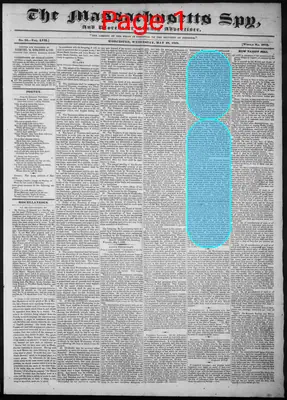
Story
May 28, 1828
The Massachusetts Spy, And Worcester County Advertiser
Worcester, Worcester County, Massachusetts
What is this article about?
John Bushell, nephew of a Limerick merchant, falls into poverty and crime. After petty thefts, he partners with a French diamond thief in Paris and London, using clever tricks like adhesive turpentine to steal jewels. They execute elaborate robberies, including at a French jeweler's, before Bushell's arrest.
Clipping
OCR Quality
95%
Excellent
Full Text
THE DIAMOND STEALER.
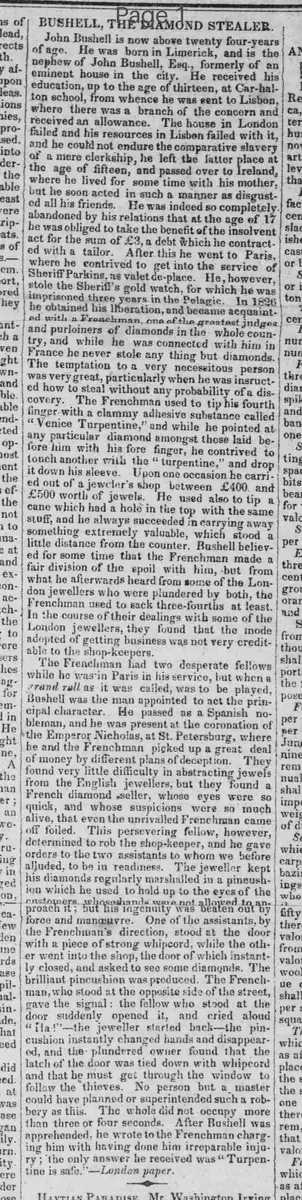
John Bushell is now above twenty four-years of age. He was born in Limerick, and is the nephew of John Bushell, Esq., formerly of an eminent house in the city. He received his education, up to the age of thirteen, at Car-hulton school, from whence he was sent to Lisbon, where there was a branch of the concern and received an allowance. The house in London failed and his resources in Lisbon failed with it, and he could not endure the comparative slavery of a mere clerkship, he left the latter place at the age of fifteen, and passed over to Ireland, where he lived for some time with his mother, but he soon acted in such a manner as disgusted all his friends. He was indeed so completely abandoned by his relations that at the age of 17 he was obliged to take the benefit of the insolvent act for the sum of £3, a debt which he contracted with a tailor. After this he went to Paris, where he contrived to get into the service of Sheriff Parkins, as valet-de-place. He, however, stole the Sheriff's gold watch, for which he was imprisoned three years in the Pelagic. In 1826 he obtained his liberation, and became acquainted with a Frenchman, one of the greatest judges and purloiners of diamonds in the whole country, and while he was connected with him in France he never stole any thing but diamonds. The temptation to a very necessitous person was very great, particularly when he was instructed how to steal without any probability of a discovery. The Frenchman used to tip his fourth finger with a clammy adhesive substance called "Venice Turpentine" and while and when he pointed at any particular diamond amongst those laid before him with his fore finger, he contrived to touch another with the "turpentine," and drop it down his sleeve. Upon one occasion he carried out of a jeweller's shop between 400. and £500 worth of jewels. He used also to tip a cane which had a hole in the top with the same stuff, and he always succeeded in carrying away something extremely valuable, which stood a little distance from the counter. Bushell believed for some time that the Frenchman made a fair division of the spoil with him, but from what he afterwards heard from some of the London jewellers who were plundered by both, the Frenchman used to sack three-fourths at least. In the course of their dealings with some of the London jewellers, they found that the mode adopted of getting business was not very creditable to the shop-keepers. The Frenchman had two desperate fellows while he was in Paris in his service, but when a grand roll as it was called, was to be played, Bushell was the man appointed to act the principal character. He passed as a Spanish nobleman, and he was present at the coronation of the Emperor Nicholas, at St. Petersburg, where he and the Frenchman picked up a great deal of money by different plans of deception. They found very little difficulty in abstracting jewels from the English jewellers, but they found a French diamond seller, whose eyes were so quick, and whose suspicions were so much alive, that even the unrivalled Frenchman came off foiled. This persevering fellow, however, determined to rob the shop-keeper, and he gave orders to the two assistants to whom we before alluded, to be in readiness. The jeweller kept his diamonds regularly marshalled in a pincushion which he used to hold up to the eyes of the customers, whose hands were not allowed to approach it; but his ingenuity was beaten out by force and manœuvre. One of the assistants, by the Frenchman's direction, stood at the door with a piece of strong whipcord, while the other went into the shop, the door of which instantly closed, and asked to see some diamonds. The brilliant pincushion was produced. The Frenchman, who stood at the opposite side of the street, gave the signal: the fellow who stood at the door suddenly opened it, and cried aloud "Thief!"-the jeweller started back-the pincushion instantly changed hands and disappeared, and the plundered owner found that the latch of the door was tied down with whipcord and that he must get through the window to follow the thieves. No person but a master could have planned or superintended such a robbery as this. The whole did not occupy more than three or four seconds. After Bushell was apprehended, he wrote to the Frenchman charging him with having done him irreparable injury; the only answer he received was "Turpentine is safe."-London paper.
John Bushell is now above twenty four-years of age. He was born in Limerick, and is the nephew of John Bushell, Esq., formerly of an eminent house in the city. He received his education, up to the age of thirteen, at Car-hulton school, from whence he was sent to Lisbon, where there was a branch of the concern and received an allowance. The house in London failed and his resources in Lisbon failed with it, and he could not endure the comparative slavery of a mere clerkship, he left the latter place at the age of fifteen, and passed over to Ireland, where he lived for some time with his mother, but he soon acted in such a manner as disgusted all his friends. He was indeed so completely abandoned by his relations that at the age of 17 he was obliged to take the benefit of the insolvent act for the sum of £3, a debt which he contracted with a tailor. After this he went to Paris, where he contrived to get into the service of Sheriff Parkins, as valet-de-place. He, however, stole the Sheriff's gold watch, for which he was imprisoned three years in the Pelagic. In 1826 he obtained his liberation, and became acquainted with a Frenchman, one of the greatest judges and purloiners of diamonds in the whole country, and while he was connected with him in France he never stole any thing but diamonds. The temptation to a very necessitous person was very great, particularly when he was instructed how to steal without any probability of a discovery. The Frenchman used to tip his fourth finger with a clammy adhesive substance called "Venice Turpentine" and while and when he pointed at any particular diamond amongst those laid before him with his fore finger, he contrived to touch another with the "turpentine," and drop it down his sleeve. Upon one occasion he carried out of a jeweller's shop between 400. and £500 worth of jewels. He used also to tip a cane which had a hole in the top with the same stuff, and he always succeeded in carrying away something extremely valuable, which stood a little distance from the counter. Bushell believed for some time that the Frenchman made a fair division of the spoil with him, but from what he afterwards heard from some of the London jewellers who were plundered by both, the Frenchman used to sack three-fourths at least. In the course of their dealings with some of the London jewellers, they found that the mode adopted of getting business was not very creditable to the shop-keepers. The Frenchman had two desperate fellows while he was in Paris in his service, but when a grand roll as it was called, was to be played, Bushell was the man appointed to act the principal character. He passed as a Spanish nobleman, and he was present at the coronation of the Emperor Nicholas, at St. Petersburg, where he and the Frenchman picked up a great deal of money by different plans of deception. They found very little difficulty in abstracting jewels from the English jewellers, but they found a French diamond seller, whose eyes were so quick, and whose suspicions were so much alive, that even the unrivalled Frenchman came off foiled. This persevering fellow, however, determined to rob the shop-keeper, and he gave orders to the two assistants to whom we before alluded, to be in readiness. The jeweller kept his diamonds regularly marshalled in a pincushion which he used to hold up to the eyes of the customers, whose hands were not allowed to approach it; but his ingenuity was beaten out by force and manœuvre. One of the assistants, by the Frenchman's direction, stood at the door with a piece of strong whipcord, while the other went into the shop, the door of which instantly closed, and asked to see some diamonds. The brilliant pincushion was produced. The Frenchman, who stood at the opposite side of the street, gave the signal: the fellow who stood at the door suddenly opened it, and cried aloud "Thief!"-the jeweller started back-the pincushion instantly changed hands and disappeared, and the plundered owner found that the latch of the door was tied down with whipcord and that he must get through the window to follow the thieves. No person but a master could have planned or superintended such a robbery as this. The whole did not occupy more than three or four seconds. After Bushell was apprehended, he wrote to the Frenchman charging him with having done him irreparable injury; the only answer he received was "Turpentine is safe."-London paper.
What sub-type of article is it?
Biography
Crime Story
Deception Fraud
What themes does it cover?
Deception
Crime Punishment
Misfortune
What keywords are associated?
Diamond Theft
John Bushell
French Accomplice
Deception Tricks
Jewel Robbery
Paris Crime
What entities or persons were involved?
John Bushell
Frenchman
Sheriff Parkins
John Bushell Esq.
Where did it happen?
Limerick, Lisbon, Ireland, Paris, London, St. Petersburg
Story Details
Key Persons
John Bushell
Frenchman
Sheriff Parkins
John Bushell Esq.
Location
Limerick, Lisbon, Ireland, Paris, London, St. Petersburg
Event Date
1826
Story Details
John Bushell, disowned after family business failure, turns to theft in Paris, learns diamond stealing from a French expert using turpentine tricks and elaborate schemes, including a pincushion robbery, before his apprehension.