Thank you for visiting SNEWPapers!
Sign up free
Editorial
October 28, 1806
The Enquirer
Richmond, Henrico County, Virginia
What is this article about?
Concluded editorial response to Decius defends Congress's 1810 appropriation for purchasing Florida from Spain, refuting objections on constitutional grounds, precedents like Louisiana, national honor, neutrality, and preference for negotiation over military escalation.
Merged-components note: Sequential reading order and content flow: the political debate on the Florida appropriation bill continues across the component boundaries.
Clipping
OCR Quality
98%
Excellent
Full Text
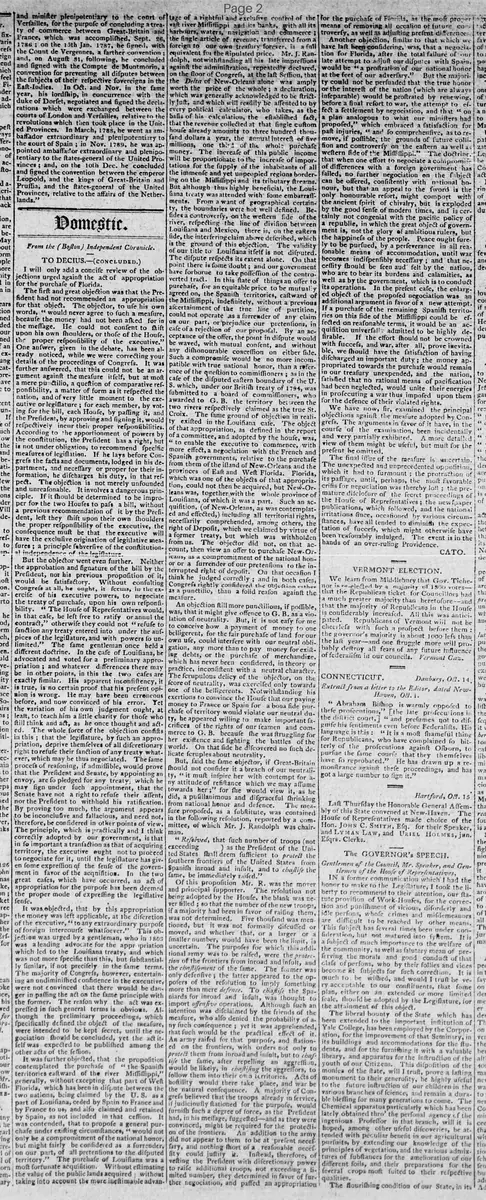
Domestic.
From the (Boston) Independent Chronicle.
TO DECIUS.-(CONCLUDED.)
I will only add a concise review of the objections urged against the act of appropriation for the purchase of Florida.
The first and great objection was that the President had not recommended an appropriation for that object. The objector, to use his own words, "would never agree to such a measure, because the money had not been asked for in the message. He could not consent to shift upon his own shoulders, or those of the House, the proper responsibility of the executive."
One answer, given in the debate, has been already noticed, while we were correcting your details of the proceedings of Congress. It was further answered, that this could not be an argument against the measure itself, but at most a mere punctilio, a question of comparative responsibility, a matter of form as it respected the nation, and of very little moment to the executive or legislature; for each member, by voting for the bill, each House, by passing it, and the President, by approving and signing it, would respectively incur their proper responsibilities.
According to the apportionment of powers by the constitution, the President has a right, but is not under obligation, to recommend specific measures of legislation. If he lays before Congress the facts and documents, lodged in his department, and necessary or proper for their information, he discharges his duty, in that respect. The objection is not merely unfounded and unreasonable. It involves a dangerous principle. If it should be determined to be improper for the two Houses to pass a bill, without a previous recommendation of it by the President, lest they shift upon their own shoulders the proper responsibility of the executive, the consequence must be that the executive will have the exclusive origination of legislative measures; a principle subversive of the constitutional independence of the legislature.
But the objector went even further. Neither the approbation and signature of the bill by the President, nor his previous proposition of it, would be satisfactory. Without consulting Congress at all, he ought, it seems, in the exercise of his executive powers, to negotiate the treaty of purchase, upon his own responsibility. "The House of Representatives would, in that case, be left free to ratify or annul the contract," otherwise they could not "refuse to sanction any treaty entered into under the auspices of the legislature, and with powers so unlimited." The same gentleman once held a different doctrine. In the case of Louisiana, he advocated and voted for a preliminary appropriation; and whatever differences there may be in other points, in this the two cases are exactly similar. His apparent inconsistency, it is true, is no certain proof that his present opinion is wrong. He may have been erroneous before, and now convinced of his error. Yet the variation of his own judgment ought, at least, to teach him a little charity for those who still think and act, as he once thought and acted. The whole force of the objection consists in this; that the legislature, by such an appropriation, deprive themselves of all discretionary right to refuse their sanction of any treaty whatever, which may be thus negotiated. The same process of reasoning, if admissible, would prove that the President and Senate, by appointing an envoy, are so pledged for any treaty, which he may sign under such appointment, that the Senate have not a right to refuse their assent, nor the President to withhold his ratification. By proving too much, the argument appears to be inconclusive and fallacious, and need not, therefore, be considered in other points of view.
The principle, which is practically and I think correctly adopted by our government, is that in so important a transaction as that of acquiring territory, the executive ought not to proceed to negotiate for it, until the legislature has given some expression of the sense of the government in favor of the acquisition. In the two great cases, which have occurred, an act of appropriation for the purpose has been deemed the proper mode of expressing the legislative sense.
It was objected, that by this appropriation the money was left applicable, at the discretion of the executive, "to any extraordinary purpose of foreign intercourse whatsoever." This objection was urged by a gentleman, who in 1803 was a leading advocate for the appropriation which led to the Louisiana treaty, and which was not more specific than this, but substantially similar, if not precisely in the same terms.
The majority of Congress, however, entertaining an undiminished confidence in the executive, were not convinced that there would be danger in passing the act on the same principle with the former. The reason why the act was expressed in such general terms is obvious. Although the preliminary proceedings, which specifically defined the object of the measure, were intended to be kept secret, until the negotiation should be concluded, yet the act itself was expected to be published among the other acts of the session.
It was further objected, that the proposition contemplated the purchase of "the Spanish territories eastward of the river Mississippi," generally, without excepting that part of West Florida, which has been in dispute between the two nations, being claimed by the U. S. as a part of Louisiana, ceded by Spain to France and by France to us, and also claimed and retained by Spain, as not included in that cession. It was contended, that to propose a general purchase under existing circumstances, "would not only be a compromitment of the national honor, but might fairly be considered as a surrender, on our part, of all pretensions to the disputed territory."
The purchase of Louisiana was a most fortunate acquisition. Without estimating the value of the public lands acquired without taking into account the more inestimable advantage of a rightful and exclusive control of the vast river Mississippi and its banks, with all its harbours, waters, navigation and commerce; the single article of revenue, transferred from a foreign to our own treasury forever, is a full equivalent for the stipulated price. Mr. J. Randolph, notwithstanding all his late impressions against the administration, repeatedly declared, on the floor of Congress, at the last Session, that the Delta of New-Orleans alone was amply worth the price of the whole; a declaration, which was generally acknowledged to be strictly just, and which will readily be assented to by every political calculator, who takes, as the basis of his calculation, the established fact, that the revenue collected at that single custom house already amounts to three hundred thousand dollars a year, the annual interest of five millions, one third of the whole purchase money. The increase of this public income will be proportionate to the increase of importations for the supply of the inhabitants of all the immense and yet unpeopled regions bordering on the Mississippi and its tributary streams.
But although thus highly beneficial, the Louisiana treaty was attended with some embarrassments. From a want of geographical certainty, the boundaries were not well defined. Besides a controversy, on the western side of the river, respecting the line of division between Louisiana and Mexico, there is, on the eastern side, the interfering claim above described, which is the ground of this objection. The validity of our title to Louisiana itself is not disputed. The dispute respects its extent alone. On that point there is some doubt; and our government have forborne to take possession of the controverted tract. In this state of things an offer to purchase, for an equitable price to be mutually agreed on, the Spanish territories, eastward of the Mississippi, indefinitely, without a previous ascertainment of the true line of partition, could not operate as a surrender of any claim on our part, or prejudice our pretensions, in case of a rejection of our proposal. By an acceptance of the offer, the point in dispute would be waived, with mutual consent, and without any dishonourable concession on either side. Such a compromise would be no more incompatible with true national honor, than a reference of the question to commissioners; as in the case of the disputed eastern boundary of the U. S. which, under our British treaty of 1794, was submitted to a board of commissioners, who awarded to G. B. the territory between the two rivers respectively claimed as the true St. Croix. The same ground of objection in reality existed in the Louisiana case. The object of that appropriation, as defined in the report of a committee, and adopted by the house, was, "to enable the executive to commence, with more effect, a negotiation with the French and Spanish governments, relative to the purchase from them of the island of New-Orleans and the provinces of East and West Florida. Florida, which was one of the objects of that appropriation, could not then be acquired. but New-Orleans was, together with the whole province of Louisiana, of which it was a part. Such an acquisition, (of New-Orleans, as was contemplated and effected,) including all territorial rights, necessarily comprehended, among others, the right of Deposit, which we claimed by virtue of a former treaty, but which was withholden from us. The objector did not, on that account, then view an offer to purchase New-Orleans, as a compromitment of the national honor or a surrender of our pretensions to the interrupted right of deposit. On that occasion I think he judged correctly; and in both cases, Congress rightly considered the objection rather as a punctilio, than a solid reason against the measure.
An objection still more punctilious, if possible, was, that it might give offence to G. B. as a violation of neutrality. But, it is not easy for me to conceive how a payment of money to one belligerent, for the fair purchase of land for our own use, could interfere with our neutral obligation, any more than to pay money for existing debts, or the purchase of merchandize, which has never been considered, in theory or practice, inconsistent with a neutral character.
The scrupulous delicacy of the objector, on the score of neutrality, was exercised only towards one of the belligerents. Notwithstanding his exertions to convince the House that our paying money to France or Spain for a bona fide purchase of territory would violate our neutral duty, he appeared willing to make important sacrifices of the rights of our seamen and commerce to G. B. because she was struggling for her existence and fighting the battles of the world. On that side he discovered no such delicate scruples about neutrality.
But, said the same objector, if Great-Britain should not consider it a breach of our neutrality, "it must inspire her with contempt for any attitude of resistance which we may assume towards her;" for she would view it, as he did, a pusillanimous and disgraceful shrinking from national honor and defence. The measure proposed, as a substitute, was contained in the following resolution, reported by a committee, of which Mr. J. Randolph was chairman.
"Resolved, that such number of troops (not exceeding ) as the President of the United States shall deem sufficient to protect the southern frontiers of the United States from Spanish inroad and insult, and to chastise the same, be immediately raised."
Of this proposition Mr. R. was the mover and principal supporter. The resolution not being adopted by the House, the blank was never filled; so that the number of the new troops, if a majority had been in favor of raising them, was not determined. Five thousand was mentioned, but it was not formally discussed or moved. and whether that, or a larger or a smaller number, would have been the limit, is uncertain. The purposes for which this additional army was to be raised, were the protection of the frontiers from inroad and insult, and the chastisement of the same. The former was only defensive; the latter appeared to the opposers of the resolution to imply something more than mere defence. To chastise the Spaniards for inroad and insult, was thought to import offensive operations. Although such an intention was disclaimed by the friends of the measure, who also denied the probability of any such consequence; yet it was apprehended, that such would be the practical effect of it. An army raised for that purpose, and stationed on the frontiers, with orders not only to protect them from inroad and insult, but to chastise the same, after repelling an aggression, would be likely, in chastising the aggressors, to follow them into their own territories. Acts of hostility would there take place, and war be the natural consequence. A majority of Congress believed that the troops already in service, if judiciously stationed for the purpose, would furnish such a degree of force, as the President had, in his message, suggested—and as they were convinced, might be required for the protection of the frontiers. An addition to the army did not appear to them to be at present necessary, and nothing short of a reasonable necessity could justify it. Instead, therefore, of vesting the President with discretionary power to raise additional troops, not exceeding a limited number, they determined in favor of further negotiation, and passed an appropriation
for the purchase of Florida, as the most proper means of removing all occasion of future controversy, as well as adjusting present differences.
Another objection, similar to that which we have last been considering, 'was, that a negotiation for Florida, after the total failure of our late attempt to adjust our disputes with Spain, would be "a prostration of our national honor at the feet of our adversary." But the majority could not be persuaded that the true honor or the interest of the nation (which are always inseparable) would be prostrated by renewing, before a final resort to war, the attempt to effect a settlement by negotiation, and that "on a plan analogous to what our ministers had proposed," which embraced a satisfaction for past injuries, "and so comprehensive, as to remove, if possible, the grounds of future collision and controversy on the eastern as well as western side of the Mississippi." The doctrine that when one effort to negotiate a compromise of differences with a foreign government has failed, no further negotiation on the subject can be offered, consistently with national honor, but that an appeal to the sword is the only honourable resort, might comport with the ancient spirit of chivalry, but is exploded by the good sense of modern times, and is certainly not congenial with the pacific policy of a republic, in which the great object of government is, not the glory of ambitious rulers, but the happiness of the people. Peace ought surely to be pursued, by a perseverance in all reasonable means of accommodation, until war becomes indispensibly necessary; and that necessity should be seen and felt by the nation, who are to bear its burdens and calamities, as well as by the government, which is to conduct its operations. In the present case, the enlarged object of the proposed negotiation was an additional argument in favor of a new attempt. If a purchase of the remaining Spanish territories on this side of the Mississippi could be effected on reasonable terms, it would be an acquisition universally admitted to be highly desirable. If the effort should not be crowned with success, and war, after all, prove inevitable, we should have the satisfaction of having discharged an important duty; the money appropriated towards the purchase would remain in our treasury unexpended, and the nation, satisfied that no rational means of pacification had been neglected, would unite their energies in prosecuting a war thus imposed upon them for the defence of their violated rights.
We have now, sir, examined the principal objections against the measure adopted by Congress. The arguments in favor of it have, in the course of the examination, been incidentally and very partially exhibited. A more detailed view of them might be useful, but must for the present be omitted.
The final issue of the measure is uncertain. The unexpected and unprecedented opposition, which it had to surmount; the protraction of its passage, until, perhaps, the most favorable crisis for negotiation was thereby lost; the premature disclosure of the secret proceedings of the House of Representatives; the newspaper publications, which followed, and the national irritations since, occasioned by various circumstances, have all tended to diminish the expectation of success, which might otherwise have been reasonably indulged. The event is in the hands of an over-ruling Providence.
CATO.
From the (Boston) Independent Chronicle.
TO DECIUS.-(CONCLUDED.)
I will only add a concise review of the objections urged against the act of appropriation for the purchase of Florida.
The first and great objection was that the President had not recommended an appropriation for that object. The objector, to use his own words, "would never agree to such a measure, because the money had not been asked for in the message. He could not consent to shift upon his own shoulders, or those of the House, the proper responsibility of the executive."
One answer, given in the debate, has been already noticed, while we were correcting your details of the proceedings of Congress. It was further answered, that this could not be an argument against the measure itself, but at most a mere punctilio, a question of comparative responsibility, a matter of form as it respected the nation, and of very little moment to the executive or legislature; for each member, by voting for the bill, each House, by passing it, and the President, by approving and signing it, would respectively incur their proper responsibilities.
According to the apportionment of powers by the constitution, the President has a right, but is not under obligation, to recommend specific measures of legislation. If he lays before Congress the facts and documents, lodged in his department, and necessary or proper for their information, he discharges his duty, in that respect. The objection is not merely unfounded and unreasonable. It involves a dangerous principle. If it should be determined to be improper for the two Houses to pass a bill, without a previous recommendation of it by the President, lest they shift upon their own shoulders the proper responsibility of the executive, the consequence must be that the executive will have the exclusive origination of legislative measures; a principle subversive of the constitutional independence of the legislature.
But the objector went even further. Neither the approbation and signature of the bill by the President, nor his previous proposition of it, would be satisfactory. Without consulting Congress at all, he ought, it seems, in the exercise of his executive powers, to negotiate the treaty of purchase, upon his own responsibility. "The House of Representatives would, in that case, be left free to ratify or annul the contract," otherwise they could not "refuse to sanction any treaty entered into under the auspices of the legislature, and with powers so unlimited." The same gentleman once held a different doctrine. In the case of Louisiana, he advocated and voted for a preliminary appropriation; and whatever differences there may be in other points, in this the two cases are exactly similar. His apparent inconsistency, it is true, is no certain proof that his present opinion is wrong. He may have been erroneous before, and now convinced of his error. Yet the variation of his own judgment ought, at least, to teach him a little charity for those who still think and act, as he once thought and acted. The whole force of the objection consists in this; that the legislature, by such an appropriation, deprive themselves of all discretionary right to refuse their sanction of any treaty whatever, which may be thus negotiated. The same process of reasoning, if admissible, would prove that the President and Senate, by appointing an envoy, are so pledged for any treaty, which he may sign under such appointment, that the Senate have not a right to refuse their assent, nor the President to withhold his ratification. By proving too much, the argument appears to be inconclusive and fallacious, and need not, therefore, be considered in other points of view.
The principle, which is practically and I think correctly adopted by our government, is that in so important a transaction as that of acquiring territory, the executive ought not to proceed to negotiate for it, until the legislature has given some expression of the sense of the government in favor of the acquisition. In the two great cases, which have occurred, an act of appropriation for the purpose has been deemed the proper mode of expressing the legislative sense.
It was objected, that by this appropriation the money was left applicable, at the discretion of the executive, "to any extraordinary purpose of foreign intercourse whatsoever." This objection was urged by a gentleman, who in 1803 was a leading advocate for the appropriation which led to the Louisiana treaty, and which was not more specific than this, but substantially similar, if not precisely in the same terms.
The majority of Congress, however, entertaining an undiminished confidence in the executive, were not convinced that there would be danger in passing the act on the same principle with the former. The reason why the act was expressed in such general terms is obvious. Although the preliminary proceedings, which specifically defined the object of the measure, were intended to be kept secret, until the negotiation should be concluded, yet the act itself was expected to be published among the other acts of the session.
It was further objected, that the proposition contemplated the purchase of "the Spanish territories eastward of the river Mississippi," generally, without excepting that part of West Florida, which has been in dispute between the two nations, being claimed by the U. S. as a part of Louisiana, ceded by Spain to France and by France to us, and also claimed and retained by Spain, as not included in that cession. It was contended, that to propose a general purchase under existing circumstances, "would not only be a compromitment of the national honor, but might fairly be considered as a surrender, on our part, of all pretensions to the disputed territory."
The purchase of Louisiana was a most fortunate acquisition. Without estimating the value of the public lands acquired without taking into account the more inestimable advantage of a rightful and exclusive control of the vast river Mississippi and its banks, with all its harbours, waters, navigation and commerce; the single article of revenue, transferred from a foreign to our own treasury forever, is a full equivalent for the stipulated price. Mr. J. Randolph, notwithstanding all his late impressions against the administration, repeatedly declared, on the floor of Congress, at the last Session, that the Delta of New-Orleans alone was amply worth the price of the whole; a declaration, which was generally acknowledged to be strictly just, and which will readily be assented to by every political calculator, who takes, as the basis of his calculation, the established fact, that the revenue collected at that single custom house already amounts to three hundred thousand dollars a year, the annual interest of five millions, one third of the whole purchase money. The increase of this public income will be proportionate to the increase of importations for the supply of the inhabitants of all the immense and yet unpeopled regions bordering on the Mississippi and its tributary streams.
But although thus highly beneficial, the Louisiana treaty was attended with some embarrassments. From a want of geographical certainty, the boundaries were not well defined. Besides a controversy, on the western side of the river, respecting the line of division between Louisiana and Mexico, there is, on the eastern side, the interfering claim above described, which is the ground of this objection. The validity of our title to Louisiana itself is not disputed. The dispute respects its extent alone. On that point there is some doubt; and our government have forborne to take possession of the controverted tract. In this state of things an offer to purchase, for an equitable price to be mutually agreed on, the Spanish territories, eastward of the Mississippi, indefinitely, without a previous ascertainment of the true line of partition, could not operate as a surrender of any claim on our part, or prejudice our pretensions, in case of a rejection of our proposal. By an acceptance of the offer, the point in dispute would be waived, with mutual consent, and without any dishonourable concession on either side. Such a compromise would be no more incompatible with true national honor, than a reference of the question to commissioners; as in the case of the disputed eastern boundary of the U. S. which, under our British treaty of 1794, was submitted to a board of commissioners, who awarded to G. B. the territory between the two rivers respectively claimed as the true St. Croix. The same ground of objection in reality existed in the Louisiana case. The object of that appropriation, as defined in the report of a committee, and adopted by the house, was, "to enable the executive to commence, with more effect, a negotiation with the French and Spanish governments, relative to the purchase from them of the island of New-Orleans and the provinces of East and West Florida. Florida, which was one of the objects of that appropriation, could not then be acquired. but New-Orleans was, together with the whole province of Louisiana, of which it was a part. Such an acquisition, (of New-Orleans, as was contemplated and effected,) including all territorial rights, necessarily comprehended, among others, the right of Deposit, which we claimed by virtue of a former treaty, but which was withholden from us. The objector did not, on that account, then view an offer to purchase New-Orleans, as a compromitment of the national honor or a surrender of our pretensions to the interrupted right of deposit. On that occasion I think he judged correctly; and in both cases, Congress rightly considered the objection rather as a punctilio, than a solid reason against the measure.
An objection still more punctilious, if possible, was, that it might give offence to G. B. as a violation of neutrality. But, it is not easy for me to conceive how a payment of money to one belligerent, for the fair purchase of land for our own use, could interfere with our neutral obligation, any more than to pay money for existing debts, or the purchase of merchandize, which has never been considered, in theory or practice, inconsistent with a neutral character.
The scrupulous delicacy of the objector, on the score of neutrality, was exercised only towards one of the belligerents. Notwithstanding his exertions to convince the House that our paying money to France or Spain for a bona fide purchase of territory would violate our neutral duty, he appeared willing to make important sacrifices of the rights of our seamen and commerce to G. B. because she was struggling for her existence and fighting the battles of the world. On that side he discovered no such delicate scruples about neutrality.
But, said the same objector, if Great-Britain should not consider it a breach of our neutrality, "it must inspire her with contempt for any attitude of resistance which we may assume towards her;" for she would view it, as he did, a pusillanimous and disgraceful shrinking from national honor and defence. The measure proposed, as a substitute, was contained in the following resolution, reported by a committee, of which Mr. J. Randolph was chairman.
"Resolved, that such number of troops (not exceeding ) as the President of the United States shall deem sufficient to protect the southern frontiers of the United States from Spanish inroad and insult, and to chastise the same, be immediately raised."
Of this proposition Mr. R. was the mover and principal supporter. The resolution not being adopted by the House, the blank was never filled; so that the number of the new troops, if a majority had been in favor of raising them, was not determined. Five thousand was mentioned, but it was not formally discussed or moved. and whether that, or a larger or a smaller number, would have been the limit, is uncertain. The purposes for which this additional army was to be raised, were the protection of the frontiers from inroad and insult, and the chastisement of the same. The former was only defensive; the latter appeared to the opposers of the resolution to imply something more than mere defence. To chastise the Spaniards for inroad and insult, was thought to import offensive operations. Although such an intention was disclaimed by the friends of the measure, who also denied the probability of any such consequence; yet it was apprehended, that such would be the practical effect of it. An army raised for that purpose, and stationed on the frontiers, with orders not only to protect them from inroad and insult, but to chastise the same, after repelling an aggression, would be likely, in chastising the aggressors, to follow them into their own territories. Acts of hostility would there take place, and war be the natural consequence. A majority of Congress believed that the troops already in service, if judiciously stationed for the purpose, would furnish such a degree of force, as the President had, in his message, suggested—and as they were convinced, might be required for the protection of the frontiers. An addition to the army did not appear to them to be at present necessary, and nothing short of a reasonable necessity could justify it. Instead, therefore, of vesting the President with discretionary power to raise additional troops, not exceeding a limited number, they determined in favor of further negotiation, and passed an appropriation
for the purchase of Florida, as the most proper means of removing all occasion of future controversy, as well as adjusting present differences.
Another objection, similar to that which we have last been considering, 'was, that a negotiation for Florida, after the total failure of our late attempt to adjust our disputes with Spain, would be "a prostration of our national honor at the feet of our adversary." But the majority could not be persuaded that the true honor or the interest of the nation (which are always inseparable) would be prostrated by renewing, before a final resort to war, the attempt to effect a settlement by negotiation, and that "on a plan analogous to what our ministers had proposed," which embraced a satisfaction for past injuries, "and so comprehensive, as to remove, if possible, the grounds of future collision and controversy on the eastern as well as western side of the Mississippi." The doctrine that when one effort to negotiate a compromise of differences with a foreign government has failed, no further negotiation on the subject can be offered, consistently with national honor, but that an appeal to the sword is the only honourable resort, might comport with the ancient spirit of chivalry, but is exploded by the good sense of modern times, and is certainly not congenial with the pacific policy of a republic, in which the great object of government is, not the glory of ambitious rulers, but the happiness of the people. Peace ought surely to be pursued, by a perseverance in all reasonable means of accommodation, until war becomes indispensibly necessary; and that necessity should be seen and felt by the nation, who are to bear its burdens and calamities, as well as by the government, which is to conduct its operations. In the present case, the enlarged object of the proposed negotiation was an additional argument in favor of a new attempt. If a purchase of the remaining Spanish territories on this side of the Mississippi could be effected on reasonable terms, it would be an acquisition universally admitted to be highly desirable. If the effort should not be crowned with success, and war, after all, prove inevitable, we should have the satisfaction of having discharged an important duty; the money appropriated towards the purchase would remain in our treasury unexpended, and the nation, satisfied that no rational means of pacification had been neglected, would unite their energies in prosecuting a war thus imposed upon them for the defence of their violated rights.
We have now, sir, examined the principal objections against the measure adopted by Congress. The arguments in favor of it have, in the course of the examination, been incidentally and very partially exhibited. A more detailed view of them might be useful, but must for the present be omitted.
The final issue of the measure is uncertain. The unexpected and unprecedented opposition, which it had to surmount; the protraction of its passage, until, perhaps, the most favorable crisis for negotiation was thereby lost; the premature disclosure of the secret proceedings of the House of Representatives; the newspaper publications, which followed, and the national irritations since, occasioned by various circumstances, have all tended to diminish the expectation of success, which might otherwise have been reasonably indulged. The event is in the hands of an over-ruling Providence.
CATO.
What sub-type of article is it?
Foreign Affairs
Constitutional
War Or Peace
What keywords are associated?
Florida Purchase
Congressional Appropriation
Spanish Territories
Louisiana Precedent
National Honor
Neutrality
Military Resolution
Executive Powers
What entities or persons were involved?
President
Congress
House Of Representatives
Mr. J. Randolph
Decius
Spain
Great Britain
France
Editorial Details
Primary Topic
Defense Of Congressional Appropriation For Florida Purchase
Stance / Tone
Supportive Of Appropriation And Negotiation Over Military Action
Key Figures
President
Congress
House Of Representatives
Mr. J. Randolph
Decius
Spain
Great Britain
France
Key Arguments
President Not Obligated To Recommend Specific Appropriations; Legislature Can Initiate Measures
Appropriation Does Not Shift Executive Responsibility Or Bind Legislature To Any Treaty
Precedent From Louisiana Purchase Supports Similar Appropriation For Florida
Negotiation Preferable To Raising Troops For Chastisement, Avoiding War
Purchase Offer Does Not Surrender Claims To Disputed West Florida Territory
Measure Aligns With Neutral Obligations And National Honor
Renewed Negotiation Honorable After Failed Attempts