Thank you for visiting SNEWPapers!
Sign up free
Literary
March 12, 1860
Alexandria Gazette
Alexandria, Alexandria County, District Of Columbia
What is this article about?
Philosophical essay by R. W. Emerson exploring the expressive power of the human eye, its honesty in revealing thoughts and emotions, and its ability to command and influence beyond words.
Clipping
OCR Quality
92%
Excellent
Full Text
MISCELLANEOUS READING.
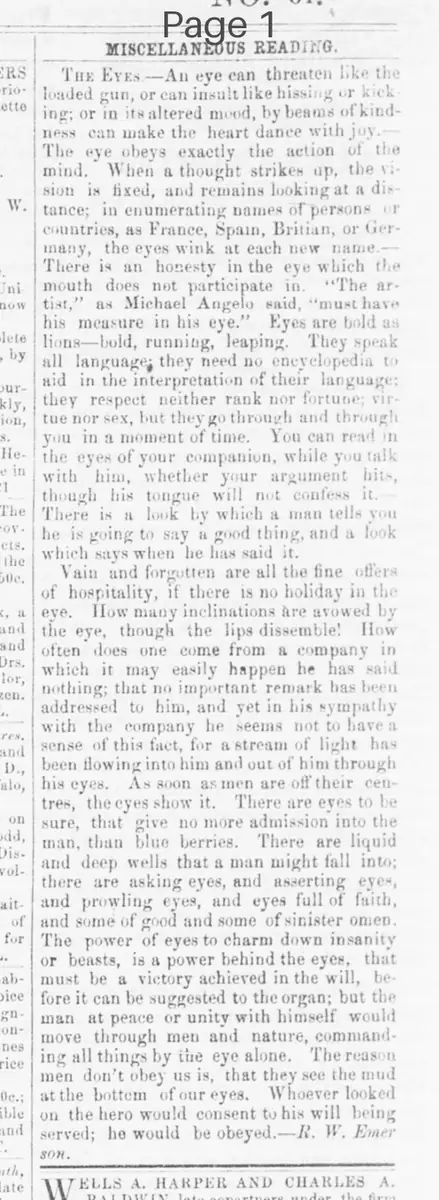
The Eyes—An eye can threaten like the loaded gun, or can insult like hissing or kicking; or in its altered mood, by beams of kindness can make the heart dance with joy. The eye obeys exactly the action of the mind. When a thought strikes us, the eye is fixed, and remains looking at a distance; in enumerating names of persons, countries, as France, Spain, Britain, or Germany, the eyes wink at each new name.
There is an honesty in the eye which the mouth does not participate in. "The artist," as Michael Angelo said, "must have his measure in his eye." Eyes are bold as lions—bold, running, leaping. They speak all language; they need no encyclopedia to aid in the interpretation of their language; they respect neither rank nor fortune; virtue nor sex, but they go through and through you in a moment of time. You can read on the eyes of your companion, while you talk with him, whether your argument hits, though his tongue will not confess it.
There is a look by which a man tells you he is going to say a good thing, and a look which says when he has said it.
Vain and forgotten are all the fine offers of hospitality, if there is no holiday in the eye. How many inclinations are avowed by the eye, though the lips dissemble! How often does one come from a company in which it may easily happen he has said nothing: that no important remark has been addressed to him, and yet in his sympathy with the company he seems not to have a sense of this fact, for a stream of light has been flowing into him and out of him through his eyes. As soon as men are off their guard, the eyes show it. There are eyes, to be sure, that give no more admission into the man, than blueberries. There are liquid and deep wells that a man might fall into; there are asking eyes, and asserting eyes, and prowling eyes, and eyes full of fate; and some of good and some of sinister omen.
The power of eyes to charm down insanity or beasts, is a power behind the eyes, that must be a victory achieved in the will, before it can be suggested to the organ; but the man at peace or unity with himself would move through men and nature, commanding all things by the eye alone. The reason men don't obey us is, that they see the mud at the bottom of our eyes. Whoever looked on the hero would consent to his will being served; he would be obeyed.—R. W. Emerson.
The Eyes—An eye can threaten like the loaded gun, or can insult like hissing or kicking; or in its altered mood, by beams of kindness can make the heart dance with joy. The eye obeys exactly the action of the mind. When a thought strikes us, the eye is fixed, and remains looking at a distance; in enumerating names of persons, countries, as France, Spain, Britain, or Germany, the eyes wink at each new name.
There is an honesty in the eye which the mouth does not participate in. "The artist," as Michael Angelo said, "must have his measure in his eye." Eyes are bold as lions—bold, running, leaping. They speak all language; they need no encyclopedia to aid in the interpretation of their language; they respect neither rank nor fortune; virtue nor sex, but they go through and through you in a moment of time. You can read on the eyes of your companion, while you talk with him, whether your argument hits, though his tongue will not confess it.
There is a look by which a man tells you he is going to say a good thing, and a look which says when he has said it.
Vain and forgotten are all the fine offers of hospitality, if there is no holiday in the eye. How many inclinations are avowed by the eye, though the lips dissemble! How often does one come from a company in which it may easily happen he has said nothing: that no important remark has been addressed to him, and yet in his sympathy with the company he seems not to have a sense of this fact, for a stream of light has been flowing into him and out of him through his eyes. As soon as men are off their guard, the eyes show it. There are eyes, to be sure, that give no more admission into the man, than blueberries. There are liquid and deep wells that a man might fall into; there are asking eyes, and asserting eyes, and prowling eyes, and eyes full of fate; and some of good and some of sinister omen.
The power of eyes to charm down insanity or beasts, is a power behind the eyes, that must be a victory achieved in the will, before it can be suggested to the organ; but the man at peace or unity with himself would move through men and nature, commanding all things by the eye alone. The reason men don't obey us is, that they see the mud at the bottom of our eyes. Whoever looked on the hero would consent to his will being served; he would be obeyed.—R. W. Emerson.
What sub-type of article is it?
Essay
What themes does it cover?
Moral Virtue
Social Manners
What keywords are associated?
Eyes
Expression
Honesty
Mind
Emerson
Human Nature
What entities or persons were involved?
R. W. Emerson
Literary Details
Title
The Eyes
Author
R. W. Emerson
Key Lines
There Is An Honesty In The Eye Which The Mouth Does Not Participate In.
Eyes Are Bold As Lions—Bold, Running, Leaping. They Speak All Language; They Need No Encyclopedia To Aid In The Interpretation Of Their Language.
The Reason Men Don't Obey Us Is, That They See The Mud At The Bottom Of Our Eyes.