Thank you for visiting SNEWPapers!
Sign up free
Literary
September 14, 1879
The New Orleans Daily Democrat
New Orleans, Orleans County, Louisiana
What is this article about?
Western visitors in Japan witness the 'John Nuge' dance, a traditional performance by young women involving a promenade with music, hand-clapping, and penalties for mistakes by removing clothing items, ending with a victor. Performed gracefully without immodesty.
Clipping
OCR Quality
95%
Excellent
Full Text
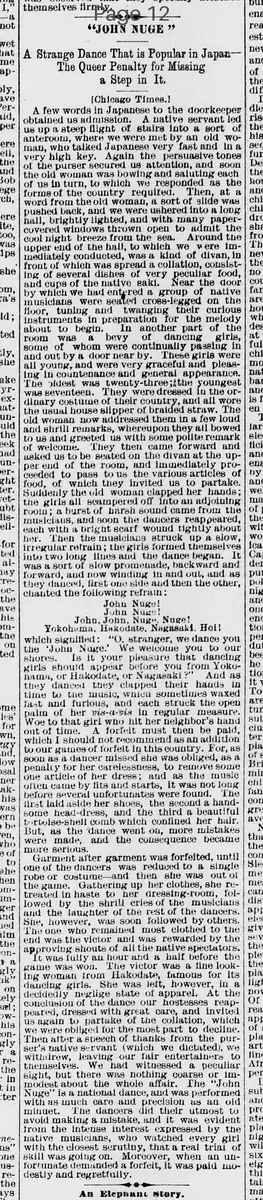
"JOHN NUGE"
A Strange Dance That is Popular in Japan
The Queer Penalty for Missing
a Step in It.
[Chicago Times.]
A few words in Japanese to the doorkeeper
obtained us admission. A native servant led
us up a steep flight of stairs into a sort of
anteroom, where we were met by an old woman,
who talked Japanese very fast and in a
very high key. Again the persuasive tones
of the purser secured us attention, and soon
the old woman was bowing and saluting each
of us in turn, to which we responded as the
forms of the country required. Then, at a
word from the old woman, a sort of slide was
pushed back, and we were ushered into a long
hall, brightly lighted, and with many paper-
covered windows thrown open to admit the
cool night breeze from the sea. Around the
upper end of the hall, to which we were immediately
conducted, was a kind of divan, in
front of which was spread a collation, consisting
of several dishes of very peculiar food,
and cups of the native saki. Near the door
by which we had entered a group of native
musicians were seated cross-legged on the
floor, tuning and twanging their curious
instruments in preparation for the melody
about to begin.
In another part of the
room was a bevy
of dancing girls,
some of whom were continually passing in
and out by a door near by. These girls were
all young, and were very graceful and pleasing
in countenance and general appearance.
The oldest was twenty-three; the youngest
was seventeen. They were dressed in the ordinary
costume of their country, and all wore
the usual house slipper of braided straw. The
old woman now addressed them in a few loud
and shrill remarks, whereupon they all bowed
to us and greeted us with some polite remark
of welcome. They then came forward and
asked us to be seated on the divan at the upper
end of the room, and immediately proceeded
to pass to us the various articles of
food, of which they invited us to partake.
Suddenly the old woman clapped her hands:
the girls all scampered off into an adjoining
room; a burst of harsh sound came from the
musicians, and soon the dancers reappeared,
each with a bright scarf wound tightly about
her. Then the musicians struck up a slow,
irregular refrain; the girls formed themselves
into two long lines and the dance began. It
was a sort of slow promenade, backward and
forward, and now winding in and out, and as
they danced, first one side and then the other,
chanted the following refrain:
John Nuge!
John Nuge!
John, John, Nuge, Nuge!
Yokohama, Hakodate, Nagasaki. Ho!
which signified: "O, stranger, we dance you
the John Nuge. We welcome you to our
shores. Is it your pleasure that dancing
girls should appear before you from Yokohama,
or Hakodate, or Nagasaki?" And as
they danced they clapped their hands in
time to the music, which sometimes waxed
fast and furious, and each struck the open
palm of her vis-a-vis in regular measure.
Woe to that girl who hit her neighbor's hand
out of time. A forfeit must then be paid,
which I should not recommend as an addition
to our games of forfeit in this country. For, as
soon as a dancer missed she was obliged, as a
penalty for her carelessness, to remove some
one article of her dress; and as the music
often came by fits and starts, it was not long
before several unfortunates were found. The
first laid aside her shoes, the second a hand-
some head-dress, and the third a beautiful
tortoise-shell comb which confined her hair.
But, as the dance went on, more mistakes
were made, and the consequence became
more serious.
Garment after garment was forfeited, until
one of the dancers was reduced to a single
robe or costume and then she was out of
the game. Gathering up her clothes, she retreated
in haste to her dressing-room, followed
by the shrill cries of the musicians
and the laughter of the rest of the dancers.
She, however, was soon followed by others.
The one who remained most clothed to the
end was the victor and was rewarded by the
approving shouts of all the native spectators.
It was fully an hour and a half before the
game was won. The victor was a fine looking
woman from Hakodate, famous for its
dancing girls. She was left, however, in a
decidedly neglige state of apparel. At the
conclusion of the dance our hostesses reappeared,
dressed with great care, and invited
us again to partake of the collation, which
we were obliged for the most part to decline.
Then after a speech of thanks from the pur-
ser's native servant (which we dictated), we
withdrew, leaving our fair entertainers to
themselves. We had witnessed a peculiar
sight, but there was nothing coarse or im-
modest about the whole affair. The "John
Nuge" is a national dance, and was performed
with as much care and precision as an old
minuet. The dancers did their utmost to
avoid making a mistake, and it was evident
from the intense interest expressed by the
native musicians, who watched every girl
with the closest scrutiny, that a real trial of
skill was going on. Moreover, when an unfortunate
demanded a forfeit, it was paid modestly
and regretfully.
A Strange Dance That is Popular in Japan
The Queer Penalty for Missing
a Step in It.
[Chicago Times.]
A few words in Japanese to the doorkeeper
obtained us admission. A native servant led
us up a steep flight of stairs into a sort of
anteroom, where we were met by an old woman,
who talked Japanese very fast and in a
very high key. Again the persuasive tones
of the purser secured us attention, and soon
the old woman was bowing and saluting each
of us in turn, to which we responded as the
forms of the country required. Then, at a
word from the old woman, a sort of slide was
pushed back, and we were ushered into a long
hall, brightly lighted, and with many paper-
covered windows thrown open to admit the
cool night breeze from the sea. Around the
upper end of the hall, to which we were immediately
conducted, was a kind of divan, in
front of which was spread a collation, consisting
of several dishes of very peculiar food,
and cups of the native saki. Near the door
by which we had entered a group of native
musicians were seated cross-legged on the
floor, tuning and twanging their curious
instruments in preparation for the melody
about to begin.
In another part of the
room was a bevy
of dancing girls,
some of whom were continually passing in
and out by a door near by. These girls were
all young, and were very graceful and pleasing
in countenance and general appearance.
The oldest was twenty-three; the youngest
was seventeen. They were dressed in the ordinary
costume of their country, and all wore
the usual house slipper of braided straw. The
old woman now addressed them in a few loud
and shrill remarks, whereupon they all bowed
to us and greeted us with some polite remark
of welcome. They then came forward and
asked us to be seated on the divan at the upper
end of the room, and immediately proceeded
to pass to us the various articles of
food, of which they invited us to partake.
Suddenly the old woman clapped her hands:
the girls all scampered off into an adjoining
room; a burst of harsh sound came from the
musicians, and soon the dancers reappeared,
each with a bright scarf wound tightly about
her. Then the musicians struck up a slow,
irregular refrain; the girls formed themselves
into two long lines and the dance began. It
was a sort of slow promenade, backward and
forward, and now winding in and out, and as
they danced, first one side and then the other,
chanted the following refrain:
John Nuge!
John Nuge!
John, John, Nuge, Nuge!
Yokohama, Hakodate, Nagasaki. Ho!
which signified: "O, stranger, we dance you
the John Nuge. We welcome you to our
shores. Is it your pleasure that dancing
girls should appear before you from Yokohama,
or Hakodate, or Nagasaki?" And as
they danced they clapped their hands in
time to the music, which sometimes waxed
fast and furious, and each struck the open
palm of her vis-a-vis in regular measure.
Woe to that girl who hit her neighbor's hand
out of time. A forfeit must then be paid,
which I should not recommend as an addition
to our games of forfeit in this country. For, as
soon as a dancer missed she was obliged, as a
penalty for her carelessness, to remove some
one article of her dress; and as the music
often came by fits and starts, it was not long
before several unfortunates were found. The
first laid aside her shoes, the second a hand-
some head-dress, and the third a beautiful
tortoise-shell comb which confined her hair.
But, as the dance went on, more mistakes
were made, and the consequence became
more serious.
Garment after garment was forfeited, until
one of the dancers was reduced to a single
robe or costume and then she was out of
the game. Gathering up her clothes, she retreated
in haste to her dressing-room, followed
by the shrill cries of the musicians
and the laughter of the rest of the dancers.
She, however, was soon followed by others.
The one who remained most clothed to the
end was the victor and was rewarded by the
approving shouts of all the native spectators.
It was fully an hour and a half before the
game was won. The victor was a fine looking
woman from Hakodate, famous for its
dancing girls. She was left, however, in a
decidedly neglige state of apparel. At the
conclusion of the dance our hostesses reappeared,
dressed with great care, and invited
us again to partake of the collation, which
we were obliged for the most part to decline.
Then after a speech of thanks from the pur-
ser's native servant (which we dictated), we
withdrew, leaving our fair entertainers to
themselves. We had witnessed a peculiar
sight, but there was nothing coarse or im-
modest about the whole affair. The "John
Nuge" is a national dance, and was performed
with as much care and precision as an old
minuet. The dancers did their utmost to
avoid making a mistake, and it was evident
from the intense interest expressed by the
native musicians, who watched every girl
with the closest scrutiny, that a real trial of
skill was going on. Moreover, when an unfortunate
demanded a forfeit, it was paid modestly
and regretfully.
What sub-type of article is it?
Essay
What themes does it cover?
Social Manners
What keywords are associated?
Japanese Dance
John Nuge
Dancing Girls
Forfeit Penalty
Cultural Welcome
What entities or persons were involved?
[Chicago Times.]
Literary Details
Title
John Nuge
Author
[Chicago Times.]
Subject
A Strange Dance That Is Popular In Japan The Queer Penalty For Missing A Step In It.
Form / Style
Narrative Description Of A Cultural Dance
Key Lines
John Nuge!
John Nuge!
John, John, Nuge, Nuge!
Yokohama, Hakodate, Nagasaki. Ho!
Which Signified: "O, Stranger, We Dance You
The John Nuge. We Welcome You To Our
Shores. Is It Your Pleasure That Dancing
Girls Should Appear Before You From Yokohama,
Or Hakodate, Or Nagasaki?"