Thank you for visiting SNEWPapers!
Sign up free
Fort Worth Gazette
Fort Worth, Tarrant County, Texas
What is this article about?
Major W. H. Parvin, Eastland, Texas banker in poor health, bought a pistol and suicided in Fort Worth hotel. Son-in-law Homer Brelsford doubts act despite stable finances and family; attributes to illness. No motive found; remains to Eastland. (187 chars)
Clipping
OCR Quality
Full Text
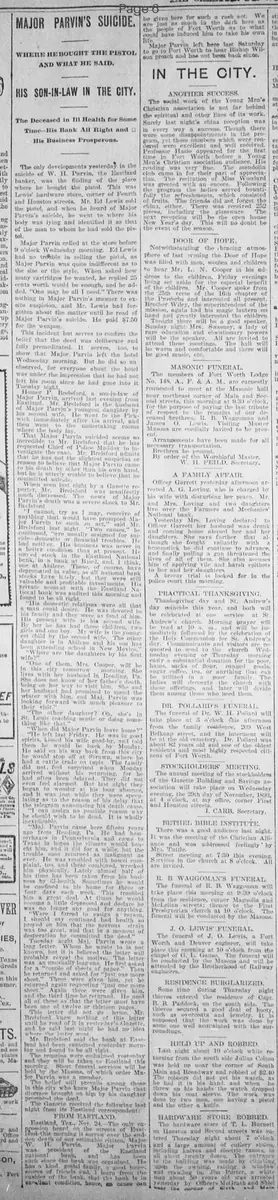
WHERE HE BOUGHT THE PISTOL AND WHAT HE SAID.
HIS SON-IN-LAW IN THE CITY.
The Deceased in Ill Health for Some Time-His Bank All Right and His Business Prosperous.
The only developments yesterday in the suicide of W. H. Parvin, the Eastland banker, was the finding of the place where he bought the pistol. This was Lewis' hardware store, corner of Fourth and Houston streets. Mr. Ed Lewis sold the pistol, and when he heard of Major Parvin's suicide, he went to where his body was lying and identified it as that of the man to whom he had sold the pistol.
Major Parvin called at the store before 9 o'clock Wednesday morning, Ed Lewis had no trouble in selling the pistol, as Major Parvin was quite indifferent as to the size or the style. When asked how many cartridges he wanted, he replied 25 cents worth, would be enough, and he added, "One may be all I need." There was nothing in Major Parvin's manner to excite suspicion, and Mr. Lewis had forgotten about the matter until he read of Major Parvin's suicide. He paid $7.50 for the weapon.
This incident but serves to confirm the belief that the deed was deliberate and fully premeditated. It serves, too, to show that Major Parvin left the hotel Wednesday morning. But he did so unobserved, for everyone about the hotel was under the impression that he had not left his room since he had gone into it Tuesday night.
Homer L. Brelsford, a son-in-law of Major Parvin, arrived last evening from Eastland. Mr. Brelsford is the husband of Major Parvin's youngest daughter by his second wife. He went to the Pickwick immediately after his arrival, and then went to the undertaking rooms where the body lay.
That Major Parvin suicided seems so incredible to Mr. Brelsford that he has requested Chief of Police Maddox to investigate the case. Mr. Brelsford admits that he has not the slightest suspicion or reason to believe that Major Parvin came to his death by other than his own hand, but he is utterly unable to believe that he committed suicide.
When seen last night by a Gazette reporter, Mr. Brelsford was manifestly much distressed. The news of Major Parvin's death was a severe shock to Mr. Brelsford.
"I cannot, try as I may, conceive of anything that would have prompted Major Parvin to such an act," said Mr. Brelsford last night. "Two causes," he continued, "are usually assigned for suicide-domestic or financial troubles. He had neither. His business was never in a better condition than at present. He owned stock in the Eastland National bank, in a bank at Baird, and, I think, one at Abilene. These, of course, have depreciated in value, as all national bank stocks have lately, but they were still valuable and profitable investments. His private account with the Eastland National bank was audited this morning and found to be all right.
"His domestic relations were all that a man could desire. He was devoted to his family and they were as fond of him. His present wife is his second wife. By her he has had three children, two girls and one boy. My wife is the youngest child by the second wife. The other daughter is in Abilene and his son has been attending school in New Mexico."
"Where are the daughters by his first wife?"
"One of them, Mrs. Cooper, will be in this city tomorrow morning. She lives with her husband in Reading, Pa. She does not know of her father's death, being on her way to visit him. She and her husband had promised to spend the winter with him, and Maj. Parvin was looking forward with much pleasure to their visit."
"The other daughter? Oh, she's in St. Louis teaching music or doing something like that."
"When did Major Parvin leave home?"
"He left last Friday. He was in good spirits, kissed his wife good-by, and told them he would be back by Monday. He said on his way back from this city he would stop off at Strawn, where he had a cattle trade on tapis. The family did not feel surprised when Monday arrived without his returning, for he had often been delayed. They did not even feel alarmed. But last night they began to wonder at his long absence, and it was just while they were speculating as to the reason of his delay that the telegram announcing his death came.
"I can assign no possible reason why he should wish to be dead. It is wholly inexplicable."
Maj. Parvin came here fifteen years ago from Reading, Pa. He had hemorrhages in Pennsylvania and came to Texas in hopes the climate would benefit him, and it did for a while, but the trouble soon returned as malignant as ever. He was troubled with bowel complaint, too, and these combined, wrecked him physically. Lately almost half of his time has been taken from his business by ill-health. Sometimes he would be confined to his home for three or four days each week. This troubled him a great deal. "At times he would become a little depressed and declare he was no longer any good for anything.
"Were I forced to assign a reason, I should say continued bad health so preyed on him that the nervous strain was too great, and that in a moment of desperation he committed the deed."
Tuesday night Maj. Parvin wrote a long letter. Whom he wrote to is not known, but it is believed the letter will probably reveal the motive. The letter was an unusually long one. He first asked for a "couple of sheets of paper." Then he returned and asked for "just one more sheet." Three were given him, yet he returned again requesting "just one more sheet." Again three were given him, and the third time he returned. He used all of these so that the letter must have been one of twelve or thirteen pages.
This letter did not go home. Mr. Brelsford knew nothing of this letter until he read of it in yesterday's Gazette, and he said last night he had no idea where the letter went.
Mr. Brelsford said the bank at Eastland had been examined yesterday morning and found to be all right.
The remains were embalmed yesterday and they will be taken to Eastland this morning. Short funeral services will be held by the Masons, of which order Major Parvin was a member.
The belief still prevails among those in this city who know Major Parvin that disgrace brought on him by his daughter prompted the deed.
The Gazette received the following last night from its Eastland correspondent:
FROM EASTLAND,
Eastland, Tex., Nov. 24.-The only expression heard on the streets of Eastland this morning is sorrow over the sudden death of our estimable citizen, Major W. H. Parvin.
Major Parvin was president of the Eastland national bank, and has been such since the bank was organized. He has a kind, genial family, a good home, scores of friends and, I learn from the cashier of the bank, that the bank is in excellent condition, hence, no cause can be given here for such a rash act. We, the people of Fort Worth as to what could have induced him to take his own life.
Major Parvin left here last Saturday to go to Fort Worth to hear Bishop Wilson preach and has not been back since.
What sub-type of article is it?
What themes does it cover?
What keywords are associated?
What entities or persons were involved?
Where did it happen?
Story Details
Key Persons
Location
Fort Worth, Texas; Eastland, Texas
Event Date
November 24
Story Details
W. H. Parvin, Eastland banker suffering from chronic ill health, purchased a pistol in Fort Worth and committed suicide in a hotel, premeditated and unobserved. Son-in-law Homer L. Brelsford, arriving from Eastland, expresses disbelief despite no financial or domestic issues, suspects health strain; requests police investigation. Family details and stable bank confirmed; remains return to Eastland for Masonic funeral. Rumors of family disgrace persist; long letter written but destination unknown.